
AI Infrastructure in 2026: What Running AI Workloads at Scale Actually Costs and Where the Market Is Heading
6/5/20264 min read
Artificial intelligence has moved from a technology category that mid-market organizations were watching to one that many are actively deploying — for customer-facing automation, internal productivity tooling, data analysis, and increasingly for core business processes. The infrastructure question that follows adoption is one that most organizations have not yet fully answered: what does running AI workloads at meaningful scale actually cost, and is the infrastructure model we started with the right one for where we are going?
The AI infrastructure market is evolving rapidly and pricing is in active flux. What was true 18 months ago about the cost of GPU compute, the economics of cloud versus on-premise AI infrastructure, and the total cost of operating large language model-based applications is already partially outdated. This post is a current-state framework for mid-market organizations evaluating or scaling their AI infrastructure strategy in 2026.
The organizations that will extract the most economic value from AI in 2026 are not necessarily the ones that adopted it earliest. They are the ones that are most deliberate about matching their AI workload requirements to the infrastructure model that delivers the best cost-per-outcome — rather than defaulting to the cloud API approach that was the path of least resistance at the start.
The three layers of AI infrastructure cost
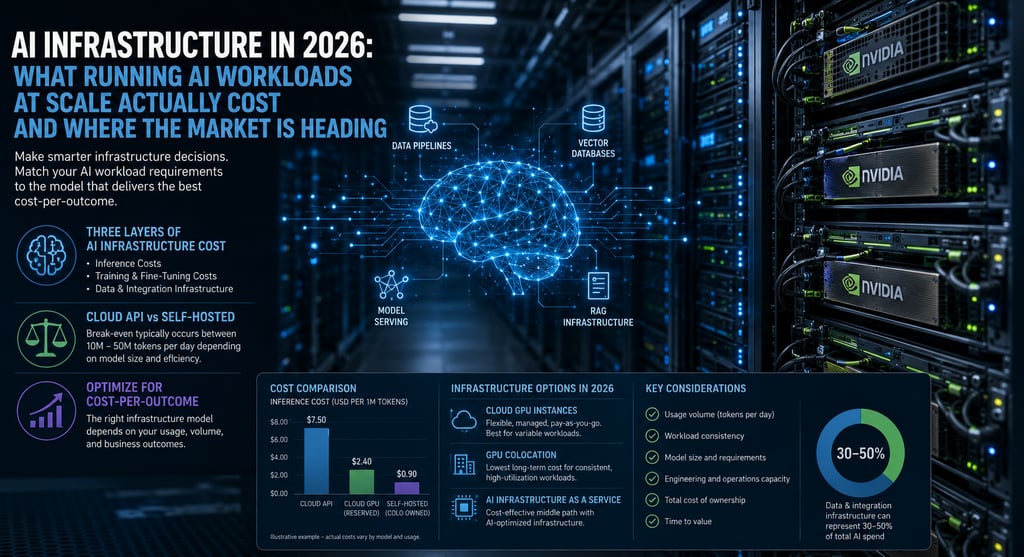
AI infrastructure costs break into three layers that are often conflated but need to be evaluated separately:
• Inference costs: the cost of running a trained model to generate outputs — answering a question, classifying an image, generating a summary, making a recommendation. This is the ongoing operational cost of AI deployment and for most mid-market organizations represents the dominant share of total AI infrastructure spend
• Training and fine-tuning costs: the cost of training a model from scratch or fine-tuning a pre-trained model on organization-specific data. For most mid-market organizations, from-scratch training is not relevant — the cost of training a frontier model runs into tens of millions of dollars. Fine-tuning a pre-trained model on proprietary data is relevant and significantly more affordable, running from hundreds to tens of thousands of dollars depending on model size and data volume
• Data and integration infrastructure: the pipelines, storage, vector databases, and retrieval-augmented generation infrastructure that connect AI models to organizational data. This layer is frequently underestimated in total cost of ownership calculations and can represent 30 to 50 percent of total AI infrastructure spend in mature deployments
Cloud API versus self-hosted: the 2026 economics
The majority of mid-market AI deployments began — and many remain — on cloud API models: calling OpenAI, Anthropic, Google, or similar providers through their APIs, paying per token consumed. This model has significant advantages for early-stage deployments: zero infrastructure overhead, immediate access to frontier models, and no engineering investment in model hosting.
The economics of cloud API inference become less favorable as usage scales. At low to moderate volumes — under approximately 10 million tokens per day — cloud API pricing is almost always the most cost-effective option when the total cost of self-hosting alternatives is accounted for. Above that threshold, the comparison changes.
Self-hosted open-source models — Llama, Mistral, Falcon, and their derivatives — deployed on dedicated GPU infrastructure deliver inference at a fraction of the per-token cost of cloud APIs at scale. The tradeoff is infrastructure overhead: GPU server procurement or colocation, model serving infrastructure, monitoring, and the engineering expertise to operate it. For organizations with consistent, high-volume inference requirements and the engineering capacity to manage self-hosted infrastructure, the break-even typically occurs somewhere between 10 million and 50 million tokens per day, depending on model size and infrastructure efficiency.
GPU infrastructure options in 2026
Organizations moving beyond cloud API inference have three primary infrastructure options:
• Cloud GPU instances: AWS, Azure, and GCP all offer GPU instance types — NVIDIA H100, A100, and L4 GPUs — on both on-demand and reserved pricing. On-demand GPU instance pricing has remained elevated due to demand pressure. Reserved GPU instances at one to three year terms offer 35 to 55 percent discounts versus on-demand. For variable-volume inference workloads, cloud GPU with reserved capacity is the most flexible cost-optimized option
• GPU colocation: placing owned or leased GPU servers in a colocation facility. This model offers the best long-term cost structure for predictable, high-utilization GPU workloads — eliminating the cloud markup on compute while leveraging colo's power, cooling, and connectivity infrastructure. The capital requirement for GPU hardware is the primary barrier: current-generation NVIDIA H100 servers run $200,000 to $400,000 per node
• AI infrastructure as a service: a growing market of specialized AI cloud providers — CoreWeave, Lambda Labs, and others — offer GPU compute specifically optimized for AI workloads at pricing that typically undercuts hyperscaler GPU instances by 30 to 50 percent. These providers offer on-demand and reserved options and have emerged as a cost-effective middle path between cloud hyperscaler pricing and full GPU ownership
What mid-market AI infrastructure strategy looks like in practice
For most mid-market organizations in 2026, the practical AI infrastructure strategy follows a progression: start with cloud APIs for initial deployment and proof of concept, optimize cloud API usage aggressively through prompt engineering and model selection before assuming infrastructure changes are needed, evaluate the break-even economics of self-hosting or GPU reservation when usage patterns are established and consistent, and consider specialized AI infrastructure providers as a cost-optimized middle path before committing to GPU ownership.
The organizations that are overspending on AI infrastructure in 2026 are predominantly those that scaled cloud API usage without optimization and those that invested in GPU hardware before their usage patterns were established enough to justify the capital commitment. Both mistakes are avoidable with deliberate infrastructure planning.
Sigma Technology Consulting helps mid-market organizations evaluate AI infrastructure strategy with the same Market Tape approach we apply to telecom and cloud compute. Contact us at sigmatechconsult.com to discuss your current AI infrastructure spend and where the optimization opportunities are.
Sigma Technology Consulting, Inc.
25 Years of Experience, Vetting & Procuring Technology Vendors
Contact Us
Support
© 2026. All rights reserved.