AI-Powered UCaaS: What the New Wave of Intelligent Communications Means for Your Monthly Bill
4/27/20263 min read
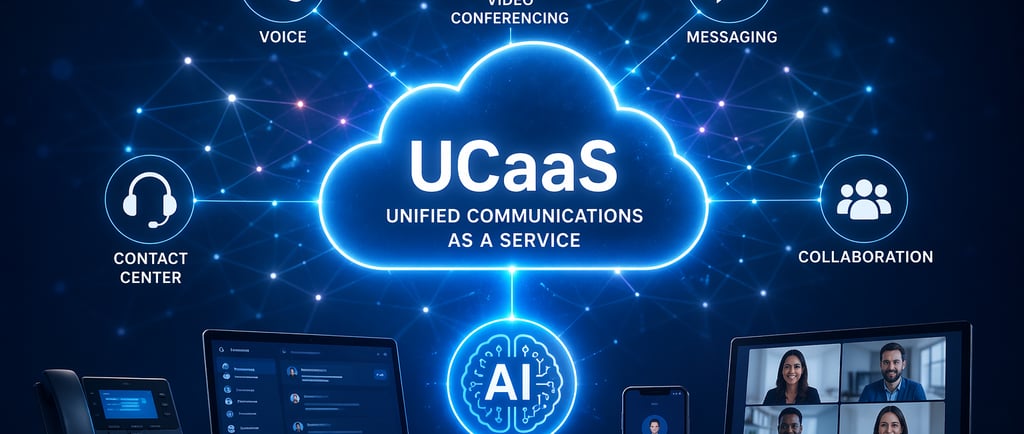
Unified Communications as a Service — UCaaS — has been the backbone of business phone systems for nearly a decade. But 2026 is different. The AI layer is no longer a marketing add-on buried in a vendor slide deck. It is now a core infrastructure decision, and if your current UCaaS contract was signed before 2024, you are almost certainly paying a Legacy Tax for a system that was architected before generative AI changed what enterprise communication looks like.
At Sigma Technology Consulting, we have spent the last 25 years watching vendors evolve and watching businesses overpay during every major technology transition. The AI-UCaaS wave is no exception — and in many ways, it is the most consequential shift we have seen since the move from on-premise PBX to cloud.
The average mid-market company with 200+ employees is sitting on a UCaaS contract that was priced in 2021 or 2022 — before AI capabilities existed, before hybrid work stabilized, and before market competition drove costs down 30 to 40 percent.
What AI is actually doing to UCaaS platforms
The major UCaaS providers — RingCentral, Microsoft Teams Phone, Zoom Phone, 8x8, Dialpad — have all embedded AI engines into their platforms. But the features vary wildly, and so do the costs. Here is what is actually being offered, and what actually moves the needle for a business with 100 to 1,000 employees:
• Real-time transcription and call summaries — reducing after-call work for sales and support teams by an estimated 20 to 40 percent
• AI-powered call routing and sentiment analysis — identifying frustrated customers before escalation
• Voicemail-to-email with intelligent prioritization — eliminating the voicemail black hole
• Automated meeting notes and CRM logging — eliminating manual data entry across platforms like Salesforce and HubSpot
These are not theoretical features. They are live, they work, and the ROI on reduced labor is measurable. However, here is the catch that most vendors will not tell you: not every AI feature is included in every tier. Many are add-ons. And if your current contract is mid-term, you may be paying for platform access without receiving the AI features that are being marketed to new customers right now.
The pricing gap nobody talks about
Between 2020 and 2023, UCaaS contract pricing was driven upward by enterprise demand, supply chain constraints on hardware endpoints, and vendor consolidation. That pricing environment no longer exists. Today, the UCaaS market is intensely competitive. Providers are fighting for market share, offering aggressive onboarding incentives, and — critically — discounting at levels they will never publish in a rate card.
We call this the Market Tape. Sigma Technology Consulting has access to real-time pricing data across 200+ global providers. What we see regularly: companies with 150 to 500 seats paying $28 to $45 per user per month for UCaaS, when current market rates for comparable capability — with AI features included — are running $14 to $22 per user per month. On a 300-seat deployment, that delta is $54,000 to $138,000 per year. Sitting in your OpEx. Every year.
What to do right now
You do not need to wait for your contract to expire to address this. Here is the framework we use when auditing a client's UCaaS environment:
• Pull your current invoice and identify your per-seat cost, feature tier, and contract end date
• Map which AI features you are actively using versus what you are licensed for — unused licenses are pure waste
• Benchmark your per-seat rate against current market pricing for equivalent capability
• Identify whether your provider offers a mid-contract renegotiation path, or whether a competitor buyout makes financial sense
The last point is where most companies stall. They assume their current provider will not negotiate mid-term. In our experience, that assumption is almost always wrong — especially if you have a multi-year agreement and significant seat count. Carriers would rather renegotiate than lose a 300-seat account to a competitor.
The bottom line
AI-powered UCaaS is a genuine productivity multiplier. But it is also a market inflection point that creates significant pricing leverage for businesses willing to engage it strategically. If your telecom contracts were last reviewed before 2024, there is almost certainly money on the table. The question is whether you have a guide who knows where to look.
At Sigma Technology Consulting, our Digital Plumbing Audit starts by mapping exactly this gap. In most cases, we find the audit pays for itself — and then some. Contact us at sigmatechconsult.com to learn how Infrastructure Arbitrage works in practice.
Sigma Technology Consulting, Inc.
25 Years of Experience, Vetting & Procuring Technology Vendors
Contact Us
Support
© 2026. All rights reserved.