
API Sprawl: The Security Gap Hiding in Plain Sight
7/14/20264 min read
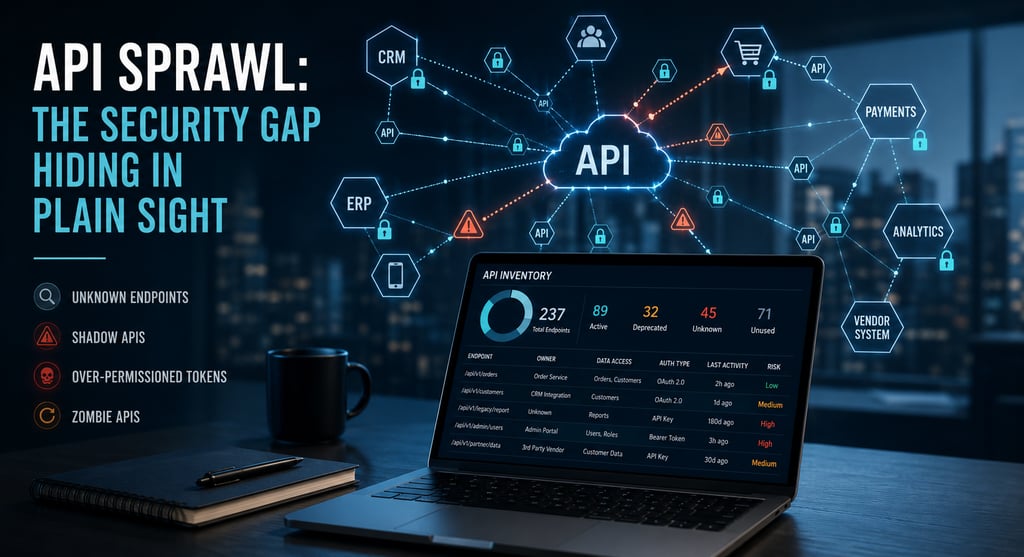
Every integration your company has ever turned on left something behind. A connection between your CRM and your marketing platform. A webhook feeding order data into a fulfillment tool. A mobile app talking to a backend service that hasn't been touched since the developer who built it left the company. Each of those is an API, and most mid-market companies have no accurate count of how many they actually have running, what data flows through them, or who still has access.
This is API sprawl, and it has quietly become one of the largest gaps between what a security review checks and what an attacker actually finds.
Why APIs Multiply Faster Than Anyone Tracks Them
Every new SaaS tool, every mobile app update, every partner integration, and every internal automation project typically introduces at least one new API connection. Unlike a new server or a new piece of software, an API rarely goes through the same procurement or change-management process. A developer connects two systems to solve an immediate problem, ships it, and moves to the next task. The connection keeps running indefinitely, usually with no formal owner and no scheduled review.
Over several years, this adds up to dozens or hundreds of active API connections at a company that believes it has a modest, well-understood technology footprint. Most were built for a legitimate reason. Very few were ever documented in a way that lets anyone answer a basic question years later: what does this connection actually do, and does it still need to exist?
Why This Is a Bigger Gap Than SaaS Sprawl
SaaS sprawl creates cost waste and data silos. API sprawl creates direct, machine-to-machine access paths into production systems, often authenticated with a credential or token that was issued once and never rotated. An API endpoint that was appropriately secured when it launched can become a liability years later, after the security standards around it have moved on and no one has gone back to check whether it kept pace.
Attackers have taken notice. Scanning the internet for exposed or misconfigured API endpoints is now a standard, automated part of how breaches begin, precisely because APIs are less consistently monitored than traditional login pages or VPN gateways, and because a single overlooked endpoint can expose an entire dataset without ever triggering the kind of alert a more visible entry point would.
The Three Patterns That Show Up in Almost Every Audit
Shadow APIs are connections nobody remembers building, often left behind by a departed employee or a vendor relationship that ended without anyone disabling the integration that supported it. They keep running, keep authenticating, and keep accepting requests, entirely outside anyone's current mental model of the technology stack.
Zombie APIs are old versions of an interface that a company believes it has retired, replaced by a newer version, but never actually decommissioned. The old version stays live, often with weaker authentication than its replacement, because shutting it down was never anyone's job and nothing forced the issue.
Over-permissioned tokens are credentials issued with broad access for convenience during initial setup, meant to be narrowed later, that never get revisited. A token created to let one system read a single data field frequently ends up with far broader read-and-write access than the integration has ever actually used, simply because narrowing permissions after the fact requires someone to notice and prioritize it.
Why Mid-Market Companies Are the Least Prepared
Large enterprises increasingly run dedicated API security platforms that continuously discover and monitor every endpoint. Small businesses tend to have few enough systems that the problem stays manageable by accident. Mid-market companies, again, sit in the gap: complex enough to have accumulated a real, sprawling API footprint over years of growth, but rarely staffed with anyone whose job is specifically to inventory and govern it.
This gap becomes especially visible during due diligence for PE-backed companies, where a buyer's technical review increasingly asks for a documented API inventory as a standard request, and a company that can't produce one raises a flag that has nothing to do with whether the underlying systems are actually secure.
It's also a gap that tends to widen rather than shrink over time without intervention, since each additional year of operation brings new integrations, new vendor relationships, and new employee turnover, each adding to a footprint that was already undocumented before any of this year's additions arrived.
Building an Inventory That Actually Reflects Reality
The starting point looks similar to a Digital Plumbing Audit applied specifically to machine-to-machine connections: pulling API gateway logs, reviewing every third-party integration with API access enabled, and cross-referencing authentication tokens currently in use against the list of vendors and internal systems the company believes are active. This exercise routinely surfaces connections tied to vendors the company stopped using years ago, and tokens with access far broader than any current integration requires.
From there, the fix is a matter of discipline rather than new technology spend: assigning an owner to each API connection, setting a recurring review cadence for authentication tokens, decommissioning old API versions on a defined timeline instead of an indefinite one, and requiring new integrations to go through at least a lightweight review before they go live rather than being deployed silently.
The Payoff Is Bigger Than Security Alone
Companies that complete this exercise usually find more than security exposure. They find integrations that duplicate each other, connections supporting features that were retired years ago, and vendor relationships that could be consolidated or eliminated entirely. The security review becomes, almost as a side effect, a map of the company's actual technology dependencies, something most mid-market leadership teams have never had in one place before.
Starting Small Still Counts
A full API inventory can sound like a multi-month project, and for a company with years of accumulated integrations, it genuinely can be. That's not a reason to delay starting. Prioritizing the handful of connections with access to the most sensitive data, customer records, payment information, or administrative system access, gives a mid-market company most of the risk reduction long before the full inventory is complete, and turns an intimidating project into a manageable first step that can begin this quarter rather than waiting for a larger initiative to get funded and scheduled.
The companies that get this right treat it as an ongoing discipline rather than a one-time project. A single audit closes today's gap. A recurring review, built into how new integrations get approved and how existing ones get retired, keeps the gap from reopening the moment the audit report is filed away.
Sigma Technology Consulting, Inc.
25 Years of Experience, Vetting & Procuring Technology Vendors
Contact Us
Support
© 2026. All rights reserved.