
Business Email Compromise 2.0: How AI Voice Cloning Is Bypassing Verification Calls
7/17/20264 min read
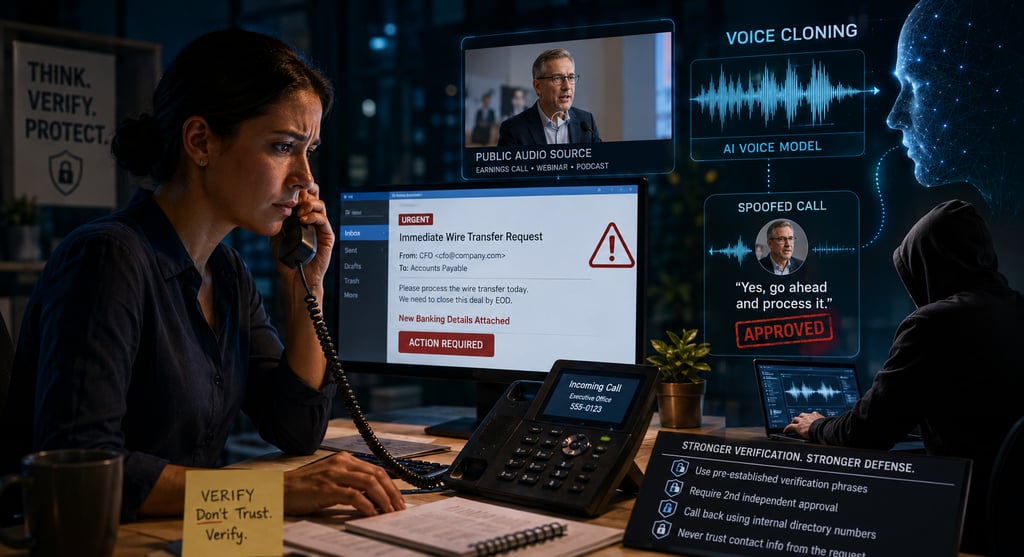
For years, the standard defense against business email compromise was simple and effective: if an email asks for an urgent wire transfer or a change to payment details, pick up the phone and verify it with the person directly, using a known number, not one provided in the email. That single habit stopped a huge share of BEC attempts. It's now being defeated by a new twist that inherits all the trust of a phone call while removing the one thing that made it reliable.
The financial impact of business email compromise has consistently outpaced most other categories of cybercrime for years, precisely because it doesn't require breaching any technical system at all. It only requires being convincing at the exact moment someone with payment authority is deciding whether to act. Voice cloning makes that moment easier to win.
The Attack, Updated
The updated version of the scheme starts the same way, with a convincing email impersonating an executive, a vendor, or a client, requesting an urgent payment or a change to banking details. What's changed is what happens when a cautious employee tries to do the right thing and calls to confirm. Attackers are now using short AI-generated voice clips, built from publicly available audio of the executive or vendor contact, whether from earnings calls, webinars, conference talks, or social media video, to answer a spoofed callback number or leave a convincing voicemail confirming the request.
A well-produced clone doesn't need to sustain a long, natural conversation to succeed. It needs only a few seconds of a familiar voice confirming a request the employee already suspects is probably legitimate, which is often enough to overcome the last bit of hesitation that would otherwise have stopped the transfer.
Why the Old Verification Habit No Longer Works Alone
The entire value of a callback verification was that voice was hard to fake convincingly and impossible to fake at scale. Consumer-accessible voice cloning tools have closed that gap for anyone with even a modest amount of public audio to work from, which describes almost every executive at a company with any public profile at all: a quarterly town hall recording, a podcast appearance, a conference keynote, or even a handful of video posts on a professional social platform.
This doesn't make callback verification worthless. It makes callback verification alone insufficient as the entire control, in the same way a password alone stopped being a sufficient control once credential theft became routine.
Who Attackers Are Actually Targeting
The employees most likely to receive one of these calls are rarely the executives being impersonated. They're the accounts payable clerk, the controller, or the executive assistant with standing authority to initiate or approve a payment, precisely because that person is positioned to act quickly and has a working relationship with the executive's voice and manner that an attacker is counting on to lower their guard rather than raise it.
Mid-market companies are attractive targets for this specific technique because they're large enough to have real wire transfer authority delegated to a handful of employees, but rarely have the layered financial controls of a larger enterprise, where a request of meaningful size would automatically trigger a second, independent approval regardless of how convincing the initial verification seemed.
What a Verification Process Needs to Look Like Now
The fix isn't abandoning voice verification, it's adding a layer that doesn't depend on recognizing a voice at all. A shared, pre-established verification phrase or code word, changed periodically and known only to the small group of people authorized to request or approve wire transfers, gives employees something concrete to check that a voice clone, however convincing, cannot produce without independently compromising that same small group.
A second, structural control matters just as much: any payment request above a defined dollar threshold, or any request to change existing banking details, should require a second independent approval through a completely separate channel, not just a callback to the same phone number provided in the original request. Requiring the second approver to initiate contact using a number pulled from an internal directory, never from the message requesting the transfer, closes the specific gap that voice cloning is built to exploit.
Training That Matches the Actual Threat
Generic phishing awareness training rarely mentions voice cloning specifically, which means most employees with wire transfer authority have never been told this technique exists, let alone what it might sound like. A short, specific briefing describing exactly this scenario, a callback that sounds right but arrives with unusual urgency or a request to bypass normal approval steps, gives employees a concrete pattern to recognize rather than a vague instruction to "stay vigilant."
It's also worth normalizing a simple response for employees who find themselves suspicious mid-call: hanging up and calling back through a separately verified number, even if it means a brief delay and an awkward moment with someone who turns out to be entirely legitimate. Employees need explicit permission to slow down a request that feels urgent, since the entire attack depends on urgency overriding caution before anyone stops to apply a second check.
Leadership can reinforce this directly and cheaply, simply by telling finance and accounts payable staff explicitly that no legitimate urgent request will ever be penalized for taking an extra ten minutes to verify properly, removing the unspoken pressure that often pushes an uncertain employee to act quickly rather than risk seeming difficult or slow in front of someone they believe is a senior executive.
The Broader Pattern Worth Watching
Voice cloning is one specific application of a broader trend: AI tools lowering the cost and skill required to defeat verification methods that depended on something being hard to fake. The same logic that is starting to affect voice will increasingly apply to video verification as deepfake video tools continue to improve, which means the durable fix isn't finding a new thing to trust, it's building financial controls that don't rely on trusting any single communication channel at all, no matter how convincing it seems in the moment.
Sigma Technology Consulting, Inc.
25 Years of Experience, Vetting & Procuring Technology Vendors
Contact Us
Support
© 2026. All rights reserved.