
Case Study: How a Boutique Hotel Group Cut Cloud Spend 41% Without Touching the Guest Experience
7/7/20264 min read
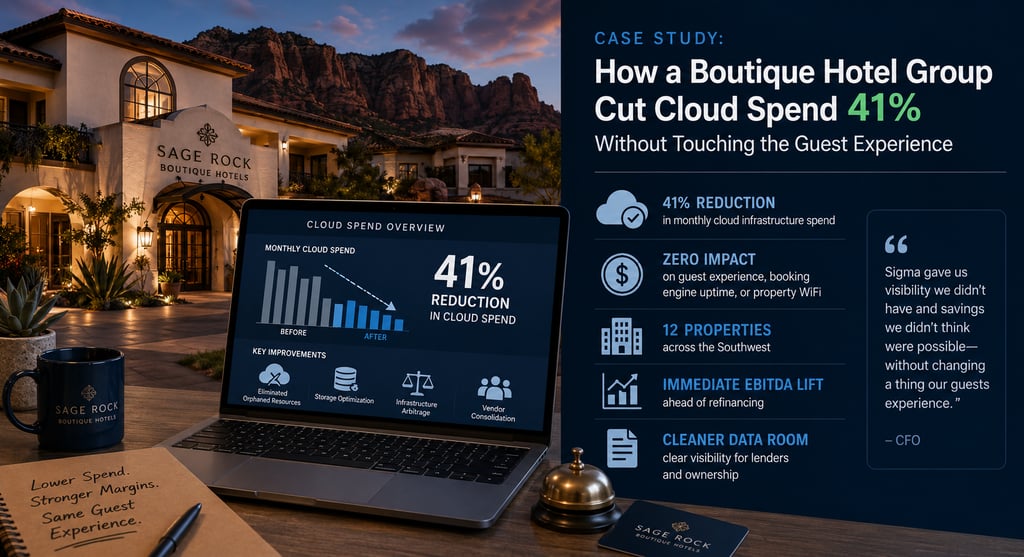
A twelve-property boutique hotel group operating across the Southwest had a familiar mid-market problem: technology spend that had grown faster than anyone had planned for, and no single person who could explain why. The company, backed by a regional private equity firm and operating with roughly 140 corporate and property-level staff, brought Sigma Technology Consulting in ahead of a planned refinancing to answer one question the ownership group kept asking: where is all this cloud spend actually going?
It's a question more mid-market operators are asking than most technology vendors would like to admit. Cloud spend has a way of growing quietly, one reasonable-sounding decision at a time, until it becomes a line item large enough to attract the attention of lenders and ownership groups alike, with no one internally positioned to explain the full picture.
A Decade of Point Solutions, Never Consolidated
Hospitality technology sprawls in a way few other industries do. Each property ran its own property management system integration, its own guest WiFi controller, its own point-of-sale environment, and its own loyalty app connection, layered on top of a corporate booking engine and a revenue management platform. Over ten years of acquisitions and property openings, every new addition brought its own cloud footprint, and none of it had ever been consolidated or reviewed as a whole.
The result was a cloud bill that had roughly tripled in four years, with no one at the company able to say with confidence which workloads were mission-critical, which were legacy holdovers from a system that had already been replaced, and which were simply orphaned.
The Digital Plumbing Audit
Sigma's engagement began with a full Digital Plumbing Audit: a systematic walk-through of every cloud account, reserved instance, storage bucket, and vendor contract tied to the company's technology stack. The audit surfaced several patterns that are common in mid-market hospitality but rarely visible without a dedicated review.
Development and staging environments for a loyalty app rebuild that had shipped eighteen months earlier were still running, fully provisioned, at production scale. Three properties were paying for redundant guest WiFi analytics platforms that had been bundled into a separate network contract without anyone noticing the overlap. A batch of reserved cloud instances purchased for a since-cancelled kiosk check-in pilot had auto-renewed twice. None of this was fraud or negligence. It was the ordinary accumulation that happens when technology decisions get made property by property, year by year, with no central review.
The audit also found meaningful storage waste: years of raw guest WiFi usage logs and point-of-sale transaction backups retained indefinitely on premium, frequently-accessed storage tiers, when the vast majority of that data had not been touched in over a year and belonged on a far cheaper archival tier. Moving that data alone accounted for a meaningful share of the eventual savings, with zero effect on retrieval times for the recent data that staff actually used.
Infrastructure Arbitrage on the Contracts That Remained
Beyond eliminating waste, Sigma applied infrastructure arbitrage across the vendor contracts the hotel group actually needed to keep. The corporate booking engine's cloud hosting agreement was up for renewal within the audit window, and Sigma's carrier and cloud provider network was used to benchmark the existing pricing against three alternative providers offering equivalent uptime guarantees. That benchmarking alone became leverage in the renewal conversation, without requiring a single migration.
SD-WAN connectivity across the twelve properties was also restructured, consolidating five separate regional contracts into a single multi-site agreement with volume pricing, cutting connectivity costs by 18% independent of the cloud savings.
The Results
The combined effort reduced the hotel group's monthly cloud infrastructure spend by 41%, without any reduction in guest-facing performance, booking engine uptime, or property WiFi quality. Property-level IT staff reported the environment was easier to manage with the duplicate tools removed. The savings translated directly into EBITDA lift ahead of the ownership group's refinancing conversation, and the documentation from the audit became part of the data room, giving lenders a clear, current picture of the company's technology cost structure instead of a decade of undocumented sprawl.
Perhaps most importantly for a hospitality operator, none of the changes were visible to a single guest. The savings came entirely from the back end: eliminating waste, consolidating vendors, and renegotiating from a position of actual market knowledge instead of accepting whatever the incumbent provider proposed at renewal.
The engagement also gave the finance team a cleaner monthly forecast. Instead of a cloud line item that fluctuated unpredictably from month to month for reasons no one could fully explain, spend became consistent and traceable to specific, documented workloads, which made the numbers far easier to defend in conversations with lenders during the refinancing process.
What the Ownership Group Learned About Its Own Technology Stack
Beyond the dollar figure, the audit gave the ownership group something it hadn't had before: an accurate, documented map of exactly what technology the company depended on and why. Prior to the engagement, that knowledge existed only in the heads of a handful of property-level IT staff and a departed corporate IT director whose institutional knowledge had left with him. Formalizing that map turned technology from a recurring budget line item nobody could explain into a set of decisions the ownership group could actually evaluate and plan around.
That documentation also changed how the company approached its next property acquisition. Rather than absorbing a new property's existing technology stack wholesale, as had happened with every prior acquisition, the company now had a standard onboarding checklist derived directly from the patterns the audit uncovered, catching duplicate contracts and orphaned environments before they were absorbed rather than years later.
The Takeaway for Mid-Market Operators
Hospitality groups scaling through acquisition are especially prone to this kind of sprawl, because every new property arrives with its own technology history attached. A Digital Plumbing Audit before a refinancing, sale, or major renewal cycle routinely uncovers savings in the range of 30-45% of cloud spend, purely from consolidation and arbitrage, with zero disruption to daily operations.
The pattern holds well beyond hospitality. Any mid-market company that has grown through acquisition, opened new locations, or simply operated for a decade without a full technology review is very likely carrying some version of the same sprawl: forgotten reserved capacity, duplicate contracts bundled into unrelated agreements, and cloud spend nobody has mapped back to a specific business need in years. Finding it is rarely the hard part once someone actually looks. The hard part is that almost no one, inside a growing company, ever has the bandwidth to look.
Sigma Technology Consulting, Inc.
25 Years of Experience, Vetting & Procuring Technology Vendors
Contact Us
Support
© 2026. All rights reserved.