Case Study: How a Corporate Umbrella Approach Delivered $1.8M in Annual EBITDA Lift Across a 4-Company PE Portfolio
7/21/20264 min read
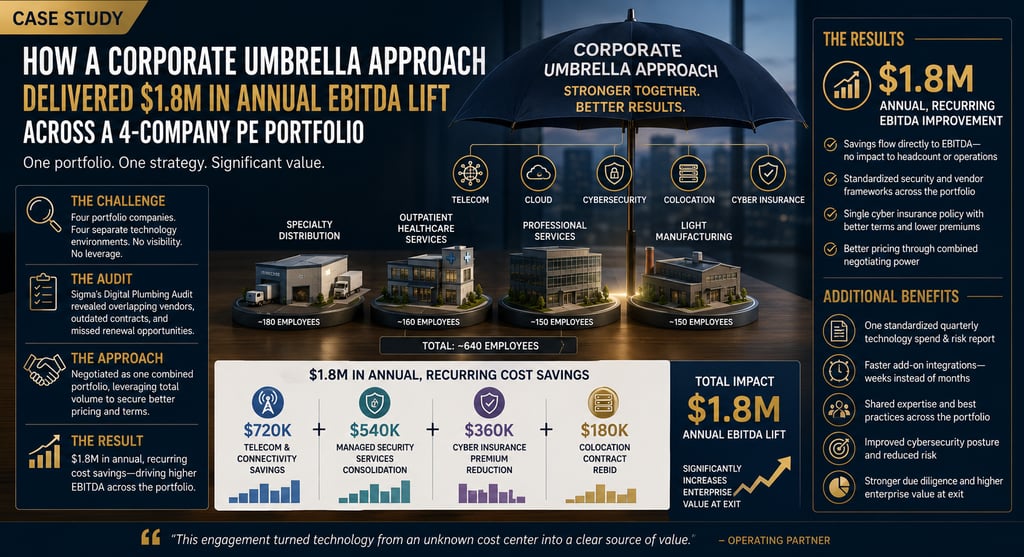
A middle-market private equity fund holding four platform companies, spanning specialty distribution, outpatient healthcare services, professional services, and light manufacturing, engaged Sigma Technology Consulting to answer a question the fund's operating partner had never had a clean answer to: across all four companies, how much was the portfolio actually spending on technology, and was any of it negotiated well.
It's a question that sounds simple and almost never has a ready answer, precisely because each portfolio company's technology spend lives in its own separate set of invoices, contracts, and internal reporting, none of it built to be compared against a sister company the fund also happens to own.
Four Companies, Four Completely Separate Technology Environments
Each portfolio company had been acquired at a different point over a five-year period, each arrived with its own existing vendor relationships, and none of the four had ever compared notes with the others. The specialty distributor was running MPLS circuits across its regional warehouses that had never been rebid. The healthcare services company was paying retail pricing for a cloud EHR hosting environment with no volume discount applied. The professional services firm had inherited three different cybersecurity vendors across its offices, none coordinated. The manufacturing company was locked into a colocation contract signed years before the fund's ownership began, with terms nobody at the fund had ever reviewed.
Combined, the four companies represented roughly 640 employees and a meaningful aggregate technology spend, none of it negotiated as a combined unit, and none of it benchmarked against what comparable combined volume should have commanded in the market.
The Portfolio-Wide Audit
Sigma ran a Digital Plumbing Audit across all four companies simultaneously rather than sequentially, specifically to build a combined picture of vendor overlap, contract terms, and renewal timing across the portfolio. The audit found that two of the four companies were already using the same national telecom carrier under completely different, independently negotiated contracts, at different rates, for comparable service. It found that three of the four could be consolidated onto a single managed security services provider without disrupting any company's operations, using the combined volume to negotiate materially better per-seat pricing than any one company could reach alone.
It also found that the portfolio's aggregate cyber insurance spend, purchased as four separate policies through four separate brokers, could be consolidated into a single portfolio-wide policy once security controls were standardized across all four companies, reducing total premium spend while improving coverage terms.
Negotiating as a Combined Unit
Once the audit was complete, Sigma approached the market on behalf of the full portfolio rather than any single company, using the combined 640-employee footprint as the basis for negotiation. The telecom consolidation alone, moving both companies with overlapping carrier relationships onto a single umbrella contract, delivered materially better pricing than either company had secured independently. The managed security services consolidation delivered similar leverage, with the added benefit of standardizing security posture across three of the four companies under a single, consistent framework.
The colocation contract inherited by the manufacturing company was rebid entirely, using current market data the company had never previously had access to, delivering meaningful savings on its own even before considering the rest of the portfolio.
The Results
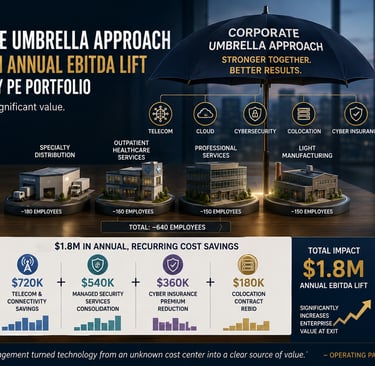
Combined across all four companies, the engagement delivered $1.8 million in annual, recurring cost reduction, split roughly evenly between telecom and connectivity savings, managed security consolidation, cyber insurance premium reduction, and the colocation rebid. Every dollar of that reduction flows directly to EBITDA, since none of it required any change to revenue, headcount, or operations at any of the four companies.
At the fund's targeted exit multiple for platform companies in this size range, that $1.8 million in annual EBITDA improvement translates into a meaningful multiple of that figure in added enterprise value across the portfolio at exit, a return on the audit and standardization engagement that dwarfs its cost many times over, and one that compounds every year the savings remain in place before any exit occurs at all.
What Changed Beyond the Number
The operating partner now receives a single, standardized quarterly technology spend and risk report across all four companies, something that didn't exist in any form before the engagement. New add-on acquisitions for any of the four platforms are onboarded directly onto the portfolio's existing umbrella contracts rather than negotiating fresh agreements each time, cutting integration time for bolt-on technology stacks from months to weeks.
The Detail That Surprised the Operating Partner Most
The single finding that generated the most internal discussion wasn't the largest dollar figure. It was discovering that two portfolio companies had been paying meaningfully different rates to the same underlying telecom carrier for years, a fact neither company had any way to know on its own, since neither had visibility into what the other was paying, and the carrier had no incentive to point out the discrepancy. That single overlap, once identified, took less than a month to correct through a renegotiated combined contract, and became the clearest illustration to the fund's investment committee of exactly why portfolio-wide visibility matters in a way that company-by-company reviews structurally cannot replicate.
Extending the Model to Future Acquisitions
Following the engagement, the fund updated its standard 100-day post-close plan for new platform and add-on acquisitions to include an immediate technology audit and onboarding onto the portfolio's existing umbrella contracts, rather than waiting, as had happened with all four original companies, until years after acquisition to identify the opportunity. The operating partner estimates this alone will meaningfully shorten the timeline to full EBITDA contribution for every future acquisition the fund makes in this space.
The fund's next platform acquisition, currently in diligence, is already being evaluated in part on how easily its technology environment will integrate into the existing portfolio umbrella, a consideration that wasn't part of the fund's diligence checklist at all before this engagement.
Sigma Technology Consulting, Inc.
25 Years of Experience, Vetting & Procuring Technology Vendors
Contact Us
Support
© 2026. All rights reserved.