
Case Study: How a Regional Distribution Company Cut Connectivity Costs 37% While Fixing a Ransomware Gap
7/14/20264 min read
A regional distribution company operating six warehouses and a fleet of delivery routes across two states came to Sigma Technology Consulting with a problem that looked, at first, like a connectivity issue. Warehouse management systems were timing out during peak shipping windows, and the company, backed by a private equity growth fund with roughly 210 employees across corporate and warehouse staff, wanted a network refresh to fix it. The network was indeed part of the problem. It wasn't the whole story.
It's a pattern Sigma sees often in logistics and distribution: a specific, visible symptom prompts the engagement, while the audit that follows uncovers a second, unrelated risk that had been sitting quietly in the environment for years, unnoticed simply because nothing had yet triggered it.
A Network Built One Warehouse at a Time
Each of the six warehouses had been connected to the corporate network on its own timeline, as the company expanded from a single facility into a six-site regional operation over eight years. Circuit types varied by site, several locations were still running legacy MPLS connections priced for a fraction of the bandwidth the warehouse management system now required, and no one at the company had ever compared what any individual site was paying against current market rates.
The slowdowns during peak shipping windows were real, and they were a direct, predictable consequence of running modern, data-heavy warehouse software over connectivity that had been sized for a much lighter workload years earlier.
Compounding the problem, each site's contract had been negotiated by a different regional manager at a different point in the company's growth, with no central procurement function ever stepping in to standardize terms, renewal dates, or vendor relationships across the six locations. Renewal dates were staggered unpredictably throughout the year, which meant no one ever had a natural moment to step back and evaluate the whole network as a single system rather than six separate, unrelated contracts.
The Audit Found a Second, More Urgent Problem
While reviewing the network environment, Sigma's audit surfaced a second issue that had nothing to do with bandwidth: backup infrastructure for the warehouse management databases was running as standard, mutable backups on the same network segment as production systems, with no offline or immutable copy anywhere in the environment. A ransomware event hitting the production network would have had a direct path to the backups meant to recover from it, a gap the company had no visibility into until the audit specifically went looking for it.
This is a common and often invisible failure mode: a backup strategy that technically exists, runs on schedule, and would show green on a checklist, while still being fully exposed to the exact threat it's supposed to protect against.
Fixing the Network with Infrastructure Arbitrage
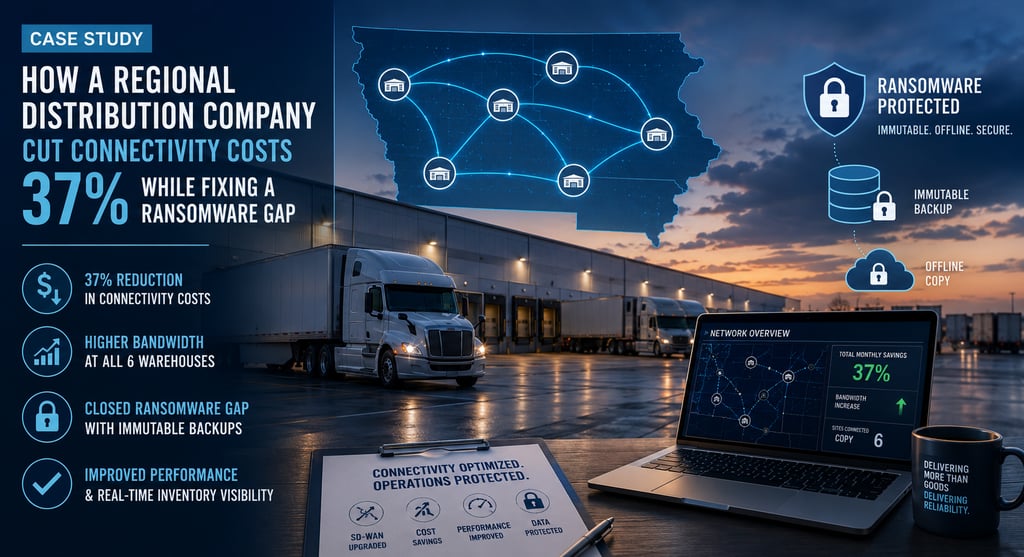
Sigma's carrier and vendor network was used to benchmark all six warehouse connections against current market pricing and bandwidth options. Three sites still running legacy MPLS circuits were migrated to SD-WAN, delivering more usable bandwidth at a lower monthly cost. The remaining three sites, already on more modern connections, were renegotiated using competitive benchmarking as leverage, without requiring a technology change.
The result was a 37% reduction in total monthly connectivity spend across all six sites, combined with meaningfully higher available bandwidth at every warehouse, directly addressing the peak-window slowdowns that had prompted the engagement in the first place.
Closing the Ransomware Gap
Alongside the network work, Sigma implemented an immutable, offline backup architecture for the warehouse management databases, segmented from the production network and protected against modification or deletion even by an account with administrative credentials on the primary environment. A tested recovery drill confirmed the new backups could restore full warehouse operations within a defined recovery time objective, something the company had never previously verified under real conditions.
This part of the engagement cost a fraction of what the connectivity work saved on an annual basis, and closed a gap that, left unaddressed, could have meant the difference between a contained incident and a multi-week operational shutdown during peak shipping season.
What the Company Learned About Its Own Risk Profile
Before the engagement, leadership had assessed the company's cybersecurity posture almost entirely in terms of firewalls, endpoint protection, and employee training, all of which were reasonably solid. Backup resilience specifically as a ransomware control had never been evaluated on its own, largely because backups were treated as a data recovery function rather than a security control in their own right. The audit reframed that thinking permanently, and the company has since added a standing annual backup recovery drill to its operational calendar, independent of any broader security review.
The connectivity upgrade also had a downstream effect the company hadn't anticipated: with reliable, higher-bandwidth connections at every warehouse, the operations team was able to roll out real-time inventory visibility across all six sites, a capability the previous network simply couldn't have supported regardless of the software involved.
That unplanned benefit turned out to matter almost as much to leadership as the direct cost savings, since real-time inventory visibility had been on the company's roadmap for over a year, repeatedly delayed because nobody had traced the delay back to the underlying network limitation rather than the software itself.
The Takeaway for Mid-Market Logistics and Distribution
Companies that have grown warehouse by warehouse or route by route over several years are especially likely to be carrying both of these gaps simultaneously: connectivity priced and provisioned for a much earlier stage of the business, and a backup strategy that exists on paper without ever having been tested against the specific threat it's meant to defend against. Neither gap tends to announce itself until it's tested by an actual peak-season slowdown or an actual security incident, which is exactly why a proactive audit finds them at a fraction of the cost of discovering them the hard way.
For any distribution or logistics operator running more than two or three sites, the version of this exercise worth prioritizing first is simple: pull every site's connectivity contract into one place, and ask, separately, when backups were last actually tested with a real restore, not just confirmed to be running on schedule.
Sigma Technology Consulting, Inc.
25 Years of Experience, Vetting & Procuring Technology Vendors
Contact Us
Support
© 2026. All rights reserved.