
CCaaS in 2026: How AI Contact Centers Are Redefining Customer Experience — and What It Costs to Fall Behind
5/5/20263 min read
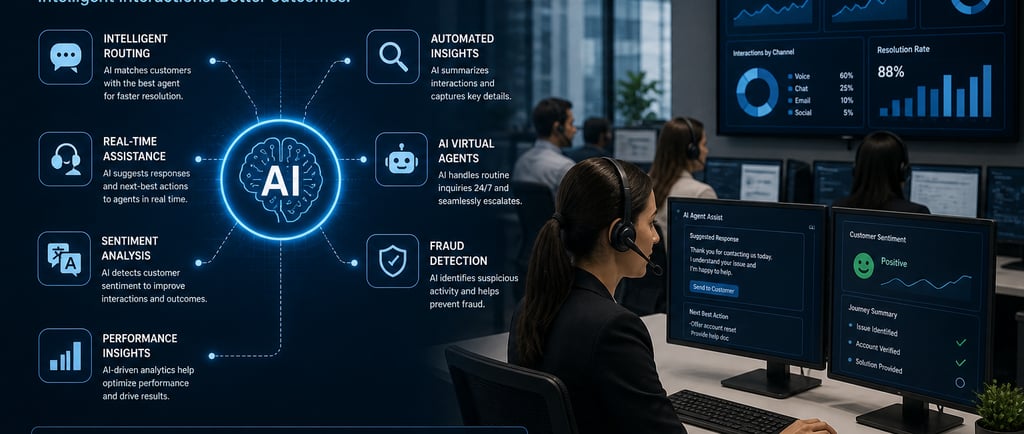
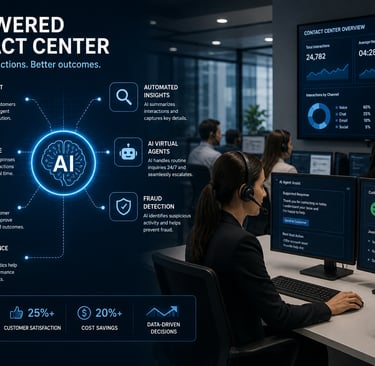
Contact Center as a Service — CCaaS — has undergone a more dramatic transformation in the past 24 months than in the previous decade combined. The catalyst, unsurprisingly, is AI. But unlike many technology categories where AI remains largely aspirational, the AI features now embedded in leading CCaaS platforms are operational, measurable, and delivering documented productivity gains that show up in headcount efficiency, customer satisfaction scores, and average handle time.
The problem: most mid-market businesses with contact center functions are running CCaaS contracts that were signed before these AI capabilities existed. They are paying 2022 prices for 2022 functionality while their competitors — and the platforms themselves — have moved significantly beyond that baseline.
The gap between a best-in-class AI-assisted CCaaS deployment and a legacy CCaaS contract from 2022 is no longer a feature gap. It is a competitive gap. And for businesses where customer experience is a differentiator, that gap has a dollar value.
What AI is actually doing inside CCaaS platforms
The current generation of AI CCaaS capabilities — available today, in production, at scale — includes capabilities that were science fiction four years ago and vendor roadmap items two years ago:
• Real-time agent assist: AI listens to live calls and surfaces relevant knowledge base articles, suggested responses, and customer history to the agent in real time — reducing average handle time by 15 to 35 percent in documented deployments
• Automated call summarization: every call is automatically summarized and logged to CRM, eliminating after-call work and reducing the manual documentation burden on agents by an average of 40 percent
• Predictive routing: AI matches incoming contacts to the agent most likely to resolve the issue on first contact, based on historical performance data — measurably improving first call resolution rates
• Sentiment analysis and escalation triggers: AI monitors call sentiment in real time and alerts supervisors when a customer interaction is trending toward churn risk or escalation — enabling intervention before the call deteriorates
• Conversational AI for tier-one deflection: AI handles routine inquiries — account status, appointment scheduling, basic troubleshooting — without agent involvement, deflecting 20 to 40 percent of inbound volume in well-implemented deployments
The pricing reality in 2026
Here is the market reality that most businesses with existing CCaaS contracts are not aware of: the platforms that lead the current AI capability rankings — Five9, Genesys Cloud, NICE CXone, Talkdesk, Amazon Connect — are competing aggressively for market share. New contract pricing for these platforms, with full AI feature sets included, is running $32 to $45 per agent per month for most mid-market deployments.
By comparison, we regularly audit organizations that are paying $48 to $65 per agent per month under contracts signed in 2021 and 2022 — for platforms that have either been deprecated or that lack the AI features now standard in competitive offerings. On a 100-agent contact center, that delta is $79,000 to $241,000 per year.
The hidden cost: agent productivity
The direct contract cost comparison understates the full financial picture. The productivity differential between an AI-assisted CCaaS environment and a legacy one is measurable and significant. Reduced handle time, lower after-call work, improved first call resolution, and reduced supervisor intervention time each have labor cost implications. When we model the full cost of a legacy CCaaS deployment against a current AI-assisted alternative for a 100-agent center, the total cost of ownership gap — including productivity differences — typically ranges from $400,000 to $900,000 per year.
What to do if your CCaaS contract is mid-term
Mid-term CCaaS transitions are more complex than UCaaS moves, because contact center platforms are typically more deeply integrated with CRM systems, workforce management tools, and reporting infrastructure. A migration requires careful sequencing and a transition period where dual systems may need to run in parallel.
However, mid-term renegotiation — rather than replacement — is often possible and can deliver meaningful short-term savings while you plan the longer-term platform modernization. Carriers and CCaaS vendors have retention economics that create renegotiation incentives, especially for accounts with significant agent counts and multi-year histories.
Sigma Technology Consulting evaluates CCaaS environments as part of every Digital Plumbing Audit. If your contact center contract is more than two years old, contact us at sigmatechconsult.com to benchmark where you stand against current market pricing and capability.
Sigma Technology Consulting, Inc.
25 Years of Experience, Vetting & Procuring Technology Vendors
Contact Us
Support
© 2026. All rights reserved.