
CLOUD COMPUTE Cloud Database Economics: How to Choose Between RDS, Aurora, and Self-Managed PostgreSQL Without Overpaying
6/30/20264 min read
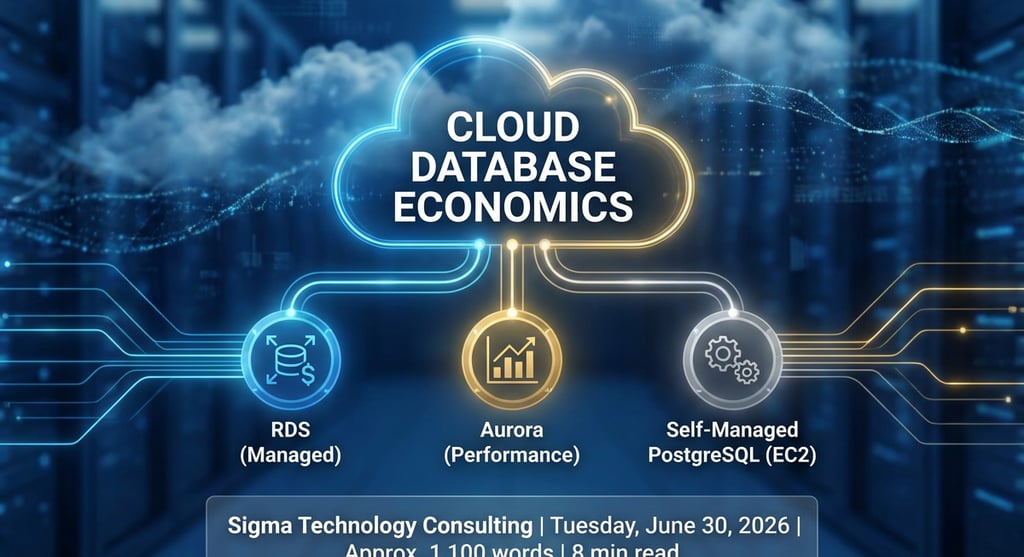
Database costs represent one of the largest and most opaque line items in cloud infrastructure spending. For mid-market organizations running meaningful workloads on AWS, the choice between Amazon RDS, Amazon Aurora, and self-managed PostgreSQL on EC2 has direct, significant cost implications — implications that are rarely modeled comprehensively before a database architecture decision is made and that become clear only when the monthly bill arrives.
This post is a practical framework for the database economics decision: what each option actually costs at mid-market scale, which workload characteristics favor each model, and what the total cost of ownership looks like over a three-year horizon — the comparison that procurement decisions should be based on but rarely are.
Database architecture decisions are rarely revisited after initial deployment, even when the workload's growth has moved it into a cost tier where a different architecture would be significantly more economical. A database choice made at ten gigabytes of data and one hundred concurrent connections may be the wrong choice at one terabyte and a thousand connections — but migrations are operationally complex, so the original choice persists indefinitely.
Amazon RDS: the managed baseline
Amazon RDS for PostgreSQL provides managed database infrastructure — automated backups, patch management, Multi-AZ failover, and monitoring — at a pricing model based on the instance type, storage volume, and data transfer. A db.r6g.large instance (2 vCPU, 16GB RAM) running Multi-AZ for high availability costs approximately $0.48 per hour in on-demand pricing, or $0.24 per hour with a one-year reserved instance commitment — $2,102 per year in reserved compute. Add storage at $0.115 per GB-month, backup storage, and data transfer, and a typical mid-market RDS deployment runs $4,000 to $12,000 per year for moderate workloads.
RDS eliminates the operational overhead of database administration — patching, backup management, failover configuration — which has a real labor cost that is frequently omitted from cost comparisons. For organizations without dedicated database administration expertise, the managed overhead reduction justifies a meaningful premium over self-managed alternatives.
Amazon Aurora: when RDS economics stop working
Aurora PostgreSQL-compatible offers performance improvements over standard RDS — up to five times higher throughput according to AWS benchmarks — along with a distributed storage architecture that provides automatic replication and faster failover than standard RDS Multi-AZ. Aurora Serverless v2 adds automatic scaling of compute capacity based on actual load, which can significantly reduce costs for workloads with variable demand.
Aurora's pricing is meaningfully higher than RDS on a like-for-like basis. An Aurora db.r6g.large instance runs approximately $0.29 per hour per Aurora Capacity Unit, with storage billed at $0.10 per GB-month but with a minimum storage allocation and I/O charges that add materially to the total. For workloads that need Aurora's performance characteristics — high concurrent connections, read replicas, global database distribution — the premium is justified. For workloads that do not need those capabilities, Aurora is a significant overspend relative to RDS or self-managed alternatives.
Self-managed PostgreSQL on EC2: the total cost of ownership question
Running PostgreSQL on EC2 instances eliminates the managed service markup — approximately 20 to 35 percent of RDS pricing is attributed to the managed overhead — but transfers all database administration responsibility to the internal team or a managed service provider. The decision is not simply managed versus unmanaged pricing. It is a question of whether the labor cost of database administration — patching cycles, backup configuration and testing, failover setup and testing, performance tuning, upgrade management — is lower than the managed service premium being paid to RDS or Aurora.
For organizations with dedicated database administration expertise, self-managed PostgreSQL on EC2 with appropriate tooling for backup (pgBackRest or Barman), monitoring (pg_stat_statements, Prometheus with Postgres exporter), and high availability (Patroni or Repmgr) can deliver equivalent capability at 30 to 50 percent lower cost than equivalent RDS configurations. For organizations without that expertise, the operational risk of self-managed databases — unpatched vulnerabilities, misconfigured backups, untested failover — makes the managed service premium a rational investment.
The Aurora Serverless consideration for variable workloads
Aurora Serverless v2 deserves separate evaluation for workloads with significant demand variability. Rather than provisioning a fixed instance size and paying for it continuously, Aurora Serverless scales compute in fine-grained increments based on actual load, with a minimum capacity that can be set to zero for workloads that are truly intermittent. For development databases, staging environments, and applications with significant traffic variability, Aurora Serverless can deliver the cost profile advantages of paying for actual consumption rather than provisioned capacity.
The caution: Aurora Serverless scales up within seconds but not instantaneously, and at high sustained loads, the per-ACU pricing of Serverless can significantly exceed the cost of a fixed Aurora instance sized appropriately for that load. Serverless is optimal for variable workloads, not for high, consistent demand.
The total cost of ownership framework
A complete database cost comparison should include: compute costs over a three-year period using reserved instance pricing for fixed deployments, storage costs projected against expected data growth, I/O costs for Aurora or IOPS-intensive RDS configurations, backup storage costs, data transfer charges for read replica traffic and cross-region replication, and the labor cost of database administration — either the internal FTE allocation or the MSP cost for managed database services.
When all of these factors are included, the decision frequently looks different from a comparison of headline instance pricing alone. Self-managed with strong internal DBA expertise often wins on pure cost. RDS wins when DBA expertise is limited or expensive. Aurora wins only when its specific performance or availability characteristics are actually required. Organizations that have chosen Aurora without modeling this comparison are frequently overpaying by 40 to 80 percent for capabilities their workloads do not fully utilize.
Sigma Technology Consulting conducts cloud database cost assessments as part of our FinOps and cloud architecture engagements. Contact us at sigmatechconsult.com to evaluate your current database cost profile.
Sigma Technology Consulting, Inc.
25 Years of Experience, Vetting & Procuring Technology Vendors
Contact Us
Support
© 2026. All rights reserved.