
CLOUD COMPUTE The Hidden Cost of Cloud Lock-In: How Proprietary Services Trap Your Workloads and What to Do About It
6/16/20264 min read
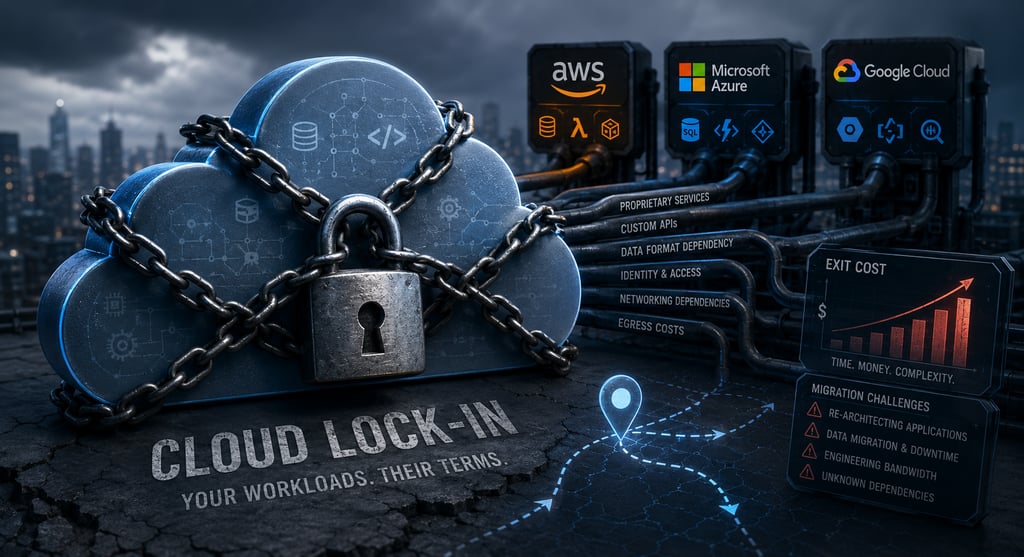
Cloud providers are in the business of building platforms that customers find indispensable. That is not cynicism — it is their stated strategy. AWS, Azure, and GCP each invest billions annually in proprietary managed services, developer tooling, and platform integrations specifically designed to make their ecosystem more capable, more convenient, and more deeply embedded in customer architectures. The services that result from this investment are genuinely excellent. They are also, by design, not portable.
Cloud lock-in is the condition that results when an organization's workloads, data, or operational processes become dependent on platform-specific services that cannot be easily migrated to an alternative provider or on-premise environment. It is not a bug in cloud strategy. For cloud providers, it is a feature. For customers, it is a risk that is worth understanding and managing deliberately — because the cost of lock-in becomes most visible at exactly the moment when you most need flexibility.
The organizations that have the most leverage with cloud providers are the ones that have maintained genuine portability in their architectures. Not because they plan to leave — but because the credible ability to leave is what gives them negotiating power to stay on acceptable terms.
How lock-in accumulates
Cloud lock-in rarely happens in a single decision. It accumulates incrementally, service by service, as engineering teams make pragmatic choices to use the most capable tool available for a given requirement. The proprietary managed database is easier to operate than a self-managed alternative. The platform-native messaging service integrates more cleanly than an open-source equivalent. The cloud provider's AI platform is better than anything available elsewhere. Each decision is individually defensible. The aggregate is a deeply platform-specific architecture that would be expensive and disruptive to migrate.
The specific service categories where lock-in accumulates fastest:
• Managed databases: AWS Aurora, Azure Cosmos DB, Google Cloud Spanner — each offers capabilities that justify adoption and each uses proprietary APIs and query dialects that are not portable to alternative environments without significant re-engineering
• Serverless and function-as-a-service: AWS Lambda, Azure Functions, and Google Cloud Functions use platform-specific deployment models, triggers, and runtime environments. Applications built natively on these services require substantial rearchitecting to run on alternative platforms
• AI and ML platforms: AWS SageMaker, Azure AI Studio, and Google Vertex AI each provide managed ML pipelines with proprietary training, deployment, and monitoring tooling. Models trained and deployed within these platforms are not trivially portable
• Identity and access management: organizations that build their identity architecture around AWS IAM, Azure Active Directory, or Google Cloud Identity create dependencies that affect every other service and every user in the environment
• Networking and connectivity: proprietary VPC configurations, transit gateways, and direct connect implementations create network architectures that are meaningful migration efforts to replicate in alternative environments
The cost of lock-in becomes visible at negotiation time
The most direct financial consequence of deep platform lock-in is reduced negotiating leverage at pricing renewal. Cloud providers know, and can estimate with reasonable accuracy, how difficult it would be for a given customer to migrate their workloads. Customers with architectures that are deeply embedded in proprietary services have less credible exit options — and therefore less leverage to negotiate enterprise discount programs, reserved instance pricing, or support tier adjustments.
This is not theoretical. In our cloud cost engagements, the organizations that achieve the largest enterprise discount program reductions are consistently those that can demonstrate a credible alternative — either an actual competitive bid from another provider or a documented migration assessment showing feasibility. Organizations whose architectures are deeply locked in to a single platform frequently find that their account team's flexibility is limited precisely because the provider knows they are not going anywhere.
The egress cost dimension
Beyond negotiating leverage, cloud lock-in creates direct costs through data egress charges. Moving data out of a cloud provider's environment — to an alternative cloud, to on-premise infrastructure, or to a colocation facility — incurs egress fees that cloud providers charge at rates designed to make large-scale data migration financially painful. AWS charges $0.09 per gigabyte for data transferred out to the internet. A 100-terabyte dataset costs $9,000 in egress fees alone to move — before accounting for the engineering effort, the time required, and the potential downtime during migration.
Organizations that have accumulated large data estates in proprietary cloud storage formats face egress costs that can represent significant barriers to migration even when the economics of the destination environment are compelling. Understanding your current data egress exposure is a prerequisite for any meaningful evaluation of cloud portability.
Building for portability without sacrificing capability
Avoiding lock-in entirely is neither realistic nor desirable — proprietary cloud services often deliver genuine value that justifies their adoption. The practical approach is to make deliberate, documented choices about which lock-in to accept and which to avoid, based on the strategic importance of the workload and the realistic likelihood that migration flexibility will be needed.
Principles that guide portable-by-default cloud architecture:
• Prefer open standards where capability is equivalent: PostgreSQL-compatible managed databases rather than proprietary alternatives, open container standards rather than proprietary deployment targets, open ML frameworks rather than platform-specific training pipelines
• Abstract platform dependencies behind application-layer interfaces: if your application code calls platform-specific APIs directly, migration requires code changes. If it calls an abstraction layer that can be pointed at alternative implementations, migration is a configuration change
• Maintain documented migration assessments: for each major platform-specific service in use, maintain a current assessment of the effort and cost required to migrate to a portable alternative. This documentation serves both as a migration planning tool and as negotiating leverage
• Evaluate egress exposure annually: track data volume by storage tier and assess the current cost of moving that data to an alternative destination. This number should inform both architecture decisions and cloud provider negotiation strategy
Sigma Technology Consulting evaluates cloud architecture portability and lock-in exposure as part of our infrastructure planning engagements. Contact us at sigmatechconsult.com to discuss your current cloud architecture and where portability risk is accumulating.
Sigma Technology Consulting, Inc.
25 Years of Experience, Vetting & Procuring Technology Vendors
Contact Us
Support
© 2026. All rights reserved.