
Confidential Computing: What It Is and Why It's About to Matter for Mid-Market Cloud Strategy
6/26/20264 min read
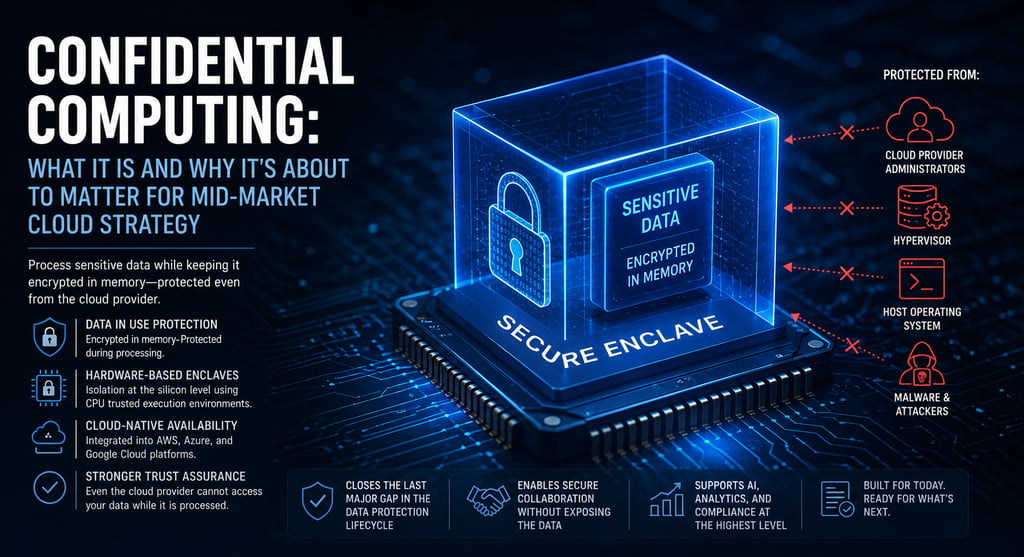
Data security architecture has historically addressed two states: data at rest, protected by storage encryption, and data in transit, protected by transport encryption such as TLS. Data in use — the state where data is actively being processed in a system's memory — has remained largely unprotected, because processing data requires decrypting it, and decrypted data in memory is accessible to anyone with sufficient system-level access, including a compromised hypervisor, a malicious cloud administrator, or sophisticated memory-scraping malware.
Confidential computing addresses this gap. Using hardware-based trusted execution environments — secure enclaves built into modern CPU architectures — confidential computing allows data to be processed while remaining encrypted in memory, protected even from the operating system, the hypervisor, and the cloud provider's own infrastructure administrators. This closes the last major gap in the data protection lifecycle, and it is moving from a specialized enterprise capability toward mainstream cloud platform availability in 2026.
Confidential computing changes a foundational assumption of cloud security: that you must trust your cloud provider's infrastructure operators with access to your unencrypted data during processing. With confidential computing, that trust requirement is removed at the hardware level — even the cloud provider cannot access your data while it is being processed.
How confidential computing works
Confidential computing relies on hardware-based trusted execution environments implemented by CPU manufacturers — Intel Software Guard Extensions, AMD Secure Encrypted Virtualization, and ARM Confidential Compute Architecture. These technologies create isolated, encrypted regions of memory — enclaves — where code and data are protected from access by anything outside the enclave, including the host operating system and hypervisor.
When an application runs within a confidential computing enclave, the data it processes is encrypted in memory using keys that are managed by the hardware itself and never exposed to the host system. Even an attacker with root access to the underlying server, or a cloud provider employee with administrative access to the physical infrastructure, cannot access the data being processed within the enclave. The protection is enforced at the silicon level, not the software level — making it resistant to the categories of attack that compromise traditional software-based security controls.
Why this matters now
Confidential computing has been technically available since approximately 2015 but has remained a specialized capability used primarily by organizations with extreme security requirements — financial services firms processing the most sensitive transaction data, healthcare organizations with the strictest data protection mandates, and government agencies. Three developments are bringing it into mainstream relevance for mid-market organizations in 2026:
• Cloud provider platform integration: AWS Nitro Enclaves, Azure Confidential Computing, and Google Cloud Confidential VMs have made confidential computing capabilities available as standard configuration options rather than specialized infrastructure requiring custom deployment — significantly reducing the operational complexity of adoption
• AI and multi-party data collaboration: as organizations increasingly process sensitive data through third-party AI services, or collaborate on shared data analysis with partners who should not have access to each other's underlying data, confidential computing provides a technical mechanism for processing shared data without exposing the underlying data to any party — including the cloud provider hosting the computation
• Regulatory and contractual pressure: data protection regulations and increasingly sophisticated client security requirements — the kind of vendor security assessments addressed in this week's law firm case study — are beginning to specifically reference data-in-use protection as an expected control for organizations handling highly sensitive data categories
Practical use cases for mid-market organizations
The use cases where confidential computing delivers clear value for mid-market organizations in 2026 include:
• Sensitive data processing in shared cloud infrastructure: organizations processing highly sensitive data — financial records, health information, proprietary algorithms — in multi-tenant cloud environments gain hardware-level assurance that the data is protected even from the cloud provider's own infrastructure access
• Multi-party data analytics: organizations that need to combine data with partners, vendors, or clients for joint analysis — without exposing the underlying raw data to each other — can use confidential computing to process the combined dataset within an enclave that produces only the agreed-upon output, never exposing the source data
• AI model protection: organizations with proprietary AI models that represent significant competitive value can process inference within confidential computing enclaves to protect the model itself from extraction, even when running on third-party infrastructure
• Regulatory compliance for highly sensitive data categories: organizations in financial services, healthcare, and legal services handling data subject to the strictest regulatory protection requirements can use confidential computing to provide hardware-level evidence of data protection that exceeds what software-based controls alone can demonstrate
What adoption looks like in 2026
For most mid-market organizations, full confidential computing adoption across all workloads is not yet a near-term priority — the operational complexity and the relatively narrow set of workloads that genuinely require this level of protection mean that broad adoption is still primarily relevant to specific use cases rather than general infrastructure strategy. The practical 2026 approach is selective: identify the specific workloads processing your most sensitive data, or the workloads subject to the most stringent regulatory or contractual data protection requirements, and evaluate confidential computing adoption for those specific cases.
Cloud providers have made the technical barrier to entry significantly lower than it was even two years ago — for organizations with a specific sensitive workload, a confidential computing pilot is now achievable without the specialized infrastructure investment that adoption previously required. Sigma Technology Consulting evaluates confidential computing applicability as part of our cloud security architecture engagements. Contact us at sigmatechconsult.com to discuss whether your organization has workloads that warrant this level of protection.
Sigma Technology Consulting, Inc.
25 Years of Experience, Vetting & Procuring Technology Vendors
Contact Us
Support
© 2026. All rights reserved.