CYBERSECURITY Phishing in 2026: Why Traditional Email Security Is No Longer Enough and What Has Replaced It
6/16/20264 min read
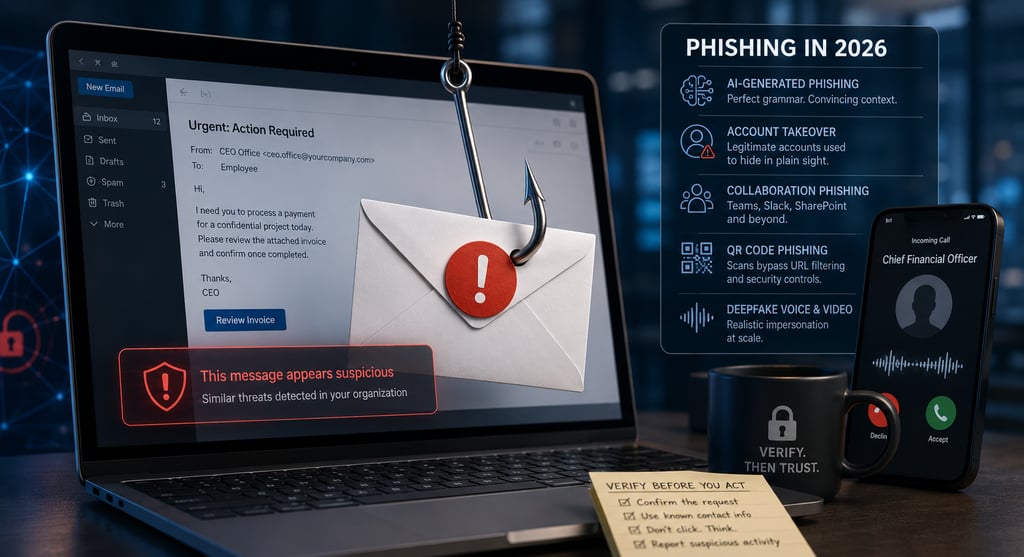
Phishing remains the most common initial access vector in cyberattacks — responsible for approximately 36 percent of confirmed breaches according to the 2025 Verizon Data Breach Investigations Report. But the phishing that security awareness training was designed to teach employees to recognize — poorly worded emails with suspicious links, impersonating Nigerian princes or package delivery services — represents an increasingly small fraction of the phishing attacks that organizations actually face in 2026.
Modern phishing has been transformed by AI, by the professionalization of the cybercriminal ecosystem, and by the shift of organizational communications from email to collaboration platforms. The email security architecture that most mid-market organizations put in place between 2018 and 2022 — secure email gateway, spam filtering, basic anti-phishing rules — is defending against a threat that no longer looks the way it did when those controls were designed. This post covers what has changed and what effective email and communications security looks like in 2026.
AI-generated phishing emails are now indistinguishable from legitimate communications written by native speakers. The grammatical errors and awkward phrasing that employees were trained to recognize as phishing indicators are gone. The volume of personalized, contextually appropriate phishing messages is now scalable to any target population because AI has eliminated the labor cost of crafting them.
What phishing looks like in 2026
The evolution of phishing has proceeded along three dimensions simultaneously — sophistication, targeting precision, and channel diversity:
• AI-generated spear phishing: large language models have made it trivial to generate contextually appropriate, grammatically perfect phishing emails tailored to a specific individual, referencing their actual role, their actual colleagues, their actual projects. The social engineering quality of AI-generated phishing significantly exceeds what human attackers could produce at scale, and the volume limitation that previously constrained spear phishing — it requires research and craft — is eliminated
• Business Email Compromise evolution: BEC attacks, in which attackers impersonate executives or vendors to redirect payments or extract sensitive information, have evolved from simple email spoofing to full account takeover. An attacker with access to a legitimate email account — obtained through a prior phishing or credential theft — conducts BEC attacks from the actual account, with actual email history, making them extremely difficult to detect through technical controls alone
• Collaboration platform phishing: Microsoft Teams, Slack, and similar platforms have become primary phishing vectors as organizations have reduced email communication in favor of messaging platforms. Teams messages from external organizations or compromised internal accounts, Slack DMs with malicious links, and SharePoint file sharing notifications are all active phishing channels that bypass email-focused security controls entirely
• QR code phishing: QR codes in emails and physical materials redirect victims to credential harvesting sites while bypassing URL reputation filtering, since the QR code itself is an image rather than a scannable link. QR phishing campaigns targeting Microsoft 365 credentials have been among the highest-volume phishing techniques in 2025
• Deepfake voice and video: AI voice cloning and video deepfake technology have made vishing — voice phishing — and video-based social engineering scalable. Audio deepfakes impersonating executives are being used in real-time phone calls to authorize wire transfers and credential resets
Why traditional email security is insufficient
Traditional secure email gateways work by scanning incoming messages for known malicious indicators: malware attachments, known phishing domains, suspicious link patterns, and sender reputation signals. These controls are effective against the commodity phishing campaigns that accounted for most email threats five years ago. Against modern phishing, their limitations are structural:
• AI-generated content produces no linguistic indicators that flag as suspicious — the text is fluent, contextual, and indistinguishable from legitimate communication
• BEC attacks conducted from legitimate, previously trusted accounts are not flagged by sender reputation systems
• Collaboration platform messages never touch the email security infrastructure
• QR codes bypass URL scanning because the malicious link is encoded in an image, not present as text
What effective anti-phishing looks like in 2026
The controls that provide meaningful protection against modern phishing require a layered approach that extends beyond email security:
• Phishing-resistant MFA: FIDO2 hardware security keys or passkeys are the only MFA methods that are resistant to real-time phishing attacks. SMS-based and authenticator app MFA can be bypassed by adversary-in-the-middle phishing proxies that capture one-time codes in real time. Deploying phishing-resistant MFA for all high-value accounts — executives, finance, IT administrators — significantly reduces the impact of successful phishing
• AI-powered email security: next-generation email security platforms — Abnormal Security, Proofpoint Aegis, Microsoft Defender for Office 365 Plan 2, Sublime Security — use behavioral AI rather than rule-based filtering. They establish baselines for normal communication patterns and flag anomalies: unusual senders, atypical requests, behavioral changes that indicate account compromise. These platforms detect the BEC and account takeover scenarios that traditional gateways miss
• Collaboration platform security: Microsoft Teams and Slack both have security controls — external access policies, message scanning, DLP integration — that are frequently misconfigured or left at default settings. Extending security policy to collaboration platforms is no longer optional
• Payment and wire transfer controls: procedural controls that require out-of-band verification for payment requests above defined thresholds address BEC attacks even when technical controls fail. A phone call to a known number to verify a wire transfer request is the most reliable control against AI-generated BEC
• Continuous security awareness training: training that is updated quarterly to reflect current attack techniques — including AI phishing, QR code attacks, and deepfake voice calls — rather than annual point-in-time training against outdated attack patterns
The threat has evolved. The controls need to evolve with it. Sigma Technology Consulting helps mid-market organizations assess and modernize their email and communications security architecture. Contact us at sigmatechconsult.com.
Sigma Technology Consulting, Inc.
25 Years of Experience, Vetting & Procuring Technology Vendors
Contact Us
Support
© 2026. All rights reserved.