
CYBERSECURITY The Password Is Dead: Why Passkeys and Passwordless Authentication Are the Security Upgrade Mid-Market Businesses Need Now
6/29/20264 min read
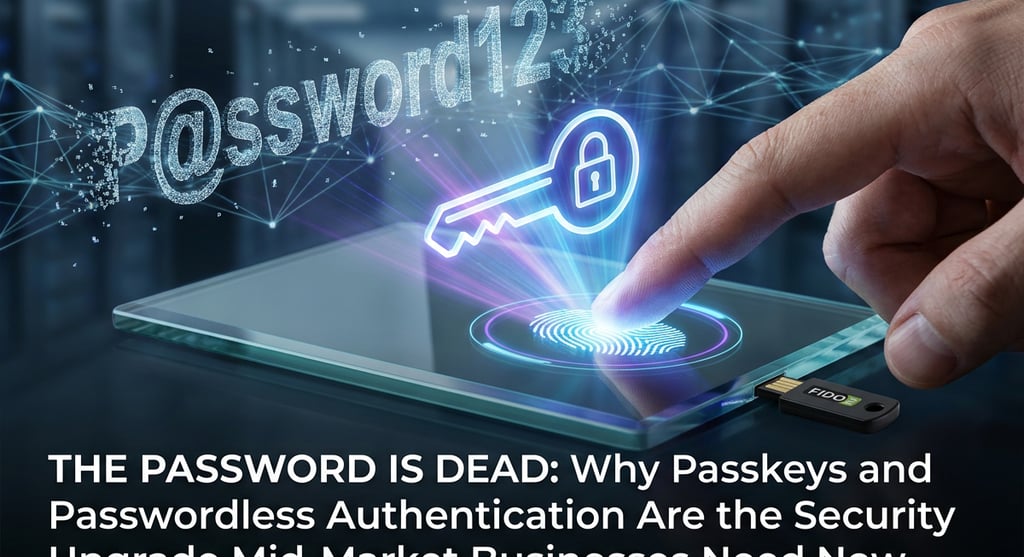
The password has been the primary authentication mechanism for enterprise computing since the 1960s. It has also been the primary attack vector for credential-based breaches throughout that entire period — a vulnerability that has been well understood, extensively documented, and largely unaddressed at the architectural level for decades. In 2026, that architectural solution is finally available, mature, and increasingly deployed at enterprise scale: passkeys and passwordless authentication built on the FIDO2 standard.
This is not an incremental improvement to password security. It is a replacement for the password as an authentication mechanism — one that eliminates the entire category of attacks that exploit password weaknesses, including phishing, credential stuffing, brute force, and password reuse. For mid-market organizations, deploying passkeys represents the single highest-impact authentication security improvement available in 2026, and the operational barriers to deployment have never been lower.
Eighty-six percent of breaches in 2025 involved stolen or weak credentials. Passkeys make credential theft structurally impossible for the authentication flows where they are deployed — not harder, not more expensive, not less likely. Structurally impossible. The credential does not exist in a form that can be stolen.
Why passwords are a structural vulnerability
The fundamental problem with passwords is that they are shared secrets — the same credential exists in two places simultaneously, in the user's memory and in the service provider's authentication system. This dual existence creates attack surface in both locations: the user's copy can be phished, guessed, or reused across services; the service provider's copy can be breached through a database compromise, exposing credentials at scale.
Multi-factor authentication addresses the single-factor weakness of passwords but does not eliminate the shared secret problem. SMS-based and authenticator app MFA can be bypassed by real-time phishing proxies that capture one-time codes mid-session, as detailed in our June 16 post on phishing evolution. Standard MFA improves security meaningfully but does not resolve the underlying architectural vulnerability that passwords represent.
How passkeys work
Passkeys use public key cryptography to replace the shared secret model with an asymmetric key pair. When a user creates a passkey for a service, their device generates a unique cryptographic key pair: a private key that never leaves the device and a public key that is registered with the service. Authentication is performed by the device signing a challenge with the private key — proving possession of the key without ever transmitting it or storing it on the service's servers.
The result: there is no shared secret to steal. The service never holds a credential that, if breached, would allow an attacker to authenticate as the user. The private key never leaves the device and cannot be phished — a phishing site cannot capture a credential that is never transmitted. And passkeys are bound to the specific domain they were created for, making cross-site credential reuse structurally impossible.
User verification — confirming that the person attempting to authenticate is the legitimate owner of the device — is handled by the device itself through biometrics or PIN, providing the equivalent of MFA in a single step that is faster and significantly more resistant to attack than traditional MFA methods.
The enterprise passkey landscape in 2026
Passkey support has reached mainstream availability across the major platform and identity ecosystems. Apple, Google, and Microsoft all support passkeys natively on their respective platforms and operating systems. The major identity providers — Okta, Microsoft Entra ID, Google Workspace, and Ping Identity — all support passkey authentication for enterprise deployments. The most widely used enterprise SaaS applications, including Microsoft 365, Salesforce, and GitHub, have deployed or are actively deploying passkey support.
For mid-market organizations, this means the ecosystem now supports a credible passkey deployment without requiring custom development or niche tooling. The identity provider that most mid-market organizations already use almost certainly supports passkeys — the question is whether passkey authentication has been enabled and deployed.
Implementation approach for mid-market organizations
A practical passkey deployment for a mid-market organization follows a phased approach:
• Phase 1 — high-value accounts: deploy passkeys for the highest-risk user population first — administrators, executives, finance team members, and anyone with access to sensitive systems or the ability to authorize financial transactions. This delivers the greatest immediate risk reduction while limiting the scope of initial deployment complexity
• Phase 2 — broad workforce deployment: extend passkey availability to the broader workforce, initially as an optional alternative to existing authentication and then as the default or required method. Modern device ecosystems handle passkey storage and sync automatically, minimizing the user experience friction that historically complicated authentication changes
• Phase 3 — legacy system migration: identify applications and systems that do not yet support passkeys and develop a migration timeline. For systems that cannot be updated, compensating controls — hardware security keys for FIDO2-capable applications, enhanced monitoring for systems limited to password authentication — address the residual risk while longer-term platform decisions are made
The operational case beyond security
Passkeys also address a significant operational cost that organizations rarely quantify: password management overhead. Password resets are the single most common helpdesk ticket category in most mid-market organizations, typically consuming 20 to 30 percent of helpdesk volume. A workforce using passkeys experiences essentially zero password-related helpdesk requests — the credential is managed by the device, syncs automatically across the user's registered devices, and cannot be forgotten in the way a password can.
The productivity case compounds with the security case: passkey authentication is faster than typing a password and completing an MFA step, reducing login friction for every authentication event across the workday. At scale, this is a measurable productivity improvement that makes the security upgrade also an operational one.
Sigma Technology Consulting helps mid-market organizations plan and implement identity modernization, including passkey deployment strategy. Contact us at sigmatechconsult.com to discuss your current authentication architecture.
Sigma Technology Consulting, Inc.
25 Years of Experience, Vetting & Procuring Technology Vendors
Contact Us
Support
© 2026. All rights reserved.