
Data Center Power Constraints: Why Grid Capacity, Not Cooling, Is the Next Bottleneck
7/16/20264 min read
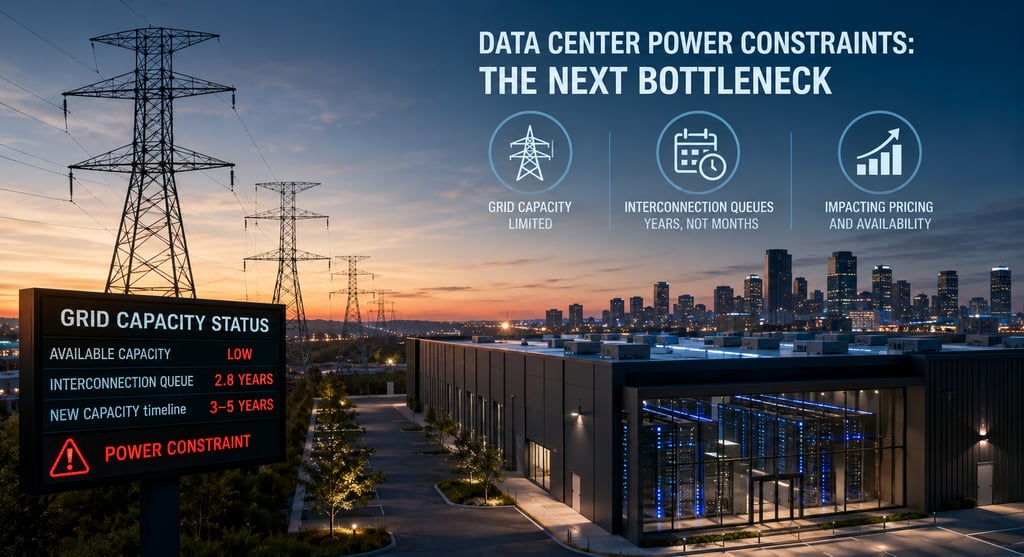
Cooling gets most of the attention in conversations about AI-driven data center demand, and for good reason. But a quieter constraint is starting to matter just as much for mid-market companies shopping for colocation space: whether a facility can actually get enough power from the local grid to support it. In several major data center markets, the wait to secure new grid interconnection capacity now stretches years, not months, and that scarcity is reshaping colocation pricing and availability well beyond the AI workloads driving the demand.
This is a different kind of constraint than the cooling story most technology coverage has focused on. Cooling limits how much a given facility can support once it has power. The interconnection queue limits whether new facilities, or new capacity at existing ones, can get built at all, regardless of how sophisticated their cooling design turns out to be.
The Interconnection Queue Problem
Building a new data center, or significantly expanding an existing one, requires securing enough power capacity from the regional utility or grid operator. In high-demand markets, requests for new large-load interconnections have piled up faster than utilities can study and approve them, creating queues that stretch years in some regions. A data center operator can have the capital, the land, and the customer demand ready to go, and still be stuck waiting for grid capacity that simply isn't available yet.
This queue dynamic didn't exist in any meaningful way five years ago. It's a direct consequence of a surge in large-load requests concentrated in a handful of markets, driven heavily by AI training and inference infrastructure, arriving at a pace utility planning cycles were never built to absorb quickly.
Utilities themselves face a genuine planning challenge here, since approving a large-load interconnection request commits regional grid infrastructure for decades, and utilities have every incentive to study these requests carefully before committing, which is precisely why the queue has grown rather than simply been cleared faster. Speeding up the process meaningfully would require transmission and substation investment that also takes years to plan and build, creating a structural lag that isn't likely to resolve quickly regardless of how much political or commercial pressure builds around it.
Why This Affects Companies With No AI Workloads at All
A mid-market company that simply needs standard colocation space for ordinary business systems is not competing for power in the same sense a hyperscale AI facility is. But the two are increasingly competing for the same underlying scarce resource inside the same facilities and the same regional grids. A colo provider deciding how to allocate limited available power capacity across a facility has a strong incentive to prioritize large, long-term AI-related commitments over smaller standard customers, and pricing for the remaining standard capacity reflects that scarcity even when the customer using it has nothing to do with AI.
In markets where interconnection queues are longest, this is starting to show up as longer lead times for provisioning new colocation space, less negotiating leverage for smaller customers, and renewal pricing that reflects a facility's genuine power scarcity rather than simply the cost of running it.
It's a dynamic that rewards companies willing to plan further ahead than the industry has historically required. A colocation decision that used to be a three-to-six-month process, from initial evaluation to signed contract, increasingly benefits from starting closer to twelve months out in constrained markets, simply to leave enough runway to evaluate multiple facilities' actual power status rather than accepting the first available option under time pressure.
What This Means for Site Selection
Mid-market companies evaluating new colocation relationships increasingly need to ask a question that used to be irrelevant: what is the actual grid interconnection status of this specific facility, not just its advertised capacity. A facility with power already secured and available is a fundamentally different, more valuable commitment than one still waiting in an interconnection queue, even if both are marketed with similar specifications today.
This also argues for geographic diversification in site selection. Markets with long-established grid infrastructure and less concentrated AI-driven demand are seeing far less of this scarcity dynamic, and a facility in one of those regions may offer more predictable pricing and availability than a comparable facility in a market where interconnection queues have become a genuine bottleneck.
The Renewal Conversation Is Changing Too
Companies already established in a supply-constrained market face a different version of this problem at renewal time. A provider that knows its facility sits in a power-constrained region, with a long interconnection queue behind any request for additional capacity, has less incentive to compete aggressively on price, since a departing customer's space can likely be backfilled at a premium by a larger commitment waiting for exactly that capacity to open up. This dynamic is genuinely new relative to just a few years ago, when colocation markets in most regions had enough available capacity that customers held meaningfully more negotiating leverage at renewal by default.
The Questions Worth Asking Before the Next Renewal or New Contract
Before committing to a new colocation agreement or renewing an existing one, it's worth asking directly whether the facility's current power capacity is fully secured or partially dependent on pending grid interconnection approval, how the provider is prioritizing capacity allocation as demand grows, and whether the facility has a documented plan for expanding power capacity that goes beyond a general statement of intent. A provider with clear, specific answers is a meaningfully safer long-term commitment than one offering vague reassurance.
The Broader Pattern
Power availability joining cooling capacity as a genuine constraint on data center growth is a structural shift, not a temporary blip that resolves once a few large projects finish construction. Grid infrastructure upgrades take years to plan and build, and demand from AI infrastructure shows no sign of slowing enough to let interconnection queues clear quickly. Mid-market companies that treat colocation site selection as a simple price comparison, without factoring in the underlying power reality of a specific facility, risk locking into a relationship that becomes progressively less favorable as the surrounding market tightens.
The practical response isn't panic, it's due diligence that now includes a question most technology buyers have never had to ask before: not just what a facility costs today, but whether the power behind it is actually secured, or simply promised.
Sigma Technology Consulting, Inc.
25 Years of Experience, Vetting & Procuring Technology Vendors
Contact Us
Support
© 2026. All rights reserved.