
Edge Computing in 2026: What It Is, Who Actually Needs It, and What It Costs to Deploy
5/29/20264 min read
Edge computing has been on technology trend lists for several years. For much of that time, it was a concept looking for applications — a solution in search of a problem that most organizations did not yet have at the scale required to justify the investment. In 2026, that has changed. Specific use cases have matured, deployment costs have declined, and the convergence of AI inference, IoT device proliferation, and 5G connectivity has created genuine edge computing requirements across a broader range of mid-market industries than at any previous point.
This post is not a marketing document for edge computing. It is a framework for evaluating whether your organization has a legitimate edge computing requirement — and if so, what deployment looks like in terms of architecture, cost, and operational complexity.
Edge computing is not the right answer for most workloads. It is the right answer for workloads that have specific latency, bandwidth, or data sovereignty requirements that centralized cloud architecture cannot meet. Understanding which workloads those are — and whether you have any of them — is the starting point for any serious edge evaluation.
What edge computing actually is
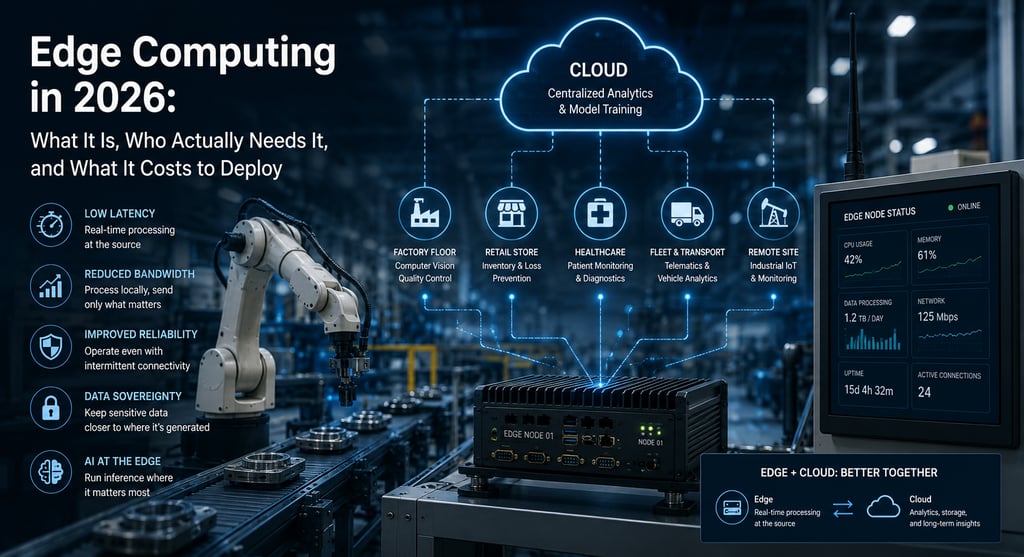
Edge computing refers to processing data at or near the source of its generation, rather than sending it to a centralized cloud or data center for processing. The computing infrastructure is physically located at the edge of the network — on a factory floor, in a retail store, in a hospital, in a vehicle, at a cell tower — where data is generated and where low-latency responses are required.
The distinction from cloud computing is not architectural philosophy but physical proximity. Cloud computing centralizes processing. Edge computing distributes it. The two are not mutually exclusive — most edge architectures use the cloud for centralized analytics, model training, and data aggregation, while edge nodes handle real-time processing where latency or bandwidth constraints make cloud processing impractical.
The workloads that genuinely require edge computing
The use cases where edge computing delivers value that centralized cloud architecture cannot match share a common characteristic: they require processing that is either time-critical, bandwidth-constrained, or data-sovereignty-sensitive in ways that make a round trip to the cloud impractical or non-compliant.
• Manufacturing quality control and process automation: computer vision systems inspecting products at line speed require sub-10 millisecond response times. A camera capturing 60 frames per second cannot wait for a cloud round-trip — typical cloud latency of 50 to 150 milliseconds is six to fifteen times too slow for real-time inspection at production speed
• Retail inventory and loss prevention: in-store computer vision for inventory tracking and loss prevention generates significant video data volumes that are prohibitively expensive to send to the cloud for processing. Edge processing handles video analytics locally and sends only structured data — inventory counts, alert events — to cloud systems
• Healthcare at the point of care: medical devices and diagnostic equipment generating patient data in clinical settings face both latency requirements for real-time monitoring and data sovereignty requirements for patient data that make local processing preferable to cloud transmission
• Connected vehicle and fleet management: vehicles generating telematics, navigation, and safety data require real-time local processing for safety-critical functions. Cloud connectivity for non-critical analytics supplements but cannot replace local processing for functions where latency tolerance is measured in milliseconds
• Oil, gas, and utilities field operations: industrial sensors in remote locations with limited or intermittent connectivity require local processing capability. Edge nodes buffer and process data locally, syncing with central systems when connectivity is available
The workloads that do not need edge computing
For most business applications — ERP, CRM, UCaaS, collaboration platforms, financial systems, HR platforms — the latency of cloud processing is entirely adequate. A user submitting a purchase order does not require sub-10ms response time. An employee joining a video call tolerates 150 to 200ms of latency without degraded experience. These workloads belong in the cloud. Adding edge infrastructure to support them adds cost and complexity without adding value.
The filter is straightforward: if your workload's users or systems can tolerate 50 to 150 milliseconds of processing latency without functional or safety impact, cloud architecture is the right model. Edge computing is for the workloads where that latency is genuinely unacceptable.
What edge deployment actually costs in 2026
Edge computing deployment costs have declined significantly as the hardware ecosystem has matured. The primary components of an edge deployment are: edge compute nodes, edge software and orchestration platform, connectivity infrastructure connecting edge nodes to cloud or central systems, and ongoing management and monitoring overhead.
Edge compute hardware has converged around several form factors. Rack-mounted edge servers for industrial environments run $8,000 to $25,000 per node depending on compute and GPU requirements. Compact industrial PCs for retail and commercial environments run $1,500 to $6,000 per node. Hyperscaler edge offerings — AWS Outposts, Azure Stack Edge, Google Distributed Cloud Edge — provide managed edge infrastructure at monthly pricing that ranges from $3,000 to $15,000 per month per node depending on compute tier.
For a mid-market manufacturing operation deploying edge at five production lines, total first-year deployment cost — hardware, software licensing, connectivity, and implementation — typically runs $120,000 to $280,000. Ongoing annual operating cost runs $40,000 to $80,000. The business case requires quantifying the value of the specific capability being enabled: defect reduction, throughput improvement, downtime prevention, or compliance requirement fulfillment.
How to evaluate whether edge is right for your organization
Start with the workload requirement rather than the technology. Identify the specific application or process that has the latency, bandwidth, or sovereignty requirement driving the edge consideration. Quantify what the consequence of that requirement not being met currently costs the business — in defects, downtime, compliance exposure, or operational inefficiency. Then compare that cost against the total cost of ownership of an edge deployment sized to address it.
If the business case is positive and the workload requirement is genuine, edge computing in 2026 is more accessible and cost-effective than at any previous point. If the business case does not hold, cloud architecture almost certainly serves your needs adequately — and at a fraction of the complexity. Sigma Technology Consulting evaluates edge computing requirements as part of our infrastructure planning engagements. Contact us at sigmatechconsult.com to discuss whether your organization has a legitimate edge use case.
Sigma Technology Consulting, Inc.
25 Years of Experience, Vetting & Procuring Technology Vendors
Contact Us
Support
© 2026. All rights reserved.