FinOps in Practice: How to Build a Cloud Cost Governance Program That Actually Sticks
6/9/20264 min read
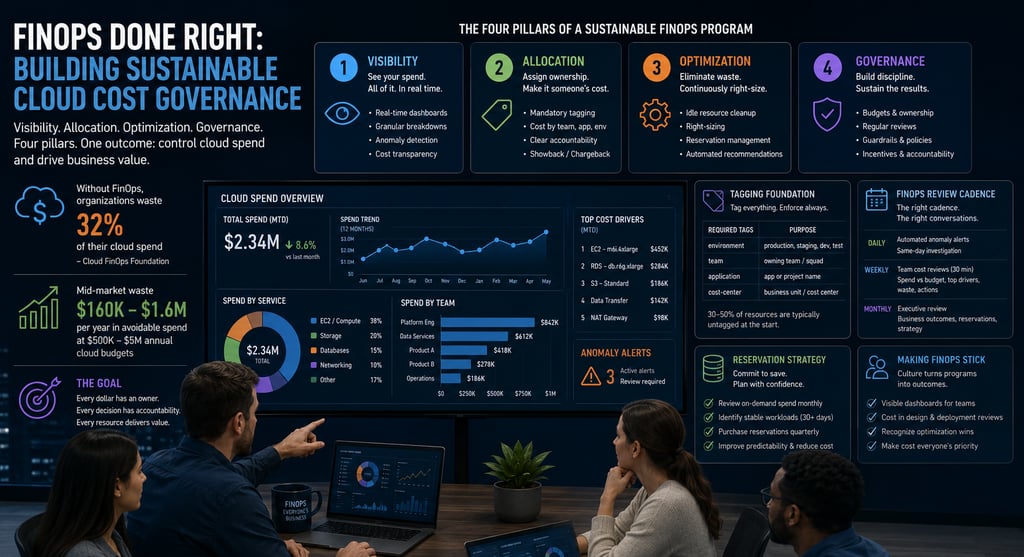
FinOps — the practice of bringing financial accountability to cloud spending — has moved from a niche discipline practiced by large cloud-native companies to a mainstream business requirement for any organization spending meaningfully on AWS, Azure, or GCP. The Cloud FinOps Foundation estimates that organizations without active FinOps practices waste an average of 32 percent of their cloud spend. At mid-market cloud budgets of $500,000 to $5 million annually, that waste represents $160,000 to $1.6 million per year sitting in avoidable spend.
The problem is not that organizations are unaware that cloud costs need to be managed. Most are. The problem is that cloud cost governance programs — the processes, tooling, and organizational structures that translate FinOps principles into consistent behavior — are difficult to implement and even harder to sustain. Organizations start them in response to a budget crisis, see some improvement, and then watch governance erode as engineering teams revert to convenience-driven provisioning patterns. This post is about building a FinOps program that persists.
Cloud cost governance fails not because the economics are unclear but because accountability is unclear. When nobody owns a cloud resource, nobody is accountable for its cost. The first and most important step in any FinOps program is assigning ownership — of accounts, of workloads, of cost centers — so that every dollar of cloud spend has a named owner.
The four pillars of a sustainable FinOps program
Sustainable cloud cost governance rests on four interconnected pillars that must all be in place for the program to produce consistent results:
• Visibility: comprehensive, real-time visibility into cloud spend by account, service, team, and workload. Without accurate, current cost data broken down at meaningful levels of granularity, governance is guesswork. Cloud provider native tools — AWS Cost Explorer, Azure Cost Management, GCP Billing Console — provide baseline visibility. Third-party FinOps platforms — CloudHealth, Apptio Cloudability, Spot.io — provide more sophisticated allocation, anomaly detection, and optimization recommendations
• Allocation: tagging all cloud resources with metadata that identifies the owning team, application, environment, and cost center. Tagging is the mechanism by which cost visibility translates into cost accountability — without it, you know the total but not who is responsible for what. A tagging policy defined at the organizational level and enforced at the provisioning layer is the prerequisite for meaningful allocation
• Optimization: an ongoing process of identifying and eliminating waste — idle resources, over-provisioned instances, unused reservations, orphaned storage — and right-sizing active resources to match actual utilization. Optimization is not a one-time project; it is a continuous practice that requires dedicated time and tooling. Automated optimization tools can address the most straightforward waste categories — instance right-sizing, idle resource detection — without engineering intervention
• Governance: the organizational structures, processes, and incentives that ensure cost discipline is maintained over time. This includes defined budget owners for each team and workload, a regular cadence of cost reviews, anomaly alerting that triggers human review when spend deviates from expectations, and engineering standards that include cost considerations alongside performance and reliability requirements
Building the tagging foundation
Tagging is the unglamorous prerequisite that everything else depends on. A practical tagging policy for mid-market organizations should require at minimum: environment tag (production, staging, development, test), team or owner tag, application or project tag, and cost center tag. These four tags enable allocation of spend to the business units responsible for it and are the minimum required to have meaningful cost accountability conversations.
Implementing tagging retroactively on existing resources is a significant project that is best approached with automated tooling. AWS Config, Azure Policy, and GCP Organization Policies can enforce tagging requirements on new resources and identify existing untagged resources for remediation. Most organizations find that 30 to 50 percent of their cloud resources are untagged or inconsistently tagged at the start of a FinOps initiative — a finding that explains why cost allocation has been impossible.
The FinOps review cadence
Visibility and allocation provide the data. The review cadence is the organizational mechanism that converts data into action. A sustainable FinOps review cadence for mid-market organizations involves three layers: daily automated anomaly alerting that flags spend deviations greater than a defined threshold for same-day review; weekly team-level cost reviews where engineering teams examine their spend against budget and identify optimization opportunities; and monthly executive cost reviews where cloud spend is evaluated against business outcomes, reservations are assessed, and strategic infrastructure decisions are made.
The weekly team-level review is the most important and the most commonly skipped. Without regular team-level engagement, cost governance becomes an occasional finance initiative rather than an engineering discipline. The weekly review should be short — 30 minutes — and focused on a small number of specific metrics: spend versus budget, top cost drivers, waste identified, and optimization actions taken since last week.
Reservation strategy as a governance mechanism
Reserved instances and savings plans — discussed in detail in our May 19 post — are not only cost optimization tools. They are governance mechanisms. Committing to reserved capacity forces a conversation about workload stability and future requirements that on-demand provisioning never triggers. Organizations with active reservation strategies have materially better cost predictability than those operating entirely on on-demand pricing, because reservations create a financial stake in understanding and planning workload requirements.
A sustainable approach: review on-demand spend monthly, identify workloads with 30 or more days of consistent utilization, and evaluate reservation purchases on a quarterly cycle. This rhythm builds reservation coverage incrementally without requiring a large upfront commitment before usage patterns are understood.
Making FinOps stick
The governance programs that persist are the ones that make cloud cost a visible, shared concern rather than a background finance function. Visible cost dashboards accessible to engineering teams, cost included as a deployment review criterion alongside performance and security, and recognition for teams that achieve meaningful optimization — these cultural elements determine whether FinOps becomes embedded in how the engineering organization operates or remains an initiative that fades after the first budget cycle.
Sigma Technology Consulting helps mid-market organizations build FinOps programs from the ground up, including tagging policy design, tooling selection, and review cadence establishment. Contact us at sigmatechconsult.com to discuss your current cloud cost governance maturity.
Sigma Technology Consulting, Inc.
25 Years of Experience, Vetting & Procuring Technology Vendors
Contact Us
Support
© 2026. All rights reserved.