
How a 350-Person Professional Services Firm Eliminated Its Cybersecurity Blind Spots and Cut Security Spend 31%
5/28/20263 min read
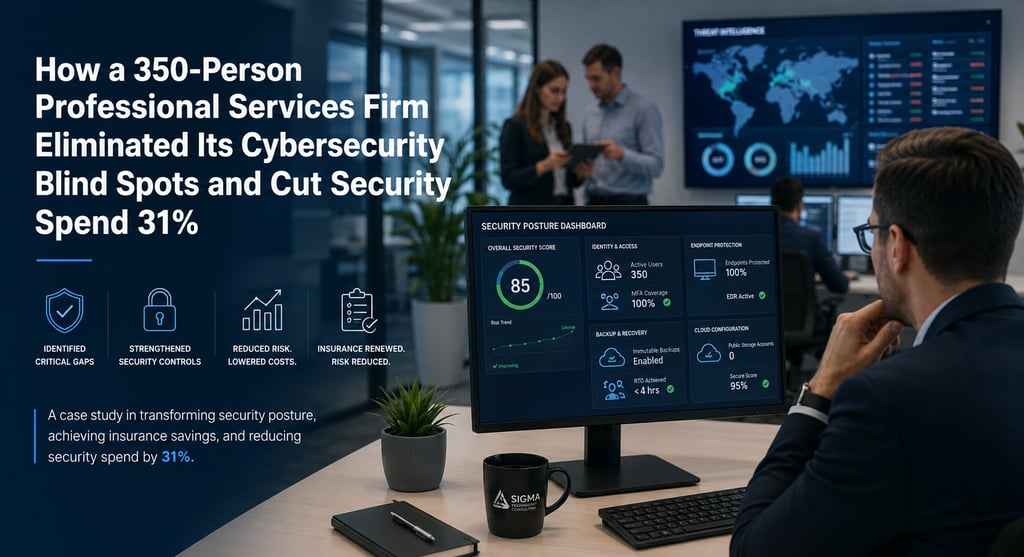

Professional services organizations — consulting firms, accounting practices, engineering companies, marketing agencies — share a cybersecurity profile that is both high-risk and chronically under-resourced. They handle sensitive client data. They operate distributed workforces with significant remote access requirements. They maintain long-term access to client systems and networks. And they typically have IT teams that are sized for operations and helpdesk support, not for proactive security management.
The client in this case study is a management consulting firm with 350 employees across five offices. They came to us not in response to an incident — but because their cyber insurance carrier had flagged specific security control gaps during their annual policy renewal and indicated that coverage would either be significantly restricted or repriced unless those gaps were addressed within 90 days. The pressure was external, the timeline was fixed, and the scope of what needed to change was unclear.
The cyber insurance market has become, inadvertently, one of the most effective drivers of mid-market security improvement. When a carrier tells a CFO that coverage depends on implementing MFA, immutable backup, and EDR within 90 days, those controls get implemented faster than any internal security recommendation ever could.
The security assessment findings
We began with a full security posture assessment covering identity and access management, endpoint security, network architecture, cloud security configuration, backup and recovery, and vendor/third-party access. The findings:
• Identity and access: MFA was enforced for the primary Microsoft 365 environment but not for the firm's project management platform, its client portal, its document management system, or its VPN. Of 350 active user accounts, 31 belonged to former employees — including three with administrative privileges
• Endpoint security: the firm was running a traditional antivirus solution across all endpoints. No EDR platform was deployed. 23 percent of endpoints were running operating system versions that had exceeded Microsoft's end-of-support date and were no longer receiving security patches
• Cloud security: the firm's Azure environment had 14 storage accounts with public access enabled — a misconfiguration from the original deployment that had never been remediated. Several service accounts had owner-level permissions across the entire subscription
• Backup and recovery: daily backups were running to a network share on the primary domain. No immutable or offsite backup existed. The recovery time from the existing backup in a full-environment failure scenario was estimated at 72 to 96 hours — well beyond the four-hour RTO documented in the DR plan
• Third-party access: six vendors had standing remote access to the firm's environment with no time-limited or just-in-time access controls. Two of these vendor accounts had not been used in over 18 months but remained active with full access
The remediation — scoped to the insurance requirement and beyond
We structured the remediation in two phases. Phase one addressed the specific controls required by the insurance carrier within the 90-day window: universal MFA enforcement across all applications, EDR deployment across all endpoints, immutable cloud backup implementation, decommissioning of former employee accounts, and remediation of the public Azure storage configurations. This phase was completed in 67 days.
Phase two, completed over the following 60 days, addressed the broader security posture: OS upgrade and patch management standardization, right-sizing of cloud service account permissions, implementation of just-in-time access controls for vendor and third-party access, and a formal access recertification process to ensure the identity inventory stays current on a quarterly basis.
The financial outcome
The cyber insurance carrier renewed the policy at a 14 percent premium reduction — reflecting the improved security posture — rather than the 38 percent increase that had been indicated before remediation. Annual premium savings: $47,200. The security tooling rationalization that accompanied the EDR deployment also allowed the firm to consolidate and eliminate redundant security products: three separate endpoint protection tools, an email security gateway that was superseded by Microsoft Defender for Office 365 already included in their existing M365 licensing, and a standalone password management tool that was replaced by Azure AD functionality they were already paying for.
Total annual security spend reduction: 31 percent, or $84,600 per year. Total one-time remediation cost: $38,000. Net first-year savings after remediation cost: $46,600. Ongoing annual savings: $84,600.
The strategic outcome
Beyond the financial results, the engagement produced a security posture that the firm's leadership characterized as the first time they had a clear, comprehensive picture of what their actual security environment looked like. The access inventory, the cloud configuration review, and the backup assessment surfaced risks that had been invisible — not because they were hidden, but because no one had ever looked systematically.
Professional services firms with client data obligations, vendor access relationships, and distributed workforces are among the highest-priority targets for cybersecurity assessment. If your firm has not had a formal security posture review in the past 12 months, contact Sigma Technology Consulting at sigmatechconsult.com.
Sigma Technology Consulting, Inc.
25 Years of Experience, Vetting & Procuring Technology Vendors
Contact Us
Support
© 2026. All rights reserved.