
How a Regional Grocery Chain Modernized Its Store Network and Cut Connectivity Costs 44%
6/11/20263 min read
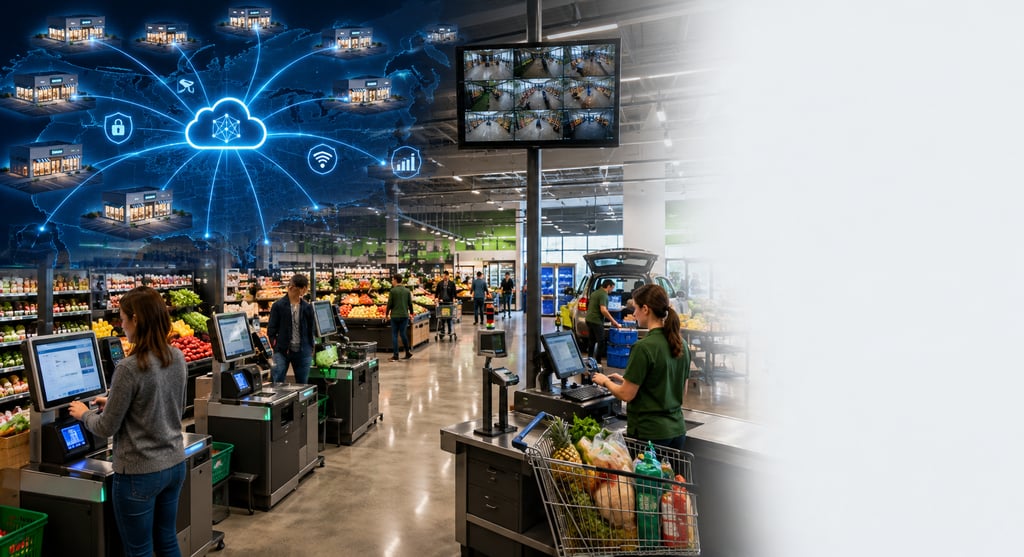

Grocery retail has some of the most demanding network requirements in the mid-market: point-of-sale systems that cannot tolerate downtime during business hours, loyalty and inventory applications with real-time cloud synchronization requirements, digital signage, loss prevention cameras, self-checkout kiosks, and increasingly, click-and-collect fulfillment systems that require tight integration between in-store and e-commerce platforms. All of this runs over the store's network connectivity — and in most regional grocery operations, that connectivity was last evaluated when the store was built or last remodeled.
The client in this case study is a regional grocery chain operating 38 locations across two states. Average store size: 42,000 square feet. Total employees: approximately 1,400. They came to us with a specific complaint: connectivity outages at multiple locations were disrupting point-of-sale operations with increasing frequency, and the IT team's response to each outage was reactive and inconsistent. They suspected the underlying issue was infrastructure, not operations. They were right.
Grocery is one of the most connectivity-dependent retail formats — and one of the most historically underinvested in network infrastructure. The combination of mission-critical POS dependency, high transaction volume, and store networks built on five-to-ten-year-old circuits creates exactly the conditions where connectivity failures are frequent, expensive, and entirely preventable.
The audit: mapping connectivity across 38 locations
We conducted a full connectivity audit across all 38 locations, reviewing every circuit contract, every carrier relationship, and every incident log for the prior 18 months. The findings were consistent across the estate:
• Circuit technology: 31 of 38 locations were running on bonded DSL or legacy MPLS circuits provisioned between 2016 and 2019. Bonded DSL, which aggregates multiple DSL lines for bandwidth, was the predominant technology — appropriate for 2016 bandwidth requirements, significantly undersized for current POS, inventory, and digital signage demands
• Redundancy: 27 of 38 locations had single-circuit connectivity with no failover. When the primary circuit failed, the store went offline for POS processing until the carrier restored service — average restoration time per incident: 4.2 hours
• Carrier concentration: all 38 locations were served by a single carrier under a master agreement signed in 2018, with auto-renewal provisions that had already triggered once. The master agreement's renewal was 7 months away
• Bandwidth utilization: average bandwidth utilization at peak hours across the estate was 84 percent — operating near capacity, explaining the degraded POS performance during high-traffic periods independently of outage events
• Contract pricing: per-location monthly connectivity costs averaged $620. Current market for equivalent or superior broadband SD-WAN connectivity with dual-carrier redundancy: $280 to $360 per location per month
The solution architecture
The recommended architecture addressed the three core problems simultaneously: bandwidth adequacy, redundancy, and cost. The design: dual-carrier broadband SD-WAN at each location, with primary and secondary circuits from different carriers to ensure no single-provider outage could take a location offline. The SD-WAN overlay manages traffic prioritization — POS and inventory systems receive guaranteed bandwidth allocation, digital signage and general internet use work within remaining capacity.
The migration was sequenced by contract expiration date to minimize early termination liability. Locations within 90 days of circuit expiration were migrated first, with the carrier's renewal window used as the trigger for competitive re-procurement. For locations with longer remaining terms, we negotiated mid-term buyouts where the carrier provided buyout credits to retain the account on improved terms — a tactic that applied to 14 locations and eliminated most of the early termination exposure.
The outcome
Total monthly connectivity spend reduction: from $23,560 across 38 locations to $13,200 — a 44 percent reduction. Annual savings: $124,320. Connectivity-related POS incidents in the six months following full deployment: zero. Average store connectivity bandwidth headroom at peak hours: 62 percent — compared to 16 percent before the migration.
The IT director's comment at project close: "We spent two years reacting to outages. In six months we went from firefighting to having more bandwidth and redundancy than we knew what to do with — and spending less than before."
What grocery and multi-location retail operators need to know
The pattern above is representative of regional grocery and multi-location retail connectivity environments that were built or last upgraded between 2014 and 2019. The technology, pricing, and redundancy options available today are materially better than what existed when most of those environments were designed. If your store network runs on circuits more than five years old, has single-provider connectivity without failover, or has had recurring POS or application connectivity incidents, the economics and operational case for a refresh are almost certainly compelling.
Sigma Technology Consulting has specific experience with multi-location retail network environments, including POS connectivity requirements, SD-WAN deployment at retail scale, and carrier negotiation for large-location-count master agreements. Contact us at sigmatechconsult.com to discuss a connectivity audit for your store estate.
Sigma Technology Consulting, Inc.
25 Years of Experience, Vetting & Procuring Technology Vendors
Contact Us
Support
© 2026. All rights reserved.