INSIDER INSIGHTS — IT AUDIT The IT Audit Blind Spot: What Your Annual Technology Review Is Missing and What It Should Actually Cover
7/1/20264 min read
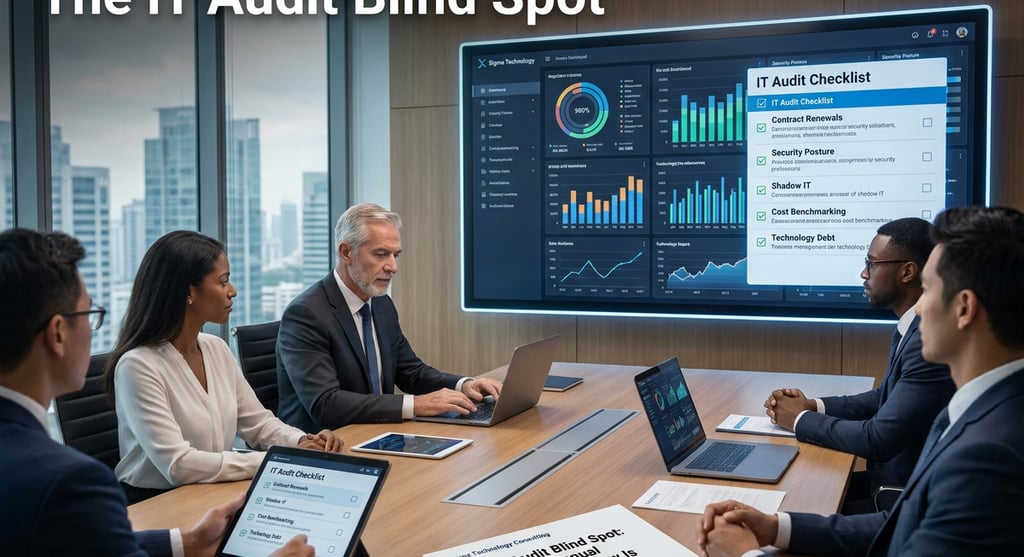
Most mid-market organizations conduct some form of annual IT review. The review covers the obvious items: hardware refresh needs, software license renewals, helpdesk performance metrics, major project status, and budget planning for the coming year. It produces a list of action items that gets partially addressed before the next annual review begins the cycle again. And it almost never surfaces the categories of information that would most significantly affect the organization's financial performance and risk profile.
Today's Insider Insights post covers the five dimensions that most annual IT reviews miss entirely — the gaps that compound silently between review cycles and that typically surface only when they have become expensive problems rather than inexpensive opportunities.
The annual IT review that most mid-market organizations conduct is a backward-looking status report. An IT audit that actually serves the organization's interests is a forward-looking risk and opportunity assessment — identifying what is about to become a problem and what could be optimized before someone else's renewal cycle or a security incident forces the conversation.
Blind spot 1: Contract renewal exposure
Most technology contracts in a mid-market organization — telecom, cloud, software licenses, managed services, colocation — contain auto-renewal provisions with notice windows of 30, 60, or 90 days. An IT review that does not include a complete contract inventory with upcoming renewal dates and notice windows is leaving the organization exposed to the single most common form of technology overspend: auto-renewal into above-market pricing because nobody identified the window in time to act.
A comprehensive contract renewal calendar — covering every vendor relationship with a recurring cost above a defined threshold — should be a standard deliverable of the annual IT review. The review should identify which contracts are within twelve months of renewal, flag the specific notice windows for each, and initiate competitive benchmarking for the highest-value contracts before the notice window closes. This is not complex. It is simply not done in most organizations.
Blind spot 2: Security posture delta since last review
Annual IT reviews rarely include a structured security assessment component. They may note that security awareness training was completed and that the firewall vendor's support contract was renewed. What they typically do not include: a review of user access permissions against current role requirements, an assessment of whether security controls deployed in the prior year are actually functioning as intended, a comparison of the current threat landscape against the controls in place, or an evaluation of whether the organization's cyber insurance application accurately reflects actual security posture.
Given that the threat landscape evolves continuously and that security control gaps accumulate through normal operational changes — new employees, new systems, system reconfigurations, vendor access additions — an annual review that does not include a structured security assessment is not evaluating a significant portion of the organization's operational risk.
Blind spot 3: Shadow IT and SaaS sprawl
The number of SaaS applications in use within a mid-market organization grows continuously as individual teams and departments adopt tools that solve immediate operational problems without IT involvement. Research consistently finds that IT-managed SaaS application inventories account for 30 to 50 percent of the applications actually in use — the remainder are unsanctioned, unreviewed, and unmanaged from both a security and a cost perspective.
The annual IT review should include a SaaS discovery exercise — using a CASB or identity provider access log review — to identify applications in actual use, not just applications IT knows about. The findings typically include both security exposure (unsanctioned applications with access to sensitive data, duplicate authentication systems, unreviewed data sharing permissions) and cost optimization opportunity (redundant subscriptions, unused licenses, overlapping capabilities across multiple paid tools).
Blind spot 4: Infrastructure utilization and cost benchmarking
Annual IT reviews rarely include a comparison of current technology costs against current market pricing. The contracts and pricing structures in place were set at a point in the past — sometimes years in the past — and the market for cloud compute, telecom, managed services, and software has moved. An annual review that does not include even a high-level market benchmarking exercise is not identifying the cost optimization opportunities that accumulate continuously as market pricing evolves.
This does not require a full vendor RFP process every year. It requires a periodic check: are our major recurring technology costs within a reasonable range of current market pricing for equivalent services? For contracts approaching renewal, the answer to this question determines whether a renegotiation effort is warranted. For contracts mid-term, it establishes the magnitude of the opportunity and informs timing decisions.
Blind spot 5: Technology debt accumulation
Technology debt — the accumulation of outdated systems, unsupported software versions, deferred upgrades, and architectural decisions that made sense at a previous scale but create operational and security risk at current scale — grows continuously and is rarely quantified in annual reviews. The review identifies that certain systems are aging. It rarely quantifies the risk those systems represent, the cost of the workarounds being maintained around them, or the increasing cost of deferring the upgrade compared to addressing it in the current budget cycle.
A technology debt register — a maintained list of known technical debt items with associated risk ratings, estimated remediation costs, and the increasing cost of deferral — is a standard practice in mature IT organizations and largely absent from mid-market IT programs. Building and maintaining this register as part of the annual IT review converts technology debt from an invisible accumulation into a managed liability with explicit financial implications.
What a comprehensive IT audit should produce
A comprehensive annual IT audit should produce five deliverables that the standard IT review does not: a complete contract renewal calendar for the coming twelve months; a security posture assessment against current threat landscape; a SaaS inventory comparing actual use against sanctioned applications; a technology cost benchmark for major recurring contracts; and an updated technology debt register with risk-adjusted remediation prioritization.
Together these deliverables give leadership the information needed to make technology investment decisions with clear financial and risk context rather than the backward-looking status reports that most annual IT reviews produce. Sigma Technology Consulting conducts IT audits for mid-market organizations that cover all five dimensions above. Contact us at sigmatechconsult.com.
Sigma Technology Consulting, Inc.
25 Years of Experience, Vetting & Procuring Technology Vendors
Contact Us
Support
© 2026. All rights reserved.