
Kubernetes in 2026: What Mid-Market Businesses Actually Need to Know Before Adopting Container Orchestration
6/1/20263 min read
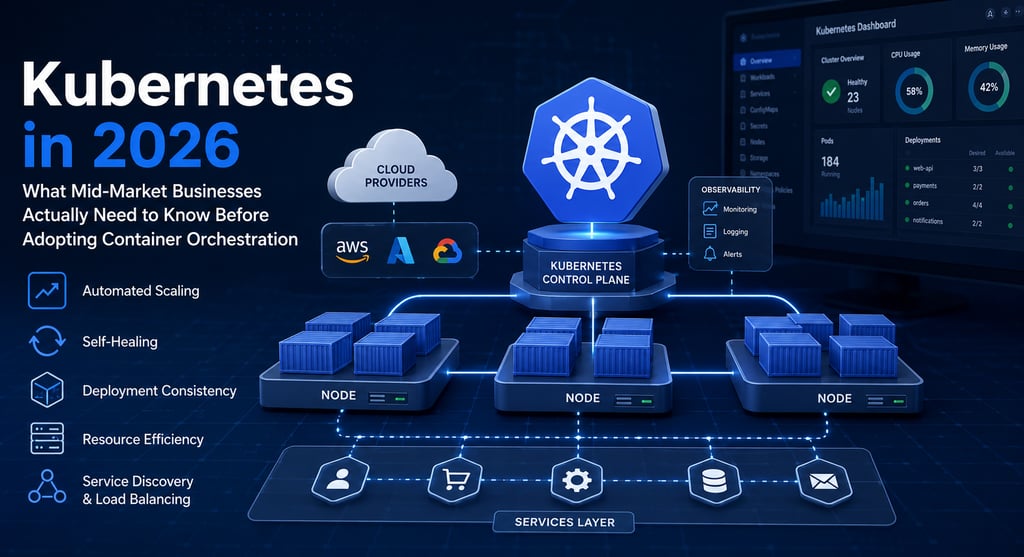
Kubernetes has become the default infrastructure conversation for organizations modernizing their application architecture. The container orchestration platform — originally developed at Google and now maintained as an open-source project under the Cloud Native Computing Foundation — is the foundation of virtually every major cloud-native application deployment. AWS, Azure, and GCP all offer managed Kubernetes services. Every major technology vendor has a Kubernetes integration story. And the platform has genuine capabilities that address real scalability, portability, and deployment consistency challenges.
The problem: Kubernetes is also one of the most operationally complex infrastructure technologies in widespread use. And the gap between the capabilities Kubernetes provides and the capabilities a given mid-market organization actually needs — right now, at their current scale and with their current team — is a gap that vendors are not incentivized to help you evaluate honestly.
This post is a framework for that honest evaluation: what Kubernetes actually solves, what it costs to operate, and how to determine whether your organization has a legitimate Kubernetes requirement or a solution looking for a problem.
Kubernetes is the right infrastructure platform for organizations running complex, multi-service applications at scale that require automated deployment, scaling, and self-healing. It is significant operational overhead for organizations running a handful of applications that could be served adequately by managed cloud services at a fraction of the complexity.
What Kubernetes actually solves
Kubernetes addresses a specific set of challenges that emerge when organizations run containerized applications at meaningful scale. The core capabilities:
• Automated scaling: Kubernetes monitors application resource consumption and automatically scales workloads up or down based on defined thresholds — eliminating manual intervention for load-driven scaling events
• Self-healing: when a container fails, Kubernetes automatically restarts it, reschedules it on a healthy node, and replaces unhealthy instances without manual intervention. Applications maintain availability without on-call engineers responding to individual container failures
• Deployment consistency: Kubernetes provides a consistent deployment model across development, staging, and production environments, eliminating environment-specific configuration drift that causes the classic it-works-on-my-machine failure mode
• Resource efficiency: Kubernetes bins workloads across available compute nodes to maximize resource utilization, reducing the compute waste that comes from provisioning dedicated servers or VMs per application
• Service discovery and load balancing: Kubernetes manages internal network routing between services automatically, enabling microservices architectures where dozens of services communicate without manual network configuration
What Kubernetes costs to operate
The capabilities above are genuine and valuable. The operational cost of delivering them is also genuine and is consistently underestimated in vendor discussions. Operating Kubernetes at a level that delivers its intended value requires:
• Kubernetes-certified engineers: running a production Kubernetes environment requires team members with specific Kubernetes expertise — cluster administration, networking, security configuration, storage management, and monitoring. Kubernetes certifications and experienced engineers command premium compensation. Hiring or developing this expertise is a meaningful investment
• Cluster overhead: Kubernetes control plane components consume compute resources that are dedicated to orchestration rather than application workloads. For small deployments, the overhead can represent 15 to 30 percent of total cluster compute cost
• Operational complexity: Kubernetes introduces a significant number of new abstractions, configuration surfaces, and failure modes that do not exist in simpler deployment models. Debugging a Kubernetes networking issue or a storage configuration problem requires expertise that differs substantially from traditional application troubleshooting
• Security hardening: default Kubernetes configurations are not production-secure. RBAC configuration, network policy definition, pod security standards, secrets management, and supply chain security for container images all require deliberate effort and ongoing maintenance
The managed Kubernetes alternative
AWS Elastic Kubernetes Service, Azure Kubernetes Service, and Google Kubernetes Engine all provide managed Kubernetes that abstracts away control plane management, reduces operational overhead, and integrates natively with cloud provider security, monitoring, and storage services. For organizations that have a legitimate Kubernetes requirement, managed services are almost always the right deployment model — they eliminate the most operationally intensive aspects of cluster management while preserving the application-layer benefits.
The cost comparison: a self-managed Kubernetes deployment on EC2 instances requires engineering time equivalent to 0.5 to 1.5 full-time engineers for cluster operations, depending on scale. EKS reduces that operational burden significantly, at a cost of approximately $0.10 per cluster per hour plus the underlying compute — typically $150 to $600 per month for the control plane at mid-market scale.
The honest evaluation framework
Before committing to Kubernetes, apply this filter to your actual situation. First, are you running containerized applications? Kubernetes orchestrates containers — if your applications are not containerized, Kubernetes is not your next step. Second, do you have more than a handful of services that need to scale independently? Kubernetes' complexity overhead is justified when you are managing dozens of services with different scaling requirements. For three to five services, managed cloud services or simpler container platforms like AWS Fargate deliver the operational benefits without the complexity. Third, do you have or can you hire the engineering expertise to operate it? Kubernetes without qualified operators is a liability, not a capability.
If your answers are yes, yes, and yes — Kubernetes, deployed on a managed service, is likely the right direction. If any answer is no, there is almost certainly a simpler path that delivers the availability and scalability you need without the operational overhead. Sigma Technology Consulting helps mid-market organizations evaluate cloud architecture decisions with honest TCO analysis. Contact us at sigmatechconsult.com to discuss your containerization strategy.
Sigma Technology Consulting, Inc.
25 Years of Experience, Vetting & Procuring Technology Vendors
Contact Us
Support
© 2026. All rights reserved.