
Liquid Cooling and the AI Compute Boom: What It Means for Your Data Center Contract
7/9/20264 min read
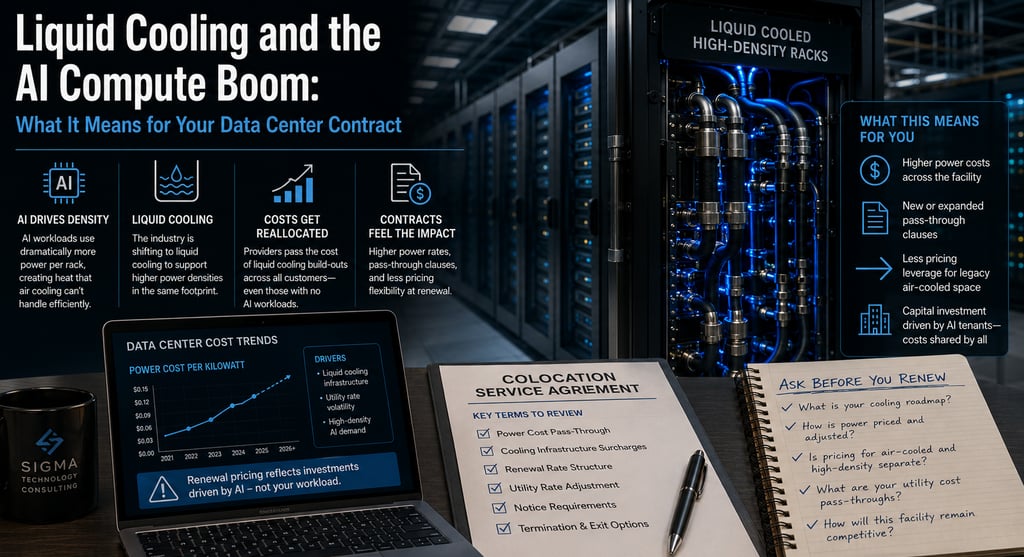
Most mid-market companies will never own a GPU cluster. That doesn't mean the AI compute boom isn't already showing up on their colocation invoice. As data centers race to retrofit for the power density that AI workloads demand, the economics of every colo contract, including the ones running ordinary business workloads with no AI in sight, are shifting underneath customers who haven't been told why.
It's an unusual position for a buyer to be in: absorbing the cost implications of a technology trend they have no direct involvement in, simply because they share a building with the companies driving it.
Why AI Workloads Broke the Old Cooling Model
Traditional data centers were built around air cooling and power densities that assumed a rack full of standard servers. AI training and inference hardware draws dramatically more power per rack, generating heat that air cooling systems were never designed to handle efficiently. The industry's answer has been a rapid shift toward liquid cooling, whether through direct-to-chip systems or full immersion, which can handle far higher power densities in the same physical footprint.
This isn't a niche upgrade happening at a handful of hyperscale facilities. Colocation providers across the country are retrofitting existing facilities or building new liquid-cooled capacity, and that capital investment doesn't stay isolated to the customers using it.
Retrofitting an existing facility for liquid cooling is also a significant undertaking, often requiring new plumbing infrastructure, redesigned rack layouts, and, in some cases, dedicated sections of a data center carved out specifically for high-density tenants. That capital doesn't get raised and deployed quietly, and providers are recovering it across their entire customer base, not just the tenants running the workloads that made the investment necessary in the first place.
How This Shows Up in a Contract That Has Nothing to Do With AI
Colo pricing has historically been driven by power draw and square footage. As providers build out liquid-cooled, high-density capacity to capture AI workloads, several things tend to happen to the rest of the facility. Power costs across the site can be reallocated in ways that raise per-kilowatt pricing for standard racks. Renewal terms increasingly include power cost pass-through clauses that didn't exist in older contracts, shifting risk from the provider to the customer as utility rates and cooling infrastructure costs rise. And providers investing heavily in AI-ready capacity have less incentive to compete aggressively on price for legacy air-cooled space, since their growth story and capital are pointed elsewhere.
A mid-market company running a handful of standard racks for ERP, backup, and internal applications can find itself absorbing a meaningful price increase at renewal, with the increase attributed vaguely to "infrastructure investment" rather than explained in terms the customer can actually evaluate.
The Questions Almost Nobody Asks Before Renewing
Before signing a colo renewal in this environment, it's worth asking the provider directly about their cooling roadmap for the facility: whether liquid cooling retrofits are planned, how power cost pass-through is calculated if it exists in the contract, and whether the pricing model separates legacy air-cooled capacity from new high-density space. A provider unwilling to answer clearly is itself useful information.
It's also worth understanding whether the current facility is on a growth path that will keep it competitive, or whether capital is flowing toward newer sites that will eventually make the existing facility a lower priority for maintenance and price competitiveness. Colocation is a long-term relationship, and a facility falling out of a provider's strategic focus tends to show up first in service quality and only later in an obvious way.
It's worth asking, too, how the facility's power costs are actually structured today versus how they're proposed to be structured in the renewal. A shift from a flat per-kilowatt rate to a variable, utility-linked pass-through clause can look like a minor contract change and turn into a meaningfully larger bill the first time regional utility rates spike, which is exactly the scenario many providers are pricing in as they absorb the capital cost of cooling retrofits. Getting this language reviewed before signing, rather than after the first unexpectedly high invoice, is consistently the cheaper path.
Infrastructure Arbitrage Still Works, But the Comparison Has Gotten Harder
The core discipline of infrastructure arbitrage, benchmarking a renewal against real market alternatives before accepting the incumbent's terms, still applies and still works. What's changed is that the comparison now needs to account for cooling architecture, not just price per kilowatt. A facility offering a lower headline rate on legacy air-cooled space may not be a meaningful alternative if it has no path to the power density modern workloads, AI-adjacent or not, increasingly require.
Companies with 100 or more employees running any meaningful on-premises or colocated infrastructure should treat this year's renewal cycle differently than the last one. The market is genuinely repricing around AI-driven demand, and providers negotiating renewals know it. Customers walking in without current market data are negotiating against a moving target they can't see.
What This Means If You're Considering Your Own AI Workloads
Some mid-market companies are starting to run their own smaller-scale AI workloads, whether fine-tuned models for internal tools or inference workloads supporting a customer-facing product. For any company in that position, the cooling question stops being background market context and becomes a direct procurement decision. Not every colo facility can support high-density racks today, and retrofitting one that can't is neither fast nor cheap. Confirming a facility's actual cooling capacity, not just its marketing materials, before committing to a multi-year contract avoids a much more expensive migration eighteen months later when the workload has already outgrown the space.
What to Do Before the Next Renewal
A market tape comparison across two or three alternative providers, reviewed alongside the current contract's power and cooling terms, gives a clear picture of whether a renewal price is reasonable or reflects a facility passing along costs from a build-out that has nothing to do with the customer's own workload. That comparison, done six to twelve months before a renewal date, is consistently the difference between negotiating from data and negotiating from whatever the incumbent proposes.
The broader lesson for mid-market technology leaders is that the AI compute boom doesn't stay contained to the companies buying GPUs. It reshapes the pricing and capacity decisions of every provider adjacent to it, and those changes arrive quietly, in renewal language, long before they show up in a headline about the cost of AI.
Sigma Technology Consulting, Inc.
25 Years of Experience, Vetting & Procuring Technology Vendors
Contact Us
Support
© 2026. All rights reserved.