
Multi-Cloud Strategy in 2026: When It Makes Sense, When It Doesn't, and How to Avoid the Traps
5/26/20263 min read
Multi-cloud — using two or more public cloud providers simultaneously for different workloads — has become one of the most discussed strategies in enterprise IT. According to recent industry surveys, more than 87 percent of large enterprises report using multiple cloud providers. The pitch is compelling: eliminate vendor lock-in, optimize each workload on the platform best suited to it, and create competitive leverage in provider negotiations.
The reality of multi-cloud in mid-market organizations is considerably more nuanced. For some organizations and specific use cases, multi-cloud delivers genuine strategic and economic value. For others — and this is the segment that rarely appears in vendor case studies — multi-cloud creates architectural complexity, operational overhead, and cost structures that significantly exceed the value it delivers. This post is about how to tell the difference.
Multi-cloud done strategically — matching each workload to the platform best suited to its requirements — is a sound architecture principle. Multi-cloud done reflexively — as a hedge against vendor lock-in that was never actually a risk — is an operational tax that compounds monthly.
When multi-cloud genuinely makes sense
There are specific scenarios where a multi-cloud approach delivers clear value that justifies its additional complexity:
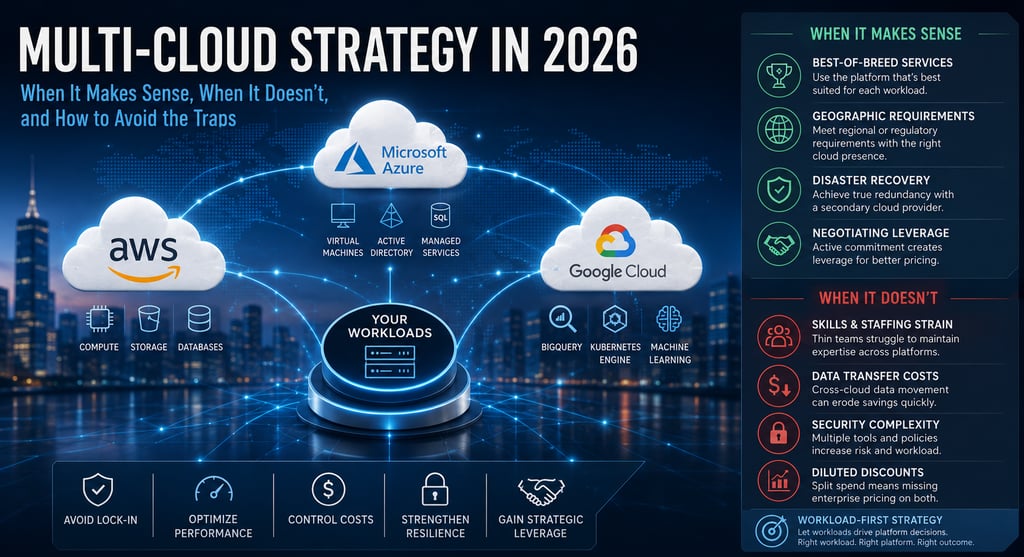
• Best-of-breed service selection: specific workloads have a clear winner across providers. Google Cloud's BigQuery for large-scale analytics, AWS for the broadest breadth of managed services, Azure for organizations deeply integrated with Microsoft 365 and Active Directory. When a critical workload has a clear platform advantage, using the best platform for that workload — rather than forcing everything onto a single provider — is sound architectural judgment
• Geographic coverage requirements: some markets or regulatory environments require cloud infrastructure in specific regions where only certain providers have a presence. A business with operations in markets where AWS has no compliant region but Azure does has a legitimate multi-cloud requirement
• Disaster recovery and redundancy: using a secondary cloud provider as a DR target for critical workloads provides genuine geographic and platform redundancy that a single-provider multi-region deployment cannot fully replicate. In regulated industries, this level of redundancy is increasingly a compliance requirement
• Negotiating leverage: an active, documented relationship with a competing cloud provider gives your primary provider a reason to offer enterprise pricing. This requires actual workload commitment on the secondary platform — not just an account — to be credible
When multi-cloud creates more problems than it solves
For mid-market organizations that do not have the specific scenarios above, multi-cloud strategy frequently creates the following problems:
• Skills and staffing overhead: operating effectively across multiple cloud platforms requires platform-specific expertise. AWS certifications do not translate directly to Azure expertise. Mid-market IT teams — typically two to eight people — are frequently spread too thin to develop deep competency on more than one platform, resulting in suboptimal configurations on both
• Data transfer costs: moving data between cloud providers generates egress fees on the sending platform and ingress processing on the receiving platform. Applications that span multiple cloud providers can generate data transfer costs that significantly exceed the per-workload savings from platform optimization
• Security posture complexity: each cloud platform has its own IAM system, security tooling ecosystem, and compliance reporting framework. Managing security posture across multiple platforms with different native tools multiplies the complexity and increases the probability of configuration gaps
• Negotiating leverage dilution: enterprise discount programs reward committed spend concentration. Splitting workloads across multiple providers to avoid lock-in frequently results in qualifying for enterprise discounts on neither platform — paying on-demand or near-on-demand rates on both
The hidden trap: multi-cloud as shadow single-cloud
The most common multi-cloud pattern we see in mid-market organizations is what we call shadow single-cloud: an organization that describes itself as multi-cloud has, in practice, 85 to 95 percent of its workloads on one provider and a small number of legacy or experimental workloads on a second. This pattern provides none of the strategic benefits of genuine multi-cloud — no negotiating leverage, no workload optimization, no redundancy — while generating all of the management overhead.
If this describes your current environment, the right question is not how to build out the secondary platform but whether the secondary workloads should be migrated to the primary platform to simplify operations and qualify for enterprise pricing.
Building a workload-first cloud strategy
The framework we recommend for mid-market cloud strategy starts with workloads rather than platforms. For each significant workload: identify the performance requirements, compliance constraints, geographic requirements, and integration dependencies. Then evaluate which platform best serves those requirements — including the total cost of ownership across compute, storage, egress, and support tiers. Let the workload requirements drive the platform decision, not the reverse.
This approach frequently results in a primary platform for the majority of workloads and a secondary platform for one or two specific workloads with clear platform advantages — a rational multi-cloud posture rather than reflexive provider diversification.
Sigma Technology Consulting helps mid-market organizations build cloud strategies grounded in workload economics rather than vendor marketing. Contact us at sigmatechconsult.com to discuss your current cloud architecture.
Sigma Technology Consulting, Inc.
25 Years of Experience, Vetting & Procuring Technology Vendors
Contact Us
Support
© 2026. All rights reserved.