
Quantum Computing and Cybersecurity: What Mid-Market Businesses Need to Know — and Do — Right Now
6/12/20264 min read
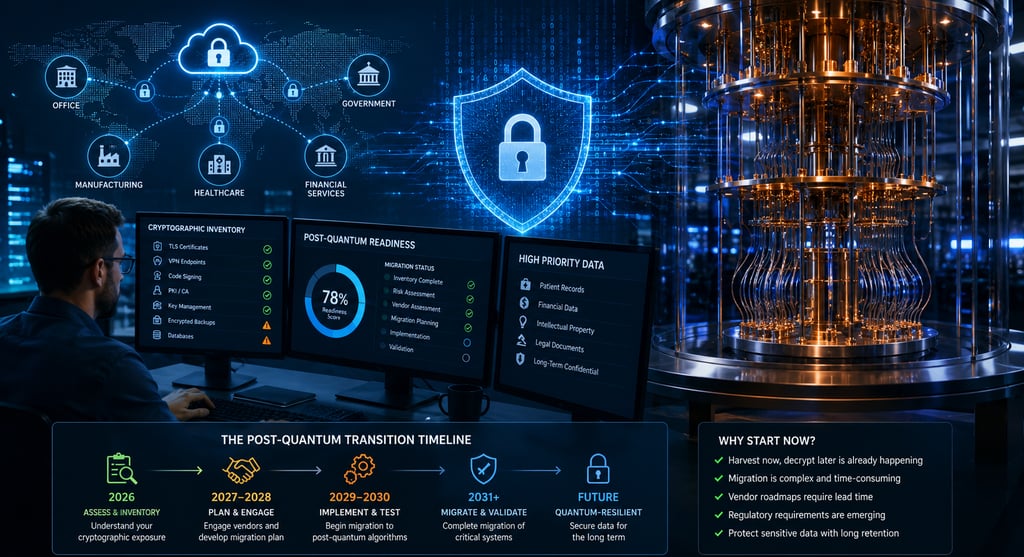
Quantum computing has been a fixture on technology trend lists for years — always promising, always five to ten years from practical relevance. That characterization is no longer accurate. While fault-tolerant quantum computers capable of breaking current encryption standards are not yet operational, the timeline to that capability has compressed significantly, and the cryptographic infrastructure that protects the data you transmit and store today is already exposed to a threat known as harvest now, decrypt later.
This post is not a prediction about when quantum computers will break RSA-2048. That timeline is genuinely uncertain — credible expert estimates range from five to fifteen years. This post is about the specific steps that mid-market organizations should be taking right now, in 2026, to ensure that their data and systems remain protected when that capability arrives — and why waiting until the timeline becomes clear is not a defensible strategy.
The harvest now, decrypt later threat is not theoretical. Nation-state actors are collecting encrypted internet traffic today — intercepting TLS-encrypted communications, VPN traffic, and file transfers — storing it, and waiting for the quantum capability to decrypt it in the future. Any data you transmit today that needs to remain confidential for five or more years is already at risk under this threat model.
Understanding the cryptographic threat
Current public-key cryptography — RSA, Elliptic Curve Cryptography, Diffie-Hellman key exchange — relies on the computational difficulty of specific mathematical problems that classical computers cannot solve efficiently at the key sizes in common use. Quantum computers running Shor's algorithm can solve these problems efficiently, rendering current asymmetric encryption theoretically breakable with sufficient quantum computing power.
Symmetric encryption — AES-256, for example — is substantially less vulnerable. Grover's algorithm provides a quadratic speedup against symmetric ciphers, which means that AES-256 would have the effective security of AES-128 against a quantum attacker. At 128-bit effective security, AES remains computationally infeasible to break even with quantum computing. The primary vulnerability is in the asymmetric cryptography used for key exchange and digital signatures — the infrastructure that underlies TLS, VPNs, PKI, and code signing.
What NIST has already decided
The National Institute of Standards and Technology finalized its first set of post-quantum cryptography standards in 2024. Three algorithms have been standardized: CRYSTALS-Kyber for key encapsulation, and CRYSTALS-Dilithium and SPHINCS+ for digital signatures. A fourth algorithm, FALCON, is also standardized for specific applications. These algorithms are designed to be secure against both classical and quantum attacks and are available for implementation today.
NIST's recommendation is explicit: organizations should begin planning their migration to post-quantum cryptography now, with a target of completing migrations for the most sensitive systems well before cryptographically relevant quantum computers arrive. The migration timeline for large organizations with complex PKI infrastructure is measured in years, not months — which is why planning needs to begin now even if operational quantum threat is still several years away.
What mid-market organizations should do in 2026
The action plan for mid-market organizations is proportionate to their actual risk profile — the sensitivity of the data they handle and the time horizon over which that data needs to remain confidential:
• Cryptographic inventory: identify where cryptographic algorithms are used in your environment — TLS certificates, VPN endpoints, code signing certificates, encrypted backup keys, database encryption, and application-level encryption. This inventory is the prerequisite for understanding migration scope and priority
• Identify high-sensitivity, long-retention data: data that is highly sensitive and needs to remain confidential for five or more years — patient records, financial data, intellectual property, legal documents — is the primary harvest-now-decrypt-later exposure. Identify it and assess the cryptographic protection currently in use
• Vendor and vendor product assessment: the cryptographic vulnerability is largely in the products and platforms you use, not in code you write. TLS implementations, VPN clients and gateways, certificate authorities, key management systems — all are on migration paths to post-quantum algorithms. Engage your vendors to understand their post-quantum roadmaps and timelines
• Prioritize crypto-agility: in any new system design or procurement, require that cryptographic algorithms are configurable rather than hardcoded — so that when post-quantum algorithms need to be deployed, the change is a configuration update rather than a code rewrite or platform replacement
• Monitor NIST and vendor guidance: the post-quantum standards landscape is still evolving. Staying current with NIST publications and vendor security advisories is the lowest-cost way to ensure your migration strategy remains aligned with current guidance
The regulated industry dimension
Organizations subject to HIPAA, PCI-DSS, FINRA, or federal contracting requirements should be aware that quantum-safe cryptography requirements are beginning to appear in regulatory guidance. NIST SP 800-131A, which governs federal agency cryptographic standards, now references post-quantum requirements. The DoD and federal civilian agencies have active migration programs. Regulated industries have historically followed federal cryptographic guidance with a lag of two to four years — meaning post-quantum requirements in regulated industry frameworks may arrive within the planning horizon of current infrastructure decisions.
The bottom line
Quantum computing is not an immediate operational threat to most mid-market businesses in 2026. It is a strategic planning requirement. The organizations that will navigate the post-quantum transition most effectively are the ones that understand their cryptographic exposure today, begin vendor engagement and cryptographic inventory work now, and build crypto-agility into new infrastructure decisions going forward. The cost of starting this work now is low. The cost of starting it after quantum capability arrives is potentially catastrophic for organizations handling sensitive long-retention data.
Sigma Technology Consulting advises mid-market organizations on post-quantum readiness assessment and cryptographic modernization planning. Contact us at sigmatechconsult.com to discuss your current cryptographic exposure.
Sigma Technology Consulting, Inc.
25 Years of Experience, Vetting & Procuring Technology Vendors
Contact Us
Support
© 2026. All rights reserved.