
Ransomware in 2026: Why Mid-Market Businesses Are the Primary Target and How to Harden Your Defenses
5/25/20264 min read

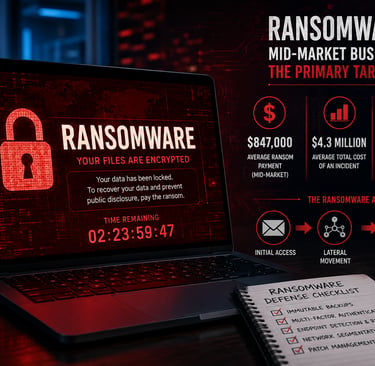
Ransomware has completed its evolution from an opportunistic criminal nuisance to a sophisticated, targeted industry. In 2025, ransomware groups generated an estimated $1.1 billion in extortion payments globally — and the organizations bearing the majority of that cost were not the large enterprises that appear in headlines. They were mid-market businesses: companies with 100 to 2,000 employees, meaningful data assets, and security programs that have not kept pace with the professionalization of the criminal ecosystem targeting them.
The economics are straightforward from an attacker's perspective. Large enterprises have incident response teams, cyber insurance with ransomware coverage, and security infrastructure that makes successful attacks expensive to execute. Small businesses often have nothing worth encrypting at scale. Mid-market businesses have the data worth holding for ransom, the revenue to pay it, and the security gaps that make entry achievable. They are the optimal target — and attack groups have organized their operations accordingly.
The average ransomware payment from a mid-market business in 2025 was $847,000. The average total cost of a ransomware incident — including downtime, recovery, reputational damage, and regulatory exposure — was $4.3 million. The average downtime before full operations resumed: 21 days.
How ransomware attacks actually work in 2026
Modern ransomware attacks follow a consistent playbook that has evolved significantly from the spray-and-pray email attachment campaigns of a decade ago. Today's attacks are targeted, patient, and multi-stage:
• Initial access: attackers gain entry through phishing emails with credential harvesting links, exploitation of unpatched vulnerabilities in internet-facing systems, compromise of remote desktop protocol endpoints, or purchase of valid credentials from initial access brokers on dark web markets
• Lateral movement: once inside, attackers spend an average of 21 days moving through the network before deploying ransomware — mapping systems, identifying backup infrastructure, escalating privileges, and exfiltrating data for double-extortion leverage
• Backup destruction: before deploying ransomware, sophisticated attackers identify and destroy or encrypt backup systems to maximize recovery leverage. Organizations whose backups are connected to the primary network and accessible with standard credentials routinely find their backups encrypted alongside their production data
• Double extortion: data is exfiltrated before encryption. The ransom demand covers both decryption and the threat of public data release — creating compliance exposure under HIPAA, GDPR, and state privacy laws that adds pressure beyond the operational disruption alone
The five most common entry points in mid-market ransomware attacks
Understanding how attackers get in is the prerequisite for hardening defenses effectively. In our security assessments, the entry points we most commonly find exposed in mid-market environments are:
• Unpatched internet-facing systems: VPN appliances, remote desktop gateways, and web application servers running firmware or software versions with known, publicly disclosed vulnerabilities. Attackers scan for these continuously and exploit them within hours of public disclosure
• Credential compromise via phishing: email-based credential harvesting remains the single most common initial access vector. Without MFA enforced on all applications, a single successful phish gives an attacker authenticated access to every system the victim can reach
• Third-party and vendor access: managed service providers, IT vendors, and contractors with remote access to client environments are frequently targeted as a pathway into multiple client networks simultaneously. A single compromised MSP credential can provide access to dozens of client environments
• Misconfigured cloud resources: publicly exposed storage buckets, open management ports, and over-permissioned service accounts in cloud environments provide attackers with direct access to data without requiring network infiltration
• Insider threat and social engineering: employees targeted via phone, text, or social media — social engineering attacks that bypass technical controls entirely by manipulating human behavior
Building a ransomware-resilient architecture
Ransomware resilience is not a single product purchase. It is a layered architectural approach that addresses each stage of the attack chain. The controls that deliver the highest ransomware risk reduction per dollar of investment, in priority order:
• Immutable, air-gapped backups: backup data that cannot be modified or deleted by ransomware, stored in a location that is not accessible from the primary network. Cloud-based immutable backup with a recovery time objective of four hours or less is the current standard for mid-market organizations
• MFA on every access point: no exceptions — VPN, email, cloud consoles, financial systems, remote desktop. MFA eliminates the credential compromise vector that enables the majority of ransomware attacks
• Endpoint detection and response: EDR solutions that monitor endpoint behavior in real time and can detect and contain ransomware activity before encryption propagates across the environment. Traditional antivirus does not detect modern ransomware variants
• Network segmentation: dividing the network into isolated segments so that a compromised device cannot move laterally to encrypt the entire environment. Flat networks — where every device can communicate with every other device — are ransomware's best friend
• Patch management discipline: a documented, enforced patch cycle that addresses internet-facing systems within 72 hours of critical vulnerability disclosure and all systems within 30 days
The cyber insurance complication
Cyber insurance has become a standard recommendation for mid-market ransomware risk management — and it remains valuable when properly structured. However, the cyber insurance market has tightened significantly since 2022. Premiums have increased 40 to 70 percent across the mid-market segment. Coverage exclusions have expanded. And underwriters now require documented evidence of specific security controls — MFA, EDR, backup immutability, incident response planning — before issuing or renewing policies.
Organizations that have not implemented these controls are finding cyber insurance either unavailable or prohibitively expensive. The controls required to obtain cyber insurance at reasonable premiums are, not coincidentally, the same controls that most effectively reduce the probability of a successful attack.
Where to start
If your organization has not conducted a security assessment in the past 12 months, start there. A ransomware readiness assessment maps your current exposure across the attack vectors above and provides a prioritized remediation roadmap. In our experience, the most impactful first steps — MFA enforcement and immutable backup implementation — can be completed within 30 to 45 days for most mid-market organizations.
Sigma Technology Consulting partners with leading cybersecurity vendors to help mid-market organizations build ransomware-resilient architectures within realistic budget constraints. Contact us at sigmatechconsult.com to start with a ransomware readiness assessment.
Sigma Technology Consulting, Inc.
25 Years of Experience, Vetting & Procuring Technology Vendors
Contact Us
Support
© 2026. All rights reserved.