
SD-WAN vs. MPLS in 2026: The Real Cost Comparison Every IT Director Needs to See
4/30/20263 min read
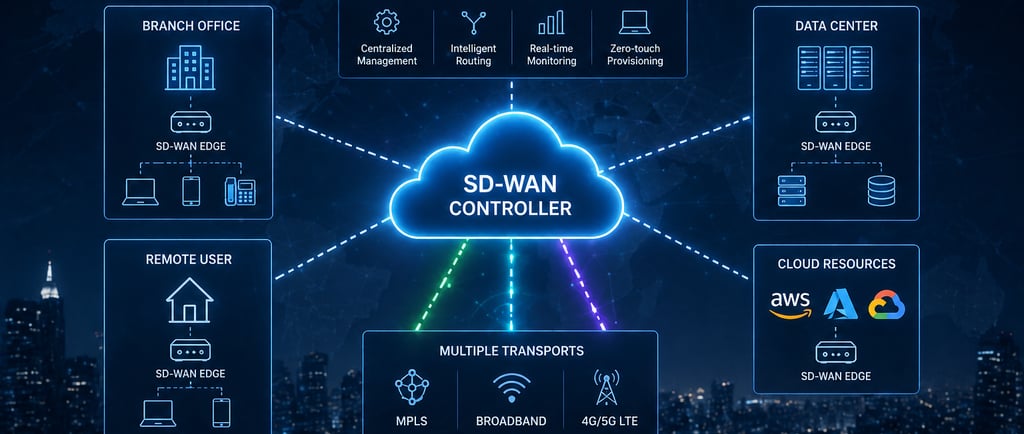
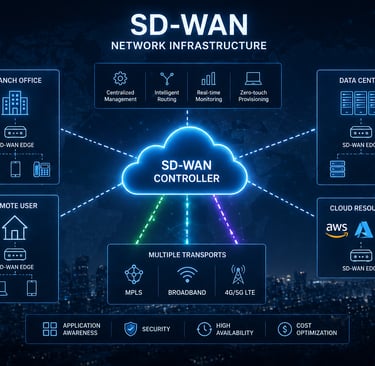
If your organization is still running MPLS as its primary wide-area network — and you signed that contract more than three years ago — you are almost certainly leaving significant money on the table. Not because MPLS is a bad technology. It is a mature, reliable technology that served enterprise networking well for two decades. But the economics have shifted fundamentally, and the performance gap that once justified MPLS premiums has narrowed to the point where it no longer supports the pricing differential most companies are still paying.
This is not a vendor pitch for SD-WAN. This is a framework for understanding what the real cost comparison looks like in 2026, and what questions to ask before your next contract renewal.
The average MPLS circuit in a mid-market enterprise is running at 2019 pricing in a 2026 market. SD-WAN alternatives delivering equivalent or superior performance are available at 40 to 70 percent lower monthly cost — depending on geography, bandwidth requirements, and provider selection.
What MPLS actually costs
MPLS pricing is opaque by design. Carriers price it based on bandwidth tier, circuit distance, number of nodes, and Class of Service configuration. A typical 100Mbps MPLS circuit connecting a regional office to a corporate data center runs $800 to $2,500 per month depending on location. A five-site MPLS deployment can easily run $8,000 to $15,000 per month in recurring circuit costs — before any management or support fees.
The justification has historically been Quality of Service guarantees and the separation of business traffic from public internet. Those are real benefits. But the context in which those benefits were priced has changed significantly since most of these contracts were written.
What SD-WAN actually delivers
SD-WAN — Software-Defined Wide Area Network — routes traffic intelligently across multiple underlying connections, which can include broadband internet, LTE, fiber, and yes, MPLS. The intelligence layer handles QoS, failover, and traffic prioritization in software rather than hardware. The result: enterprise-grade reliability and performance at broadband pricing.
A 100Mbps broadband connection with SD-WAN overlay in most US markets runs $150 to $400 per month. With dual-connection redundancy for failover — which most SD-WAN deployments use — you are looking at $300 to $700 per month per site. Compare that to $800 to $2,500 for a single MPLS circuit without redundancy.
Where MPLS still wins
This comparison is not a blanket recommendation to rip out MPLS everywhere. There are specific scenarios where MPLS remains the right call:
• Manufacturing environments with real-time control systems requiring sub-10ms latency and zero jitter tolerance
• Healthcare organizations with strict HIPAA compliance requirements and dedicated traffic isolation mandates
• Financial services firms with regulatory requirements for private circuit separation
• International deployments where broadband infrastructure quality varies significantly by country
Outside these specific scenarios, the performance delta between a well-configured SD-WAN deployment and an MPLS circuit has effectively closed for most business applications — including voice, video conferencing, cloud ERP, and CRM.
The hybrid approach most companies land on
The most common outcome of our network audits is not a full MPLS-to-SD-WAN migration. It is a hybrid architecture: MPLS retained for the highest-sensitivity traffic at headquarters or primary data center, broadband-based SD-WAN deployed at regional and branch offices. This approach typically delivers 35 to 55 percent cost reduction on total WAN spend while maintaining the QoS guarantees where they are genuinely needed.
What to do before your next renewal
If your MPLS contract is within 12 months of its renewal or auto-renewal date, now is the time to benchmark. Pull your current circuit inventory, document your bandwidth utilization by site, and compare against current broadband availability in each location. Then build competitive bids — not to necessarily switch, but to understand what the market actually offers.
Sigma Technology Consulting does this work as part of every Digital Plumbing Audit. Our Market Tape gives us real-time visibility into what providers are offering across 200+ carriers — and we use that data to either renegotiate your current MPLS contracts or architect a migration that makes financial sense. Contact us at sigmatechconsult.com to start the conversation.
Sigma Technology Consulting, Inc.
25 Years of Experience, Vetting & Procuring Technology Vendors
Contact Us
Support
© 2026. All rights reserved.