
Security Operations on a Mid-Market Budget: How to Build a Defensible Security Program Without a SOC
6/8/20264 min read
The conventional wisdom in enterprise cybersecurity is that effective security operations require a Security Operations Center: a dedicated team of analysts monitoring security telemetry around the clock, with sophisticated tooling, incident response playbooks, and the organizational infrastructure to detect and contain threats in real time. For organizations with the budget to build and staff a SOC — typically large enterprises spending $2 million or more annually on security operations alone — this model works.
For the mid-market, it is an unrealistic standard that has the unintended effect of making organizations feel that meaningful security improvement is beyond their reach. It is not. The gap between a minimally defensible security program and no program at all is not a SOC. It is a set of specific, implementable controls that address the attack vectors responsible for the overwhelming majority of mid-market security incidents — and that can be deployed and operated with existing IT staff, augmented by targeted managed services where the economics make sense.
A defensible security program is not the same as an invulnerable one. The goal is not to make breach impossible — it is to make your organization a harder target than the alternatives, to detect incidents faster when they occur, and to contain and recover from them more effectively. That standard is achievable at mid-market scale and budget.
The control framework that matters at mid-market scale
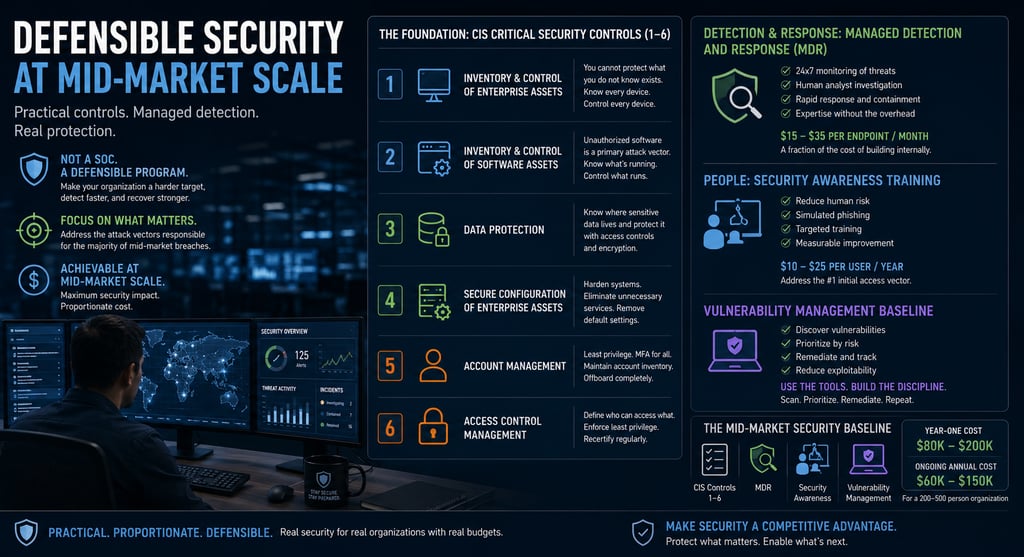
Rather than building toward an enterprise SOC model, mid-market organizations should focus on implementing the controls that address the top attack vectors in the current threat landscape. The Center for Internet Security Critical Security Controls — specifically the first six — provide the most actionable framework for mid-market security programs:
• Inventory and control of enterprise assets: you cannot protect what you do not know exists. A current, maintained inventory of every device connected to your network is the foundation of every other security control. Unknown devices are unmanaged devices. Unmanaged devices are attack surfaces.
• Inventory and control of software assets: unauthorized software running on company devices — whether installed deliberately or delivered through a compromised update — is a primary malware delivery mechanism. Software whitelisting or application control, even in audit-only mode initially, reveals the true software footprint of your environment
• Data protection: identifying where sensitive data lives — customer records, financial data, intellectual property, employee information — and applying appropriate access controls and encryption to that data. Data you do not know about cannot be protected. Data mapping precedes data protection
• Secure configuration of enterprise assets: default configurations for operating systems, network devices, and applications are designed for ease of setup, not security. Hardening configurations — disabling unnecessary services, enforcing strong authentication requirements, removing default credentials — closes a significant attack surface with no additional tooling cost
• Account management: enforcing the principle of least privilege, maintaining a current user account inventory, requiring MFA universally, and executing a formal offboarding process that revokes all access — not just Active Directory — are the controls that most directly address the credential compromise vector responsible for the majority of breaches
• Access control management: defining and enforcing who can access what, with role-based access control and regular recertification. Access that is not explicitly granted should not exist
Where managed services fill the gap
The controls above address the prevention layer. Detection — identifying when an incident is occurring — and response — containing and recovering from it — require capabilities that most mid-market IT teams cannot staff internally on a 24x7 basis. This is where Managed Detection and Response services deliver disproportionate value at mid-market scale.
MDR providers deploy endpoint detection and response agents across your environment, monitor the telemetry continuously, and provide human analyst investigation and response when threats are detected. Current MDR pricing for mid-market organizations — 200 to 1,000 endpoints — runs $15 to $35 per endpoint per month, or $36,000 to $420,000 annually depending on scope and provider. This is a fraction of the cost of staffing equivalent capability internally, and the coverage is typically superior — most MDR providers offer 24x7 monitoring that internal teams cannot match.
Security awareness training: the highest ROI control
Human behavior is both the largest attack surface in any organization and the most cost-effective one to address. Security awareness training that teaches employees to recognize phishing attempts, handle sensitive data appropriately, and report suspicious activity reduces the probability of successful social engineering attacks — which remain the most common initial access vector in mid-market breaches.
Modern security awareness platforms — KnowBe4, Proofpoint Security Awareness, Cofense, and others — combine simulated phishing campaigns with targeted training content, delivering measurable improvement in employee phishing resistance at costs ranging from $10 to $25 per user per year. For a 200-person organization, that is $2,000 to $5,000 annually for a control that addresses the attack vector responsible for approximately 36 percent of successful breaches.
The vulnerability management baseline
Knowing which vulnerabilities exist in your environment — and having a process to remediate them before attackers exploit them — is a fundamental security capability that requires no specialized staffing. Vulnerability scanning tools run automated assessments of your environment and produce prioritized remediation lists based on severity and exploitability. Several credible platforms offer free or low-cost tiers adequate for mid-market environments: Tenable Nessus Essentials, OpenVAS, and Qualys Community Edition.
The discipline is in the remediation process: designating ownership for critical and high-severity findings, establishing SLAs for patching internet-facing systems, and tracking remediation to closure. A vulnerability scan that produces a report nobody acts on provides no security value.
Putting it together: the mid-market security baseline
A defensible mid-market security program built on the framework above — CIS Controls 1 through 6, MDR for detection and response, security awareness training, and a basic vulnerability management process — can be implemented for $80,000 to $200,000 in year-one costs for a 200 to 500 person organization, with ongoing annual costs of $60,000 to $150,000. That investment addresses the attack vectors responsible for the overwhelming majority of mid-market security incidents and positions the organization to obtain cyber insurance at favorable rates.
It is not a SOC. It is a defensible program — which is the standard that actually matters. Sigma Technology Consulting helps mid-market organizations build security programs proportionate to their risk profile and budget. Contact us at sigmatechconsult.com to discuss a security program assessment.
Sigma Technology Consulting, Inc.
25 Years of Experience, Vetting & Procuring Technology Vendors
Contact Us
Support
© 2026. All rights reserved.