
Serverless in Practice: When It Actually Saves Money and When It Quietly Costs More
6/23/20264 min read
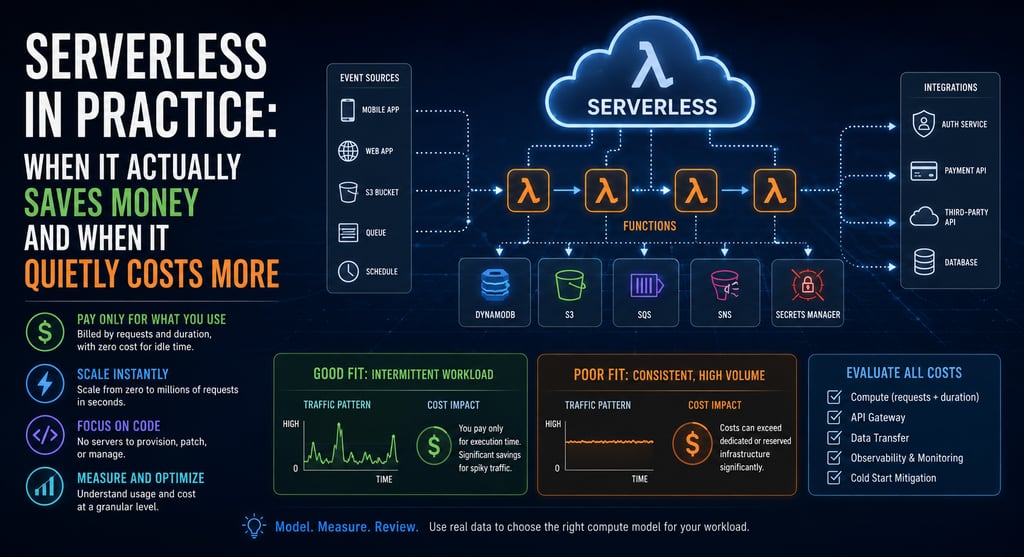
Serverless computing — AWS Lambda, Azure Functions, Google Cloud Functions — was introduced with a compelling economic pitch: pay only for the compute you actually consume, measured in milliseconds, with zero cost for idle capacity. For workloads with intermittent or unpredictable traffic, this pricing model can deliver dramatic cost savings compared to provisioning dedicated servers that sit idle between requests. For other workload patterns, the same pricing model can produce costs that exceed traditional server-based architectures significantly — a reality that is underrepresented in vendor marketing and frequently discovered only after a serverless migration is complete.
This post is a framework for evaluating which workloads benefit from serverless economics and which do not — based on actual cost behavior rather than the general appeal of the serverless value proposition.
Serverless pricing rewards exactly one usage pattern: low average utilization with occasional spikes. It penalizes the opposite pattern — consistent, high-volume execution — more severely than most organizations anticipate before they see the bill.
How serverless pricing actually works
AWS Lambda, the dominant serverless platform, charges based on the number of requests and the duration of execution, measured in gigabyte-seconds — the memory allocated to the function multiplied by execution time. A function configured with 512MB of memory that runs for 200 milliseconds and is invoked 1 million times per month costs approximately $1.67 in compute charges plus $0.20 in request charges — a total that is difficult to replicate with traditional server provisioning for a workload of equivalent unpredictability.
The same pricing model applied to a high-volume, consistently running workload produces a different outcome. A function invoked 100 million times per month, running for 500 milliseconds at 512MB memory, costs approximately $417 in compute charges plus $20 in request charges — a total of $437 per month. The equivalent workload running on a dedicated EC2 instance sized appropriately for the consistent load might cost $60 to $120 per month with reserved pricing. At high, consistent volume, serverless pricing is significantly more expensive than dedicated infrastructure.
The workload characteristics that favor serverless
Serverless economics are favorable for workloads with these characteristics:
• Intermittent or unpredictable traffic: workloads that experience significant idle periods between invocations benefit from paying only for actual execution time rather than for continuously running infrastructure
• Event-driven processing: functions triggered by specific events — file uploads, queue messages, scheduled tasks — that do not require continuous availability are a natural fit for the serverless execution model
• Rapid scaling requirements: workloads that need to scale from zero to significant volume within seconds, without the capacity planning and provisioning lead time that traditional infrastructure requires, benefit from serverless's automatic scaling
• Low operational overhead priority: organizations that value eliminating server management, patching, and capacity planning over achieving the absolute lowest compute cost find serverless's operational simplicity valuable even when the pricing comparison is not dramatically favorable
The workload characteristics that favor traditional infrastructure
Conversely, these workload characteristics typically favor dedicated infrastructure, containers, or reserved cloud compute over serverless functions:
• High, consistent volume: workloads with steady, high-frequency invocation patterns accumulate serverless costs that exceed the cost of dedicated or reserved compute sized for that consistent load
• Long-running processes: serverless platforms impose execution time limits (15 minutes for AWS Lambda) and are priced in a way that makes long-running compute economically unfavorable compared to dedicated infrastructure
• Predictable, steady-state demand: when traffic patterns are well understood and relatively stable, the capacity planning advantage of serverless's automatic scaling provides less value, while the pricing premium for that flexibility remains
• Latency-sensitive applications with cold-start sensitivity: serverless functions experience cold-start latency when scaling from zero — typically 100 milliseconds to several seconds depending on runtime and configuration. Applications with strict latency requirements may need to pay for provisioned concurrency to mitigate this, which significantly changes the cost equation toward traditional infrastructure pricing
The hidden cost categories in serverless architectures
Beyond the direct compute pricing comparison, serverless architectures introduce cost categories that are frequently underestimated in initial cost modeling:
• API Gateway costs: serverless functions exposed via HTTP typically route through API Gateway, which has its own per-request pricing that compounds with function execution costs and is easy to omit from initial cost estimates
• Inter-service data transfer: serverless architectures often decompose applications into many small functions communicating via events or direct invocation, and each of these interactions can incur data transfer costs that do not exist in monolithic architectures
• Observability tooling: the distributed nature of serverless architectures, with many independently executing functions, requires more sophisticated monitoring and tracing tooling than traditional applications, adding operational tooling costs that are not part of the core compute pricing
• Cold start mitigation: provisioned concurrency, which keeps function instances warm to eliminate cold-start latency, is billed continuously regardless of invocation — effectively converting part of your serverless cost back into a dedicated-capacity pricing model, often without organizations recognizing this shift has occurred
The practical evaluation framework
Before committing to serverless architecture for a given workload, model the actual cost using realistic invocation volume and execution duration estimates, compare against equivalent dedicated or reserved compute pricing, and explicitly account for API Gateway, data transfer, and observability tooling costs. For workloads already running on serverless infrastructure, a periodic cost review comparing actual invocation patterns against the original cost model will reveal whether the workload has grown into a volume profile where traditional infrastructure would now be more economical.
Sigma Technology Consulting evaluates serverless and cloud architecture economics as part of our FinOps and cloud cost engagements. Contact us at sigmatechconsult.com to discuss your current serverless cost profile.
Sigma Technology Consulting, Inc.
25 Years of Experience, Vetting & Procuring Technology Vendors
Contact Us
Support
© 2026. All rights reserved.