
SSO Sprawl: When Single Sign-On Becomes a Single Point of Failure
7/15/20264 min read
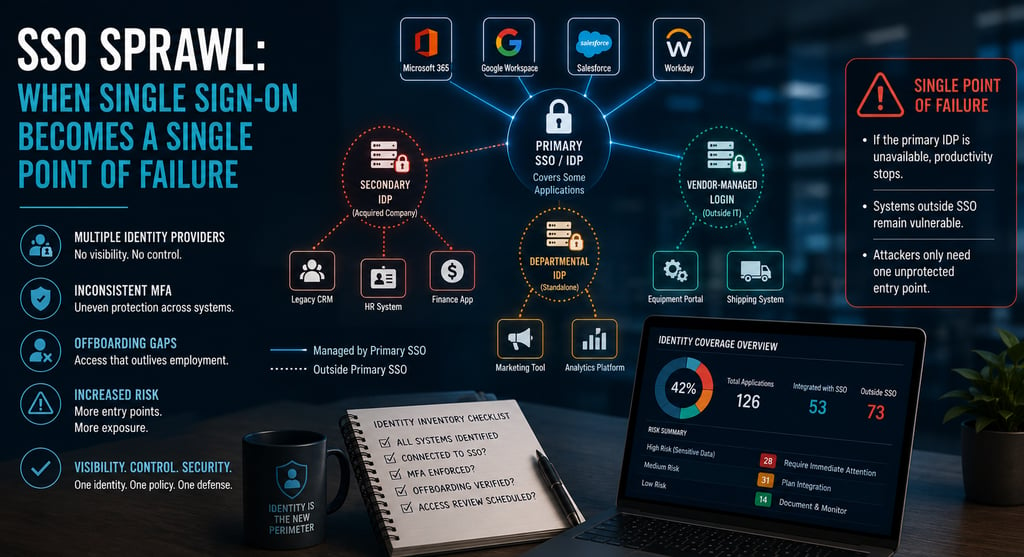
Single sign-on was supposed to make identity simpler: one login, one set of credentials, one place to manage access across every system an employee touches. For most mid-market companies, that promise has only been half kept. Instead of one clean identity provider governing everything, many organizations have quietly accumulated two, three, or more identity systems, each governing a different slice of the business, none of them talking to each other.
The uncomfortable part is that this usually isn't visible from the inside. Leadership sees a single sign-on portal in daily use, assumes it covers the environment, and has no reason to go looking for the systems sitting quietly outside it until an audit, an incident, or a due diligence process asks the question directly.
How This Actually Happens
It rarely happens on purpose. A company adopts a primary identity provider for its core business applications. An acquired subsidiary arrives with its own identity system already in place, and integrating it fully gets deprioritized in favor of more urgent post-acquisition work. A specific department adopts a tool that requires its own separate login because integrating it with the primary provider wasn't worth the engineering time at the moment it was purchased. Each decision is individually reasonable. The cumulative result is an identity environment nobody has a complete picture of.
The Single Point of Failure Nobody Planned For
The irony of SSO sprawl is that consolidating identity into a single provider, done well, is one of the strongest security moves a company can make. Done incompletely, it creates a different problem: the primary identity provider becomes a single point of failure for the systems it does cover, while the systems it doesn't cover remain governed by weaker, inconsistent, and rarely reviewed access controls.
An employee who leaves the company might be fully deprovisioned from the primary SSO system on their last day, while retaining active access to the secondary system nobody remembered to check. A department's SaaS tool with its own separate login often has no connection to the company's central offboarding process at all, which means access removal depends entirely on someone remembering that system exists and manually revoking a credential that was never centrally tracked in the first place.
The same fragmentation tends to show up in MFA enforcement. A company can have strong, consistently enforced multi-factor authentication on its primary identity provider while a handful of systems outside it enforce weaker MFA, inconsistent MFA, or none at all, creating exactly the kind of uneven security posture that a company's own leadership usually assumes doesn't exist, because the primary system they interact with daily looks solid.
The Audit Question Almost Nobody Asks
Most access reviews start from the primary identity provider and check who has access to what within it. Very few start from the opposite direction: listing every system the company actually uses, then checking which ones are NOT connected to central identity management, and why. That second list is usually longer than expected, and it's where the real exposure tends to live, because those are the systems where offboarding, access reviews, and MFA enforcement all depend on manual processes that quietly erode over time.
Building that reverse list is rarely a technical challenge. It's a matter of someone actually sitting down with finance records, department heads, and vendor invoices to compile a complete picture of every tool in active use, then checking each one against the identity provider's connected application list. Most mid-market companies have never done this exercise in either direction, which is exactly why the gap persists for years without anyone noticing it.
Consolidation Without a Painful Rip-and-Replace
Full consolidation onto a single identity provider is the ideal end state, but it's rarely realistic to do all at once for a mid-market company with years of accumulated tooling. A more practical approach starts with an inventory: every system in use, whether it's connected to central identity management, and how critical the data behind it is. Systems handling sensitive data that sit outside central identity get prioritized first for integration, even if lower-priority systems remain separately managed for longer.
Where full integration isn't immediately practical, a documented, enforced manual offboarding checklist for the systems that remain outside central identity closes much of the gap in the meantime, provided it's actually followed consistently rather than existing as a document nobody references during an actual departure.
The M&A Version of This Problem
SSO sprawl shows up in an especially acute form after an acquisition. The acquired company arrives with its own identity provider, its own access policies, and its own history of who has access to what, none of which has any relationship to the acquiring company's systems. Full identity integration after a deal closes often takes many months, and in that window, the acquired company's systems typically continue operating on their original, separately managed identity provider, reviewed by whatever process, or lack of one, existed before the deal.
This is a well-known gap in technology due diligence, and increasingly a specific line item buyers ask about directly: not just whether the target company has single sign-on, but whether it covers everything the target actually runs, and what the plan and timeline look like for consolidating any systems that fall outside it after close.
Why This Matters More Than It Used to
Identity has become the primary perimeter for most mid-market companies, more so than the network firewall that used to hold that role. A fragmented identity environment means that perimeter has multiple unguarded gaps, each shaped by a reasonable decision made years ago for reasons that no longer matter, and each invisible until an offboarded employee, a departed contractor, or an attacker with stolen credentials finds the one system nobody remembered to lock down.
None of this requires a company to feel behind. Almost every mid-market organization carries some version of this fragmentation, simply because identity consolidation has never been the priority it deserves relative to the systems it's meant to protect. Recognizing the gap, mapping it honestly, and prioritizing the highest-risk systems first is a realistic starting point regardless of how long the fragmentation has been building.
Sigma Technology Consulting, Inc.
25 Years of Experience, Vetting & Procuring Technology Vendors
Contact Us
Support
© 2026. All rights reserved.