
Supply Chain Attacks in 2026: Why Your Vendors Are Now Your Biggest Attack Surface
6/23/20264 min read
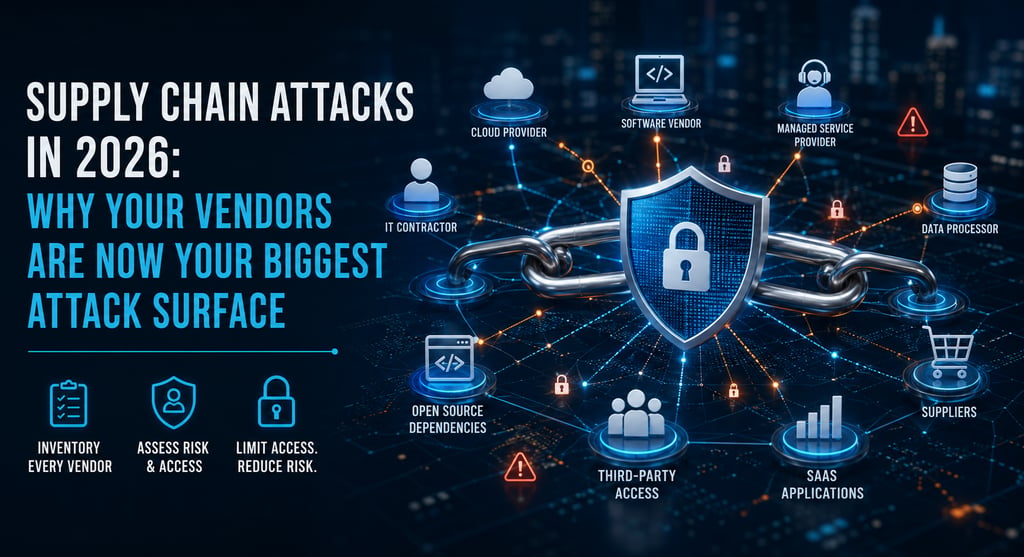
The SolarWinds breach in 2020 introduced most security professionals to the modern supply chain attack: a sophisticated actor compromises a single software vendor, inserts malicious code into a routine software update, and gains access to thousands of downstream organizations who trusted that update. Six years later, supply chain attacks have not become a rare, headline-grabbing exception. They have become a routine and growing attack vector, and mid-market organizations — who have less visibility into and less leverage over their vendor security practices than large enterprises — are increasingly the path of least resistance.
The fundamental challenge is structural: your security posture is no longer determined solely by your own controls. It is determined by the security posture of every software vendor, every managed service provider, every cloud platform, and every contractor with access to your systems — a population that, for a typical mid-market organization, numbers in the dozens to hundreds of third-party relationships, the overwhelming majority of which have never been formally assessed.
You cannot audit your way to security if you have not first inventoried what you are auditing. The starting point for supply chain risk management is not a security questionnaire. It is a complete, current inventory of every third party with access to your systems or your data — a document that most mid-market organizations have never built.
The three categories of supply chain risk
Supply chain attacks against mid-market organizations generally fall into three categories, each requiring a different mitigation approach:
• Software supply chain compromise: malicious code inserted into legitimate software updates, open-source dependencies, or development tooling. This includes compromised npm or PyPI packages, backdoored software updates, and compromised CI/CD pipelines. The 2024 xz-utils backdoor, discovered before widespread exploitation, demonstrated how deeply embedded and difficult to detect this category can be
• Vendor access compromise: a third party with legitimate access to your environment — an MSP, an IT contractor, a SaaS application with broad permissions — is compromised, and the attacker uses that access to reach your systems. This is the most common supply chain attack vector against mid-market organizations specifically, because vendor access relationships are numerous and rarely audited
• Data processor compromise: a third party that processes or stores your data on your behalf — a billing service, a marketing platform, a cloud storage vendor — is breached, exposing your data even though your own systems were never directly compromised. This category creates liability exposure independent of any technical failure on your part
Why mid-market vendor risk management is structurally weak
Large enterprises maintain formal third-party risk management programs: security questionnaires, SOC 2 report reviews, contractual security requirements, and ongoing vendor risk monitoring. These programs require dedicated staff and tooling that most mid-market organizations do not have. The result is a vendor risk management gap that compounds as the number of vendor relationships grows.
In our security assessments, the typical findings include: no current inventory of vendors with system or data access; no consistent process for evaluating vendor security posture before granting access; vendor access that was provisioned for a specific project and never reviewed or revoked afterward; and no contractual security requirements or right-to-audit provisions in vendor agreements, leaving the organization with no recourse if a vendor's security practices are inadequate.
Building proportionate vendor risk management
Enterprise-grade third-party risk management programs are not realistic for most mid-market organizations, and attempting to replicate them produces an unsustainable compliance burden. A proportionate approach focuses on the highest-risk vendor relationships and the highest-leverage controls:
• Build the inventory: identify every vendor with access to your systems, your network, or your data — including SaaS applications, MSPs, contractors, and software vendors. Classify each by the level of access and the sensitivity of data they can reach
• Tier your vendors by risk: vendors with administrative system access or access to sensitive data warrant deeper scrutiny than vendors with limited, read-only access to non-sensitive systems. Apply security review rigor proportionate to the access level
• Request SOC 2 Type II reports for high-risk vendors: most established SaaS and managed service vendors can provide a SOC 2 Type II report documenting their security controls. For your highest-risk vendor relationships, requesting and reviewing this report — or confirming its absence — is a meaningful and low-effort control
• Implement least-privilege vendor access: vendor access should be scoped to exactly what is required for their function, time-limited where possible, and reviewed on a regular cycle alongside employee access recertification
• Build security requirements into contracts: standard contract language requiring vendors to maintain specific security controls, notify you of breaches within a defined timeframe, and carry appropriate cyber liability insurance creates contractual leverage that is otherwise absent
• Monitor software dependencies: for organizations developing custom software, software composition analysis tools identify known vulnerabilities in open-source dependencies — addressing the software supply chain risk category at the development level
The incident response dimension
Supply chain attacks require an incident response approach that differs from traditional breach response, because the initial compromise occurred outside your direct control. Your incident response plan should explicitly address: how you will be notified if a vendor experiences a breach that may affect you, what access you have to audit logs covering vendor activity in your environment, and what your contractual rights are to investigate and remediate following a vendor-originated incident.
Many mid-market organizations discover during an actual incident that their vendor contracts provide no meaningful visibility or recourse — a gap that is addressable proactively but extremely difficult to fix after an incident has occurred.
Where to start
If your organization does not currently maintain a vendor inventory with risk classification, that is the starting point. From there, prioritize SOC 2 report collection and review for your five to ten highest-risk vendor relationships, and build minimum security requirements into your standard vendor contract templates going forward. Sigma Technology Consulting helps mid-market organizations build proportionate vendor risk management programs. Contact us at sigmatechconsult.com.
Sigma Technology Consulting, Inc.
25 Years of Experience, Vetting & Procuring Technology Vendors
Contact Us
Support
© 2026. All rights reserved.