
TECHNOLOGY TRENDS Platform Engineering in 2026: What It Is, Why It's Growing, and What Mid-Market Organizations Should Know
7/3/20264 min read
Platform engineering has emerged as one of the defining infrastructure trends of the mid-2020s, appearing on analyst priority lists, generating significant investment in specialized tooling, and prompting organizational restructuring at engineering-forward companies. For technology leaders at mid-market organizations trying to separate signal from noise in a crowded trends landscape, the key questions are: what problem does platform engineering actually solve, does that problem exist at mid-market scale, and if so, what does a proportionate response look like?
The honest answer, as with most infrastructure trends, is nuanced: platform engineering addresses a real and significant problem that is acutely present in large engineering organizations and begins to emerge at mid-market scale under specific conditions. Understanding those conditions — and distinguishing them from the general appeal of the concept — is the prerequisite for making a sensible decision about whether and how to invest.
Platform engineering is the organizational response to a specific failure mode: developer productivity degrading as infrastructure complexity grows faster than the team's ability to manage it. When a developer spends more time navigating cloud configuration, security policies, and deployment tooling than writing application code, the organization has a platform engineering problem. The question is whether your organization is actually experiencing that failure mode.
What platform engineering is
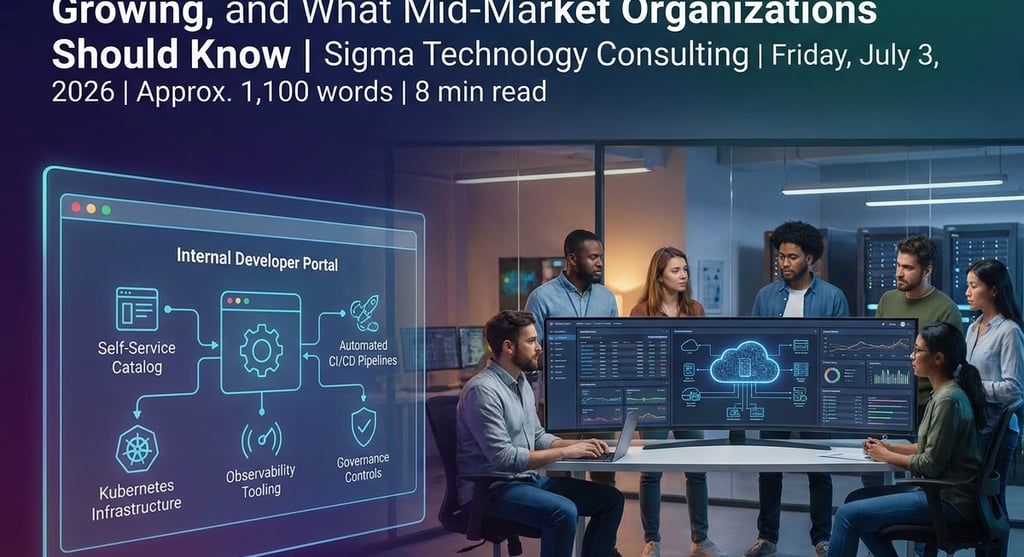
Platform engineering is the practice of building and operating internal platforms — sometimes called Internal Developer Platforms or IDPs — that abstract infrastructure complexity away from application developers. Rather than requiring each developer to understand cloud resource provisioning, Kubernetes configuration, security policy implementation, observability setup, and CI/CD pipeline management, a platform engineering team builds a curated set of tools and self-service capabilities that allow developers to deploy, operate, and monitor applications without deep infrastructure expertise.
The internal developer platform typically includes a self-service catalog for provisioning standardized infrastructure environments, automated CI/CD pipelines with security and quality gates built in, observability tooling pre-configured for the standard application stack, and governance controls that enforce security and compliance requirements without requiring developers to implement them manually on a per-application basis.
The problem platform engineering solves
The problem that drives platform engineering adoption is developer cognitive load in complex infrastructure environments. As organizations adopt cloud-native architectures, Kubernetes, microservices, and multi-environment deployment workflows, the infrastructure knowledge required to operate effectively as a developer escalates significantly. Developers who joined to build applications find themselves spending increasing portions of their time on infrastructure concerns — debugging Kubernetes networking, understanding cloud IAM policies, configuring observability tooling, and navigating security requirements that vary across environments.
This cognitive load has measurable consequences: slower development cycles, higher defect rates in infrastructure configuration, inconsistent security posture across teams and applications, and developer attrition driven by frustration with operational complexity. Platform engineering addresses these consequences by creating a standardized, self-service infrastructure layer that hides complexity while enforcing good practices automatically.
When platform engineering applies at mid-market scale
The conditions under which platform engineering investment is justified at mid-market scale:
• Engineering team size above approximately 25 to 30 developers: below this threshold, the overhead of building and maintaining a platform is likely to exceed the productivity gains it delivers. Smaller teams are better served by well-chosen SaaS developer tooling (GitHub Actions, Vercel, Render, or similar) that provides platform-like capabilities without requiring a dedicated platform team
• Kubernetes-based infrastructure: if the organization is running Kubernetes at meaningful scale — multiple clusters, dozens of deployments, multiple teams deploying to shared infrastructure — the configuration and operational complexity that Kubernetes introduces is the specific problem platform engineering is designed to address
• Multiple product teams deploying independently: when different engineering teams need to deploy to shared infrastructure while maintaining independent deployment cadences and varying technology stacks, a platform layer that provides consistent deployment patterns without requiring coordination overhead delivers clear value
• Measurable developer time spent on infrastructure: if developer surveys or time tracking data show that engineers are spending 20 percent or more of their time on infrastructure concerns rather than product development, the productivity case for a platform investment is quantifiable
What a proportionate mid-market platform investment looks like
For organizations at the lower end of the applicable scale — 25 to 60 engineers, moderate Kubernetes complexity — a full internal developer platform built from scratch is rarely the right answer. The practical options:
• Backstage: the open-source developer portal platform originally developed at Spotify, now a CNCF project with significant enterprise adoption. Backstage provides a customizable self-service catalog and portal layer that can be extended with plugins for most major cloud providers and tooling ecosystems. Implementation requires engineering investment but avoids proprietary vendor lock-in
• Commercial IDP platforms: Port, Cortex, and OpsLevel offer commercial IDP platforms that provide the core self-service catalog and developer portal functionality with less implementation overhead than Backstage. These platforms are particularly appropriate for organizations that want IDP capabilities without dedicating significant engineering time to building them
• Enhanced CI/CD standardization: for organizations not yet ready for a full IDP investment, standardizing CI/CD pipelines, enforcing infrastructure-as-code practices, and building a shared library of Terraform or Pulumi modules provides much of the consistency and self-service benefit of platform engineering without the full platform overhead
The honest assessment
Platform engineering is a genuine solution to a genuine problem. It is also a concept that has attracted enough enterprise mindshare that it is being applied in contexts where it is not the right fit — organizations investing in platform engineering infrastructure before they have the scale, the Kubernetes complexity, or the team size where the investment is justified. The honest evaluation starts with the question of whether the problem platform engineering solves is actually present in your organization, not with whether the concept is compelling.
Sigma Technology Consulting helps mid-market engineering organizations evaluate their infrastructure strategy and make technology decisions proportionate to their actual scale and requirements. Contact us at sigmatechconsult.com to discuss your current engineering infrastructure.
Sigma Technology Consulting, Inc.
25 Years of Experience, Vetting & Procuring Technology Vendors
Contact Us
Support
© 2026. All rights reserved.