
TECHNOLOGY TRENDS The Composable Infrastructure Revolution: What It Is, Who Needs It, and What Mid-Market Adoption Looks Like in 2026
6/19/20264 min read
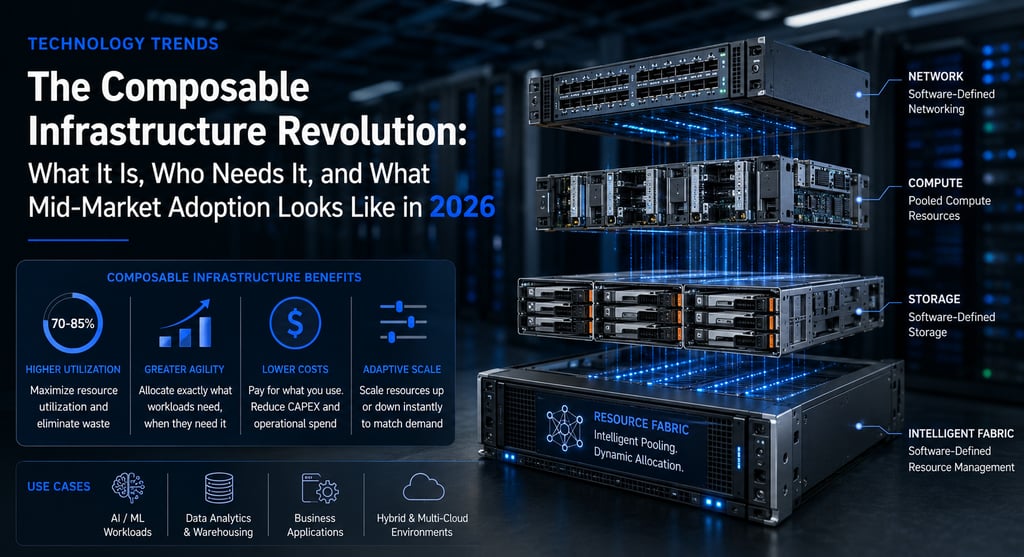
Composable infrastructure is an architecture model in which compute, storage, and networking resources are disaggregated from fixed hardware configurations and pooled as software-defined resource fabrics that can be dynamically assembled into logical systems on demand. Rather than provisioning a server — which bundles CPU, memory, storage, and networking in fixed ratios — composable infrastructure allows IT teams to allocate exactly the resources a workload requires, from a shared pool, and reallocate those resources when the workload's requirements change.
The concept has been in development at the enterprise level since approximately 2015, pioneered by HPE Synergy and similar platforms. What has changed in 2026 is the accessibility of composable principles at mid-market scale: the emergence of software-defined storage platforms, disaggregated GPU resources, and cloud-native composability models has brought the core benefits of composable architecture within reach of organizations that cannot justify hyperscale data center investment.
The fundamental problem that composable infrastructure solves is resource stranding — compute sitting idle while storage is saturated, or GPU capacity underutilized while CPU workloads wait. In traditional fixed-configuration infrastructure, stranded resources are a structural waste. In composable infrastructure, they are available for reallocation.
The resource stranding problem in traditional infrastructure
Traditional server infrastructure provisions resources in fixed bundles determined by the server configuration at purchase time. A server with 256GB of RAM will always have 256GB of RAM, regardless of whether the workload using it actually needs that much. A server with 8 GPU cores will underutilize those cores when running workloads that do not require GPU acceleration. The mismatch between fixed resource bundles and variable workload requirements is the source of the infrastructure utilization gap that hyperscale cloud providers have exploited with on-demand provisioning.
In on-premise and colocation environments, the utilization gap has historically been managed by overprovisioning — buying more capacity than current workloads require to ensure headroom for growth and peak load. This approach works but is capital-inefficient. Average server utilization in traditional enterprise data centers runs 15 to 25 percent — meaning 75 to 85 percent of purchased compute capacity is idle at any given moment.
What composable infrastructure does differently
Composable infrastructure approaches the resource utilization problem from the architecture layer rather than the procurement layer. By disaggregating physical resources into software-managed pools — compute nodes, memory nodes, storage arrays, GPU arrays, and network fabric — and presenting those pools as dynamically allocatable capacity, composable architectures allow multiple workloads to share the same physical resources in configurations that match their actual requirements.
The practical result: a GPU pool shared across multiple AI inference workloads can achieve 70 to 85 percent utilization — compared to 20 to 35 percent typical of dedicated GPU servers allocated per-workload. A storage fabric that serves both high-performance transactional workloads and high-capacity archival workloads eliminates the separate storage systems that would otherwise both run at partial utilization.
Mid-market composability options in 2026
Full composable infrastructure — HPE Synergy-class disaggregated hardware with proprietary resource management fabric — requires significant capital investment and operational expertise that is not realistic for most mid-market organizations. The more accessible composability options available in 2026:
• Software-defined storage: platforms like Pure Storage, NetApp ONTAP, and Nutanix Files abstract physical storage arrays into software-managed pools that can be dynamically allocated across workloads. These platforms provide the storage composability layer without requiring disaggregated compute
• GPU-as-a-service from specialized providers: CoreWeave, Lambda Labs, and similar AI infrastructure providers offer disaggregated GPU resources on a shared basis, allowing organizations to access GPU capacity in configurations that match their actual inference or training requirements rather than purchasing dedicated GPU servers
• Hyperconverged infrastructure: platforms like Nutanix, VMware vSAN, and Microsoft Azure Stack HCI provide software-defined compute and storage convergence that improves utilization efficiency within a hyperconverged node cluster — a stepping stone toward fuller composability
• Cloud-native composability: Kubernetes resource management, combined with cloud provider spot and preemptible instance markets, enables application-layer composability where workloads dynamically acquire and release resources based on actual demand. This is the most accessible composability model for organizations already operating cloud-native applications
Who benefits most from composable architectures
The organizations where composable infrastructure delivers the clearest ROI share a specific profile: they have variable workload requirements that create utilization mismatches in traditional fixed-configuration infrastructure; they are operating or planning significant AI or ML workloads where GPU utilization efficiency is a major cost driver; they manage multiple distinct workload types — transactional, analytical, archival — that would otherwise require separate infrastructure silos; or they are running large-scale data center operations where stranded resource costs are meaningful at the portfolio level.
For organizations running a relatively stable set of workloads on infrastructure that is reasonably well-utilized, the complexity overhead of composable architecture does not justify the efficiency gains at this stage of the technology's maturity. Composability is an infrastructure investment that makes economic sense when the resource utilization problem it solves is large enough to justify the operational sophistication it requires.
The 2026 outlook
The composable infrastructure market is converging on two trajectories: cloud-native composability, which is accessible today and requires no new hardware investment, and hardware composability at the data center level, which is becoming progressively more accessible as the platform ecosystem matures and prices decline. For mid-market organizations evaluating infrastructure modernization in 2026, the most relevant composability question is not whether to invest in composable hardware — for most, the answer is not yet — but whether cloud-native composability principles are being applied to cloud workloads to maximize resource efficiency.
Sigma Technology Consulting evaluates infrastructure efficiency and composability readiness as part of our technology strategy engagements. Contact us at sigmatechconsult.com to discuss where composability principles can improve your infrastructure economics.
Sigma Technology Consulting, Inc.
25 Years of Experience, Vetting & Procuring Technology Vendors
Contact Us
Support
© 2026. All rights reserved.