
The Cyber Insurance Application Trap: What Insurers Are Really Asking — and Penalizing You For
6/24/20263 min read
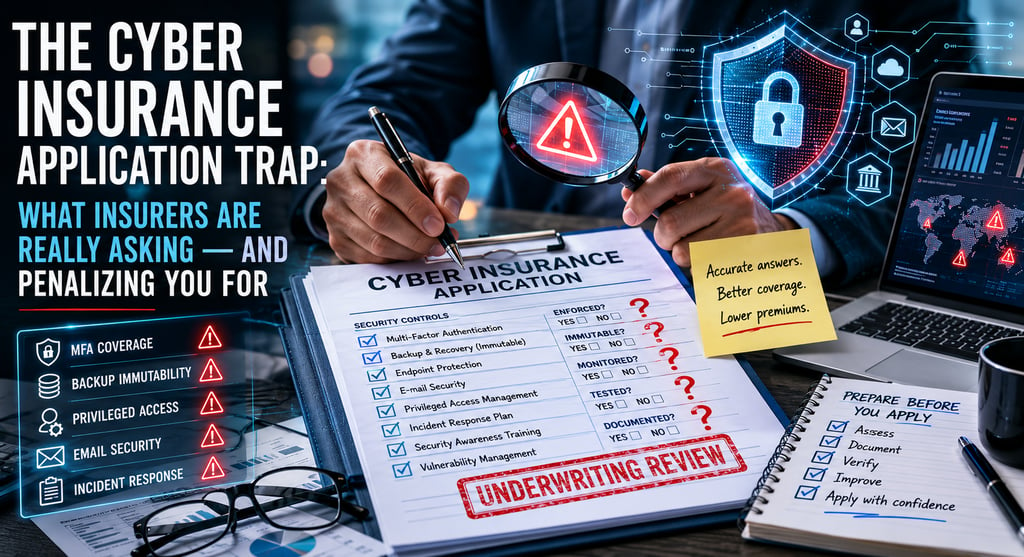
Cyber insurance applications have evolved dramatically since 2021. What was once a brief questionnaire asking general questions about IT practices has become a detailed technical assessment, frequently 20 to 40 pages long, asking precise questions about specific security controls — questions that most mid-market IT teams are not prepared to answer accurately, and that have direct, significant consequences for both premium pricing and claim eligibility.
Today's Insider Insights post covers what we have learned helping mid-market organizations navigate cyber insurance applications: the questions that carry the most underwriting weight, the common answer mistakes that increase premiums or create coverage gaps, and how to prepare for the application process in a way that improves both your insurability and your actual security posture.
Cyber insurance applications are not a compliance formality. They are a detailed technical audit conducted by an underwriter whose financial interest is in accurately pricing your risk — and increasingly, in denying claims when application answers do not match the actual security environment discovered during a post-incident investigation.
Insight 1: MFA questions are more specific than most applicants realize
Nearly every cyber insurance application asks about multi-factor authentication. The mistake we see most often: organizations answer yes to MFA questions based on partial deployment — MFA on email, for example — without recognizing that the application is typically asking about MFA coverage across all categories: email, VPN, remote access, privileged accounts, and cloud administrative consoles specifically.
Carriers have increasingly moved to verification rather than self-attestation for MFA claims, including technical scans that can detect whether MFA is actually enforced across an organization's environment. An application that claims comprehensive MFA coverage that does not match the actual deployment creates a material misrepresentation risk that can be grounds for claim denial — even if the misrepresentation was an honest misunderstanding of the question's scope rather than deliberate misstatement.
Insight 2: Backup immutability is now explicitly distinguished from backup existence
Older insurance applications asked simply whether the organization had backups. Current applications ask specifically whether backups are immutable — protected from modification or deletion, including by an attacker with administrative credentials — and whether backups are tested regularly for successful restoration. Organizations that have backups but answer the immutability question affirmatively without confirming actual immutable configuration create the same misrepresentation exposure as the MFA scenario above.
This question deserves particular attention because backup destruction is now a standard component of ransomware attacks specifically intended to eliminate recovery options and maximize ransom pressure, as covered in our earlier post on the disaster recovery gap. Insurers ask this question because backup immutability is directly correlated with claim severity — non-immutable backups that get destroyed during an attack significantly increase the cost of the resulting claim.
Insight 3: Privileged access management questions distinguish between having a tool and having a program
Applications increasingly ask detailed questions about privileged access management: whether privileged accounts use just-in-time access, whether privileged sessions are logged and monitored, and whether the number of standing administrative accounts is minimized. Organizations that have deployed a PAM tool but have not fully implemented just-in-time access workflows, or that still maintain numerous standing administrative accounts alongside the PAM deployment, frequently overstate their PAM maturity on applications — a gap that becomes visible during incident investigation.
Insight 4: Email security questions are increasingly specific about detection capability, not just filtering
As covered in our June 16 post on the evolution of phishing, modern email threats — AI-generated spear phishing, business email compromise, account takeover — require detection capabilities beyond traditional spam filtering. Current cyber insurance applications reflect this, asking specifically about behavioral email security, anomaly detection, and BEC-specific protections rather than simply whether spam filtering is in place. Organizations running only traditional secure email gateways without modern behavioral detection capability are increasingly finding this gap reflected in premium pricing.
Insight 5: Incident response plan questions test for specificity, not existence
Applications ask whether an incident response plan exists, but increasingly probe for specificity: whether the plan has been tested within a defined period, whether specific roles and responsibilities are assigned, and whether the plan addresses specific scenarios including ransomware and business email compromise. A generic incident response document that has never been tested or exercised provides materially less underwriting credit than a documented, recently-tested plan with assigned ownership — and the difference affects both premium and, in the event of a claim, the carrier's assessment of whether the organization met its policy obligations.
How to approach the application process
The most effective preparation for a cyber insurance application is a security assessment conducted before the application is submitted — not in response to specific application questions, but as a comprehensive review of actual control implementation against what the application is likely to ask. This serves two purposes: it identifies the gaps between actual security posture and the answers that would be given without verification, allowing remediation before application submission; and it produces documentation — control implementation evidence, testing records, policy documents — that supports accurate, defensible application answers.
Organizations that complete this preparation consistently achieve better premium pricing than organizations that complete applications based on assumptions about their security posture, and they carry significantly lower claim denial risk based on application misrepresentation. Sigma Technology Consulting helps mid-market organizations prepare for cyber insurance applications and underwriting reviews as part of our security assessment services. Contact us at sigmatechconsult.com.
Sigma Technology Consulting, Inc.
25 Years of Experience, Vetting & Procuring Technology Vendors
Contact Us
Support
© 2026. All rights reserved.