
The Disaster Recovery Gap: What Most Mid-Market DR Plans Get Wrong — and What a Real Test Reveals
5/27/20264 min read
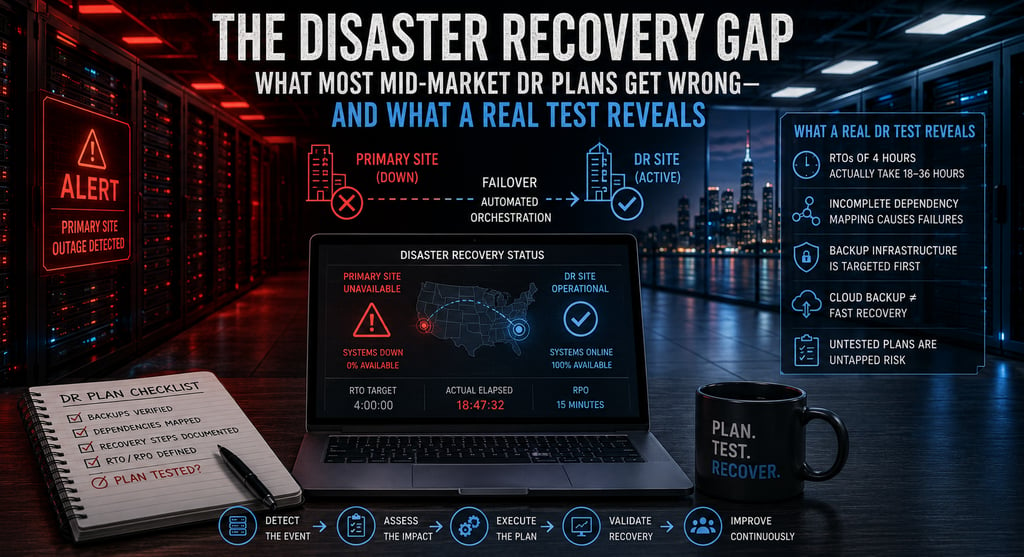
Most mid-market businesses have a disaster recovery plan. Far fewer have a disaster recovery plan that would actually work under real-world conditions. The gap between the two is the subject of today's Insider Insights post — and it is a gap that we encounter in the majority of DR assessments we conduct.
The problem is not that organizations fail to invest in backup and recovery infrastructure. Most do. The problem is a fundamental conceptual error in how DR planning is approached: treating backup as a proxy for recovery, and treating a documented plan as a proxy for a tested one. These are not the same things — and the difference becomes apparent only when you actually run the test.
Having a backup is not the same as having a recovery capability. Backup means you have a copy of the data. Recovery means you can restore business operations — all systems, all dependencies, all integrations — within a defined timeframe. Most mid-market DR plans have been validated at the backup layer and assumed at the recovery layer.
Insight 1: RTO and RPO are targets, not guarantees
Recovery Time Objective and Recovery Point Objective are the two fundamental metrics of DR planning. RTO defines how long it takes to restore operations after a failure. RPO defines how much data loss is acceptable — measured in time. Most mid-market DR plans define both metrics. What they frequently do not do is test whether the current infrastructure can actually meet them.
We regularly engage with organizations that have documented RTOs of four hours that, when tested, require 18 to 36 hours to achieve — because the recovery process involves manual steps that were never timed, dependency sequences that were never mapped, and system configurations that have changed since the plan was last updated. The document says four hours. The reality says otherwise. You do not want to discover this distinction during an actual incident.
Insight 2: Application dependency mapping is almost always incomplete
Modern business applications do not operate in isolation. Your ERP integrates with your CRM, which integrates with your email platform, which integrates with your customer portal, which depends on a third-party identity provider. Your financial system has a real-time feed from your banking integration. Your production management platform has API connections to supplier systems.
When one system fails and needs to be restored, it cannot be fully functional until every system it depends on is also restored and operational — in the correct sequence. DR plans that treat application recovery as a list of individual systems to restore, rather than a dependency graph to sequence correctly, routinely fail in testing because applications come online in the wrong order and spend hours in a partially functional state.
Insight 3: Backup infrastructure is frequently the first casualty of a ransomware attack
We addressed ransomware in detail in Monday's post, but the backup-specific dimension deserves emphasis in the DR context. Sophisticated ransomware attackers specifically target backup infrastructure before deploying encryption — because destroying backups eliminates the recovery option and maximizes ransom leverage. Backup systems that are network-connected, accessible with standard credentials, and not protected by immutability controls are vulnerable to this attack vector.
The DR implication: a backup that is stored on a network share accessible from the primary environment is not a ransomware-resilient recovery capability. Immutable backup — stored in a location that cannot be modified or deleted, whether cloud-based or physical air-gapped tape — is the minimum standard for a recovery capability that remains viable after a ransomware incident.
Insight 4: Cloud backup is not automatically faster than on-premise backup
Cloud-based backup has significant advantages over traditional on-premise tape or disk backup — cost, geographic redundancy, scalability, and ease of management. What it does not automatically provide is fast recovery. Restoring a significant data set from cloud backup over a standard internet connection takes time that many organizations have not accounted for in their RTO calculations.
A 10 terabyte restore over a 100Mbps internet connection takes approximately 22 hours under ideal conditions. A 50 terabyte environment restoring over the same connection takes more than 4 days. Organizations with cloud backup and aggressive RTOs need to either architect for cloud-native recovery — restoring directly to cloud compute rather than downloading to on-premise infrastructure — or maintain local recovery infrastructure that can be used while the cloud restore runs in parallel.
Insight 5: The DR plan has not been tested since it was written
This is the most common finding in DR assessments: a documented plan, sometimes very detailed, that has not been tested since it was created — or that has been tested only at the backup verification level, confirming that data was successfully written to backup, without ever running the full recovery sequence.
A DR plan that has not been tested is a hypothesis. It may be a well-reasoned hypothesis supported by good documentation. But until the recovery sequence has been executed — systems restored, dependencies sequenced, application functionality verified, RTOs timed — it is not a tested recovery capability. Test your plan. Do it before you need it.
What a real DR test looks like
A meaningful DR test goes beyond verifying that backups are current and accessible. It involves selecting a representative system or application, initiating a simulated recovery from scratch, timing each step against the documented RTO, verifying that all dependencies are restored in the correct sequence, and confirming that the restored application is fully functional from the end-user perspective.
The findings almost always include surprises: manual steps that were not documented, dependencies that were not mapped, configuration details that were not captured, and time requirements that exceed the documented RTO. Each finding is an opportunity to improve the plan before an actual incident requires it to perform.
Sigma Technology Consulting conducts DR assessments and tabletop exercises for mid-market organizations. Contact us at sigmatechconsult.com to schedule a DR readiness review for your environment.
Sigma Technology Consulting, Inc.
25 Years of Experience, Vetting & Procuring Technology Vendors
Contact Us
Support
© 2026. All rights reserved.