
The Exit Multiple Math Most PE Firms Aren't Doing on IT Costs
7/22/20264 min read
Every operating partner understands, in the abstract, that cutting recurring costs improves EBITDA and improves EBITDA improves enterprise value at exit. Fewer have actually run that math specifically on technology spend, which is unfortunate, because technology cost reduction tends to produce a better version of this math than almost any other cost category available to a portfolio company.
That's a striking gap given how routinely the same operating partners run this exact calculation on other cost categories, headcount, facilities, insurance, without applying the identical logic to technology, a category that in Sigma's experience tends to hold more unreviewed waste than any of those more familiar categories combined.
The Basic Mechanic, Applied Specifically to Tech Spend
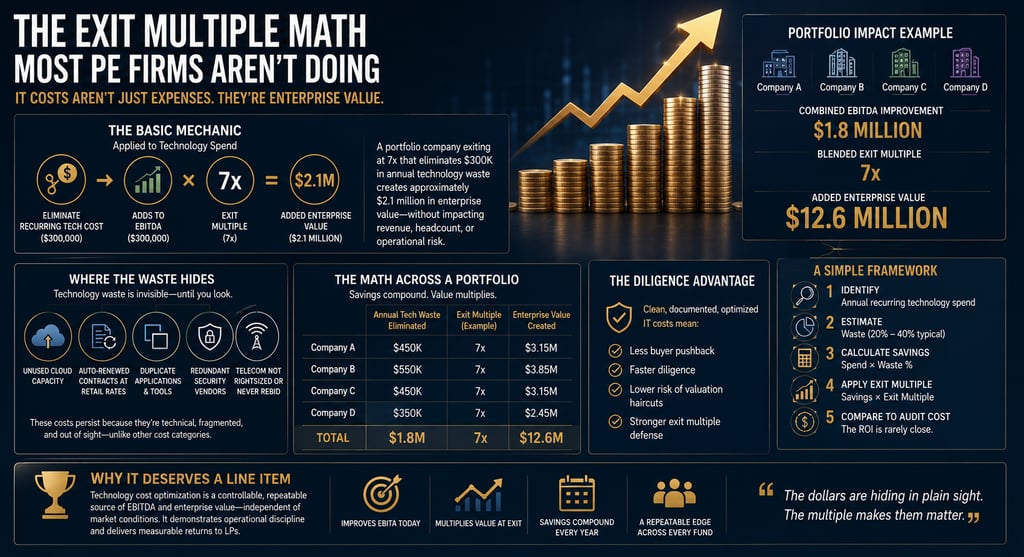
The core relationship is simple: a dollar of recurring cost eliminated is a dollar added to EBITDA, and a dollar added to EBITDA is worth that dollar multiplied by the company's exit multiple in enterprise value, assuming the multiple holds. A portfolio company exiting at a 7x multiple that eliminates $300,000 in annual, recurring technology waste, duplicate contracts, unused reserved cloud capacity, retail-priced telecom that was never rebid, has added roughly $2.1 million in enterprise value, from a single audit, without touching revenue, headcount, or any operational risk.
This is a fundamentally easier lever to pull than most of the other levers available to an operating partner. Revenue growth is slow, competitive, and uncertain. Headcount reduction carries operational risk and morale cost. Technology cost reduction, done through a structured audit rather than blunt cuts, is fast, low-risk, and, more often than most operating partners expect, larger in absolute dollar terms than anyone assumed before actually looking.
Why Technology Spend Specifically Tends to Have More Waste Than Other Categories
Technology contracts accumulate waste differently than most other cost categories. A company doesn't typically end up paying for two office leases it doesn't need, but it very often ends up paying for duplicate SaaS tools, reserved cloud capacity that outlived the project it was provisioned for, and telecom contracts that auto-renewed at retail rates years after the original volume commitment that justified the initial pricing. Because these costs are technical and less visible to a financially-oriented operating team, they tend to survive far longer than comparable waste in more visible cost categories, which is exactly why a dedicated technical audit finds so much more than a standard financial review ever would.
Why the Math Gets Better Across a Portfolio
The exit multiple math compounds further at the portfolio level. A $1.8 million combined EBITDA improvement across four portfolio companies, at a blended 7x exit multiple, represents roughly $12.6 million in added enterprise value across the fund, realized well before any exit process begins, and continuing to accrue every year those savings remain locked in. Unlike a one-time cost cut that risks reverting, contract-level savings from renegotiated telecom, consolidated vendors, and rightsized cloud spend tend to persist for the life of the new agreements, meaning the EBITDA improvement isn't a one-year event but a recurring baseline shift that compounds across the entire hold period.
The Diligence Angle Most Operating Partners Miss
There's a second, less obvious piece of this math that matters at exit specifically: a buyer's diligence team evaluating a clean, well-documented, already-optimized technology cost structure has less basis to argue for a valuation haircut or extended diligence timeline than a buyer looking at an undocumented, unreviewed technology environment full of the kind of waste a dedicated audit would have caught years earlier. Getting this right isn't just about the EBITDA number itself. It's about removing a category of diligence friction that otherwise slows down or discounts the exit process.
Running the Math Before the Next Portfolio Review
The exercise worth doing before the next quarterly portfolio review is straightforward: take current technology spend across each portfolio company, apply a conservative estimate of the waste a structured audit typically finds, in Sigma's engagements that figure has ranged from 20% to over 40% of technology spend depending on how long it had gone unreviewed, and multiply that potential savings by the fund's targeted exit multiple. The resulting number, in most mid-market portfolios, is larger than operating partners expect, and it's available well before any exit is on the calendar.
A Simple Framework Worth Keeping on Hand
The full calculation is deliberately simple enough to run in a single meeting: identify recurring annual technology spend across a portfolio company, apply a realistic waste estimate based on how long the environment has gone without a structured review, multiply the resulting savings figure by the company's or fund's targeted exit multiple, and compare that number to the cost of the audit that would actually capture it. In the large majority of engagements Sigma has run, that comparison isn't close. The audit cost is typically a small fraction of even the first year's savings, before accounting for the multiple effect on enterprise value at all.
Applying this same framework across every portfolio company at once, rather than one at a time whenever an operating partner happens to have bandwidth, turns a useful one-off exercise into a standing part of how the fund evaluates portfolio performance, alongside the financial metrics operating partners already track as a matter of course.
Why This Deserves a Line Item in the Investment Committee Deck
Most funds report portfolio company performance to their investment committee and LPs primarily through revenue and margin trends. A structured technology cost review, run consistently across the portfolio, gives operating partners a defensible, quantifiable EBITDA improvement story that's independent of market conditions or competitive pressure, precisely the kind of value creation narrative that stands out in a fundraising or LP update conversation, because it demonstrates operational discipline rather than simply favorable market timing.
The firms that build this into their standard playbook now, rather than treating it as a one-time exercise at a single portfolio company, are the ones that will be able to point to a repeatable, quantifiable value creation lever across every fund they raise going forward, not just the one deal where someone happened to think of it.
Sigma Technology Consulting, Inc.
25 Years of Experience, Vetting & Procuring Technology Vendors
Contact Us
Support
© 2026. All rights reserved.