
The Insider Threat Problem: Why Your Biggest Security Risk May Already Be Inside Your Network
6/2/20264 min read
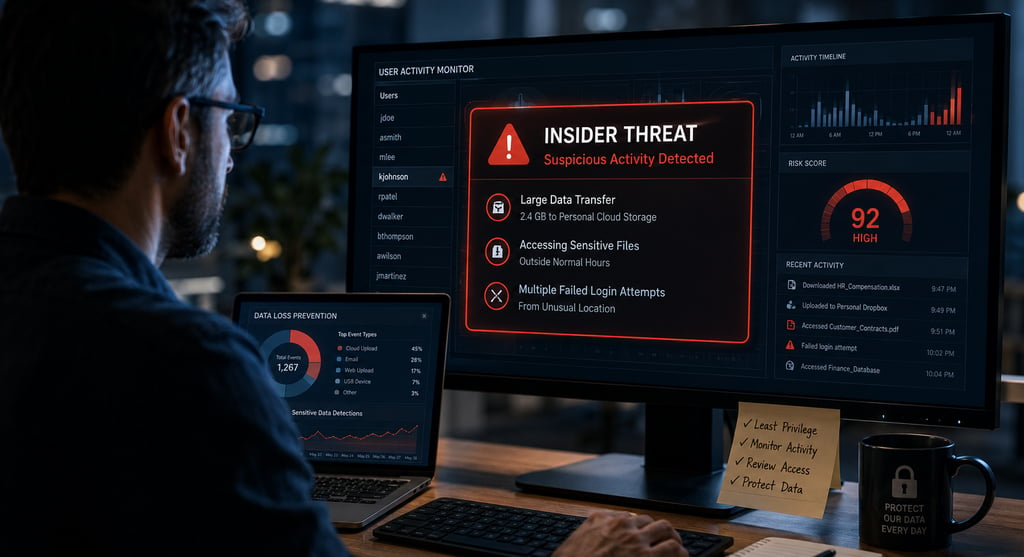
The cybersecurity conversation in mid-market organizations is almost entirely focused on external threats: ransomware groups, nation-state actors, phishing campaigns, and dark web credential markets. This focus is understandable — external threat actors generate headlines, and the attack surface presented by the external perimeter is visible and measurable. What is less visible, less measured, and statistically more likely to result in a significant data loss event is the threat that already has authenticated access to your systems.
Insider threats — security incidents caused by current or former employees, contractors, vendors, or business partners with legitimate access to organizational systems — account for 34 percent of all data breaches, according to the 2025 Verizon Data Breach Investigations Report. They are also the category of incident most likely to go undetected for extended periods, because the activity that causes the breach looks, at the access layer, like legitimate use.
The most dangerous insider threat is not the malicious employee who decides to steal data on their last day. It is the over-privileged user whose credentials are compromised by an external attacker — giving that attacker authenticated, legitimate-looking access to every system the user can reach. Identity is the attack surface. Over-provisioned identity is the vulnerability.
The three categories of insider threat
Insider threats are not a monolithic category. They break into three distinct types with different detection and mitigation approaches:
• Malicious insiders: employees or contractors who intentionally exfiltrate data, sabotage systems, or commit fraud using their legitimate access. This category represents approximately 25 percent of insider incidents. Motivations include financial gain, competitive intelligence theft, retaliation for workplace grievances, or coercion by external parties
• Negligent insiders: employees who cause security incidents through careless behavior — clicking phishing links, misconfiguring systems, sharing credentials, storing sensitive data in unauthorized locations, or using personal devices and applications for work purposes without IT oversight. This category represents approximately 62 percent of insider incidents and is the largest source of insider-related breach costs
• Compromised insiders: legitimate user accounts that have been taken over by external attackers through credential theft, phishing, or social engineering. The attacker operates with the privileges of the compromised account, making their activity difficult to distinguish from legitimate use at the network and application layer
Why insider threats are particularly dangerous in mid-market organizations
Mid-market organizations face a specific insider threat profile that differs from both small businesses and large enterprises. Small businesses have limited data worth targeting at scale. Large enterprises have behavioral analytics, DLP systems, and security operations centers that monitor for anomalous user activity. Mid-market organizations have the data, the distributed workforce, the vendor and contractor relationships that create broad access populations — and the security monitoring gaps that leave that access population largely unobserved.
The specific factors that amplify insider threat risk in mid-market environments:
• Over-provisioned access: users accumulate permissions over time as roles change, projects are added, and systems are integrated. Quarterly access recertification — reviewing whether each user's current access matches their current role — is standard practice in enterprise security but rare in mid-market organizations
• Minimal user behavior monitoring: enterprise security programs use user and entity behavior analytics platforms that establish baselines for normal user activity and flag deviations — bulk downloads, unusual access hours, data transfers to personal cloud storage. Most mid-market organizations have no equivalent monitoring capability
• Inadequate offboarding processes: access revocation for departing employees is manual, inconsistently executed, and frequently incomplete. Accounts with access to cloud platforms, SaaS applications, and vendor systems are routinely missed in offboarding checklists focused on AD account deactivation
• Vendor and contractor access without governance: third-party access for IT vendors, consultants, and contractors is provisioned for projects and rarely reviewed afterward. Standing vendor access that persists beyond the scope of the original engagement is both a security risk and a compliance exposure
Detection: what insider threat monitoring looks like in practice
Detecting insider threats requires monitoring capabilities that extend beyond perimeter security and endpoint protection. The controls that provide the most effective insider threat detection at mid-market scale:
• Data loss prevention: DLP solutions monitor for sensitive data leaving the organization — via email, cloud uploads, USB devices, or printing — and alert on patterns inconsistent with normal business activity. Modern DLP is cloud-aware and can monitor Microsoft 365, Google Workspace, and major cloud storage platforms
• Cloud access security broker: CASB platforms provide visibility into which cloud applications are being used, by whom, and what data is flowing through them. For organizations with significant SaaS footprints, CASB is the primary tool for monitoring the cloud-layer activity that traditional network security tools cannot see
• Privileged access management: PAM solutions log every privileged session — every administrative action taken by IT staff and vendors — creating an audit trail that enables forensic investigation and real-time anomaly detection for the highest-risk access tier
• Access recertification: quarterly reviews of user access permissions against current role requirements, conducted through a formal process with manager approval, are the most cost-effective control for limiting the blast radius of a compromised insider account
Building a proportionate response
Insider threat programs do not require enterprise-scale security operations centers. For mid-market organizations, the proportionate response involves: completing a comprehensive access audit to identify over-provisioned accounts, former employee accounts, and unreviewed vendor access; implementing DLP for sensitive data categories; establishing a formal quarterly access recertification process; and ensuring offboarding checklists cover all cloud and SaaS applications, not just Active Directory.
These controls do not require significant capital investment. They require process discipline and the security expertise to implement them correctly. Sigma Technology Consulting helps mid-market organizations build insider threat programs proportionate to their risk profile and budget. Contact us at sigmatechconsult.com.
Sigma Technology Consulting, Inc.
25 Years of Experience, Vetting & Procuring Technology Vendors
Contact Us
Support
© 2026. All rights reserved.