
The Managed Security Service Provider Playbook: What MSSPs Don't Tell You Before You Sign
6/10/20264 min read
Managed Security Service Providers occupy a critical position in the mid-market security ecosystem. For organizations that cannot staff their own security operations function — which describes the majority of businesses with under 1,000 employees — MSSPs provide outsourced security monitoring, threat detection, incident response, and compliance support at a fraction of the cost of equivalent internal capability. The market for MSSP services has grown significantly, and the range of providers, service models, and pricing structures has expanded accordingly.
With that expansion has come a corresponding increase in contract complexity, marketing ambiguity, and service quality variance. Today's Insider Insights post covers what we have learned from evaluating and auditing MSSP relationships across dozens of mid-market engagements — the things providers do not tell you before you sign, and the questions that reveal the difference between a capable security partner and a checkbox vendor.
The MSSP market has a fundamental information problem: the buyer cannot easily evaluate service quality before purchasing, because the value of security services is most visible during an incident — which is exactly when it is too late to discover that your provider's response capability does not match what was marketed.
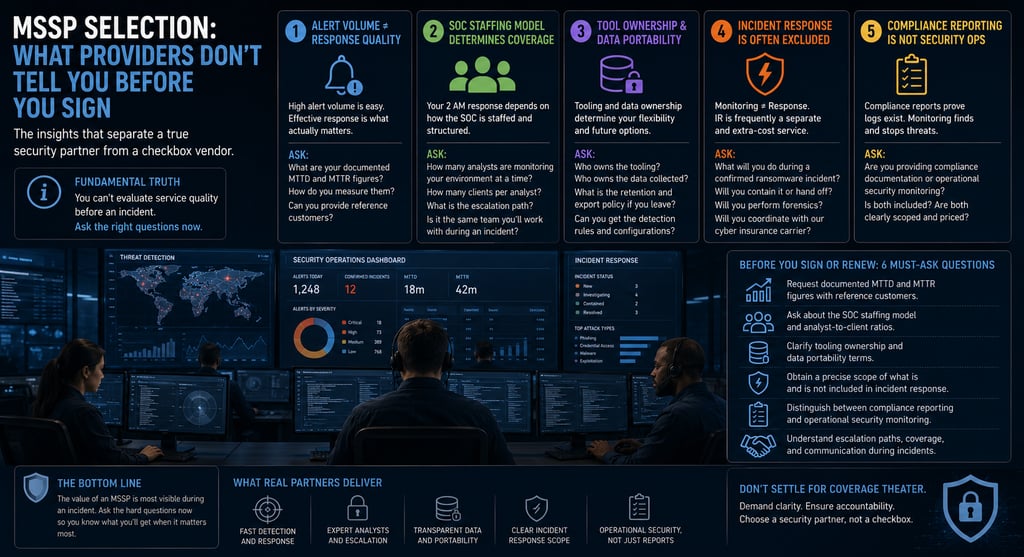
Insight 1: Alert volume and response quality are not the same thing
Many MSSPs market their services around alert volume: number of events monitored per day, number of log sources ingested, number of correlation rules applied. These metrics are easy to measure and impressive to present. They are also largely meaningless as indicators of actual security value. An MSSP that generates 50,000 alerts per day and automatically closes 99 percent of them without human review is providing coverage theater — the appearance of monitoring without the substance of investigation.
The metric that matters is mean time to detect and mean time to respond for confirmed incidents. Ask any prospective MSSP for their documented MTTD and MTTR figures, the methodology used to calculate them, and reference customers who can speak to those numbers from actual incident experience. Providers who cannot answer this question specifically and with documentation have not measured what matters.
Insight 2: The SOC staffing model determines your actual coverage
MSSP SOCs vary enormously in their staffing models. Some operate fully-staffed 24x7 SOCs with Tier 1, 2, and 3 analysts handling triage, investigation, and response. Others operate shared SOCs where analysts are covering hundreds of client environments simultaneously with automated triage doing the majority of the work. Others use follow-the-sun models where overnight coverage is handled by offshore teams with different training and tooling than the onshore team you met during the sales process.
The staffing model directly determines the response quality you will receive at 2 AM on a Sunday when an incident occurs. Ask specifically: how many analysts are monitoring your environment at any given time? What is the maximum number of client environments each analyst covers simultaneously? What is the escalation path for confirmed incidents? Is the team handling your account the same team you will work with during an incident?
Insight 3: Tool ownership and data portability are contract-level risks
Many MSSPs deploy their own security tooling — SIEM, EDR agents, network sensors — in your environment as part of the service. This creates a dependency: if you terminate the MSSP relationship, you lose access to the tooling, the historical data it has collected, and the detection rules built within it. Switching MSSPs or bringing security operations in-house becomes substantially more complex and expensive when the tooling is owned and operated by the outgoing provider.
Before signing, clarify: who owns the tooling deployed in your environment? Who owns the data collected? What is the data retention and export policy upon contract termination? Can you obtain a copy of the detection rule library if you transition to a different provider? These questions reveal whether the contract structure creates healthy accountability or proprietary lock-in.
Insight 4: Incident response is often not included — it is a separate engagement
MSSP monitoring services — detection, alerting, investigation — are typically distinct from incident response services — containment, eradication, recovery. Many MSSP contracts explicitly exclude incident response beyond initial triage, requiring the client to engage a separate IR firm when a confirmed incident requires hands-on response. This exclusion is frequently buried in the statement of work rather than highlighted in the sales conversation.
Understand precisely what your MSSP will do when a confirmed ransomware incident is detected: will they contain it, or will they notify you and hand off? Will they execute forensic investigation, or refer you to a third party? Will they coordinate with your cyber insurance carrier, or will you manage that relationship independently? The answers define the actual value of the service during the moment it matters most.
Insight 5: Compliance reporting and security operations are different services
A significant segment of the MSSP market positions compliance reporting — generating the log retention, audit trail, and reporting artifacts required by HIPAA, PCI-DSS, SOC 2, or other frameworks — as equivalent to security operations. It is not. Compliance reporting demonstrates that controls are documented and logs are retained. It does not mean that someone is actively monitoring those logs for threats or that the response capability exists to act on what is found.
Organizations purchasing MSSP services for compliance purposes should clearly understand whether they are buying compliance documentation support or operational security monitoring — and whether both are needed, which they frequently are, ensure each is explicitly scoped and priced in the contract.
What to do before signing or renewing
Before engaging or renewing an MSSP: request documented MTTD and MTTR figures with reference customers; ask specifically about the SOC staffing model and analyst-to-client ratios; clarify tooling ownership and data portability terms; obtain a precise scope of what is and is not included in incident response; and distinguish between compliance reporting and operational security monitoring in the contract scope.
If your current MSSP cannot answer these questions specifically, that is itself an important finding. Sigma Technology Consulting conducts MSSP contract and performance assessments as part of our Digital Plumbing Audit service. Contact us at sigmatechconsult.com.
Sigma Technology Consulting, Inc.
25 Years of Experience, Vetting & Procuring Technology Vendors
Contact Us
Support
© 2026. All rights reserved.