
The Rise of Sovereign Cloud: What New Data Residency Laws Mean for Your Infrastructure Strategy in 2026
5/22/20263 min read
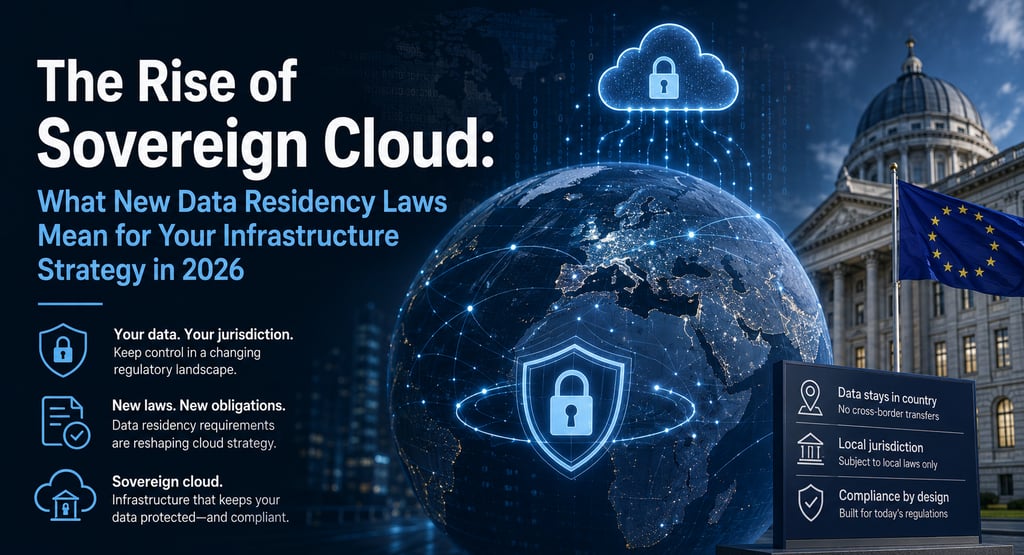
The regulatory landscape for data storage, processing, and transfer has changed more in the past 24 months than in the previous decade. A wave of new and strengthened data residency laws — in the European Union, the United Kingdom, Canada, Brazil, India, and across Southeast Asia — has created a new category of infrastructure decision that most mid-market businesses have not yet incorporated into their cloud strategy: sovereign cloud.
Sovereign cloud refers to cloud infrastructure that is operated under the legal and regulatory jurisdiction of a specific country or region, with contractual guarantees that data will not leave that jurisdiction and will not be subject to foreign government access requests. It is distinct from simply choosing a cloud region in a particular country — because region selection alone does not address foreign legal jurisdiction over the cloud provider or the data stored in its infrastructure.
For mid-market businesses with international customers, employees, or partners — and for domestic businesses in regulated industries — sovereign cloud considerations are no longer a future concern. They are a present compliance obligation that is actively shaping infrastructure decisions in 2026.
Choosing a cloud region in a specific country is not the same as ensuring data sovereignty. The legal jurisdiction of the cloud provider — where it is incorporated, where its parent company operates, and what foreign laws may compel it to disclose data — determines data sovereignty. Region selection is geography. Sovereignty is law.
What has changed in 2025 and 2026
Several regulatory developments have materially raised the compliance stakes for data residency in the past two years:
• EU AI Act data governance provisions: the European Union's AI Act, now in enforcement phase, includes data governance requirements for AI systems that process personal data of EU residents — requirements that extend to the infrastructure on which AI models are trained and inference is run
• India's Digital Personal Data Protection Act: India's comprehensive data protection law, with enforcement beginning in 2025, requires that certain categories of personal data of Indian residents be processed and stored within India — with significant penalties for cross-border transfer without explicit consent or regulatory approval
• US state-level privacy laws: a growing patchwork of state privacy laws — now covering California, Virginia, Colorado, Connecticut, Texas, and 12 additional states — creates data residency and transfer obligations for businesses serving residents of those states, with enforcement activity accelerating in 2025 and 2026
• Cross-border data transfer restrictions: the EU-US Data Privacy Framework, while operative, has been subject to ongoing legal challenges that create uncertainty for businesses relying on it for transatlantic data transfers — a compliance risk that is driving interest in European sovereign cloud infrastructure
What sovereign cloud infrastructure looks like
The major public cloud providers have responded to sovereign cloud demand with a range of offerings. AWS operates dedicated GovCloud regions for US government data, and has launched sovereign cloud partnerships in the EU through local operators. Microsoft Azure offers Sovereign Regions in partnership with European carriers and governments. Google Cloud has introduced regional sovereign controls in select markets.
Beyond the hyperscaler offerings, a parallel market of regional sovereign cloud providers has emerged — particularly in Europe — offering infrastructure that is legally domiciled, staffed, and operated entirely within a specific jurisdiction, with no hyperscaler parent company legal exposure. For organizations with strict EU data residency requirements, these regional providers offer a compliance posture that hyperscaler sovereign offerings cannot fully match.
The infrastructure strategy implications
For mid-market businesses, the sovereign cloud trend has three practical implications that need to be incorporated into infrastructure planning today:
• Workload mapping by data category: not all workloads generate data subject to residency requirements. The first step is identifying which workloads process personal data subject to specific jurisdiction requirements — and ensuring those workloads are running in compliant infrastructure
• Contract review for data processing agreements: cloud provider contracts must include data processing agreements that accurately reflect where data is stored, processed, and potentially transferred. Many mid-market organizations signed cloud contracts before data residency requirements were this specific, and their contracts do not reflect current compliance obligations
• Architecture flexibility: infrastructure decisions made in 2026 should build in the flexibility to move workloads between cloud regions or providers as the regulatory landscape continues to evolve. Architectures that create deep dependency on a single provider's proprietary services are increasingly a compliance risk as well as a vendor risk
What to do now
The starting point for most mid-market organizations is a data flow mapping exercise — understanding what personal data your organization processes, where it is stored and processed, and what regulatory jurisdictions apply. This exercise frequently surfaces compliance gaps that were created by cloud architecture decisions made before the current regulatory environment existed.
From the data flow map, you can identify which workloads require sovereign or residency-compliant infrastructure, which cloud provider contracts need data processing agreement updates, and which architecture decisions need to be revisited before upcoming regulatory enforcement dates.
Sigma Technology Consulting advises mid-market organizations on cloud compliance architecture across all major regulatory frameworks. Contact us at sigmatechconsult.com to discuss what the sovereign cloud trend means for your specific infrastructure environment.
Sigma Technology Consulting, Inc.
25 Years of Experience, Vetting & Procuring Technology Vendors
Contact Us
Support
© 2026. All rights reserved.