The Shared CTO Model: Solving the Technology Leadership Gap Across a PE Portfolio Without Adding Headcount
7/24/20264 min read
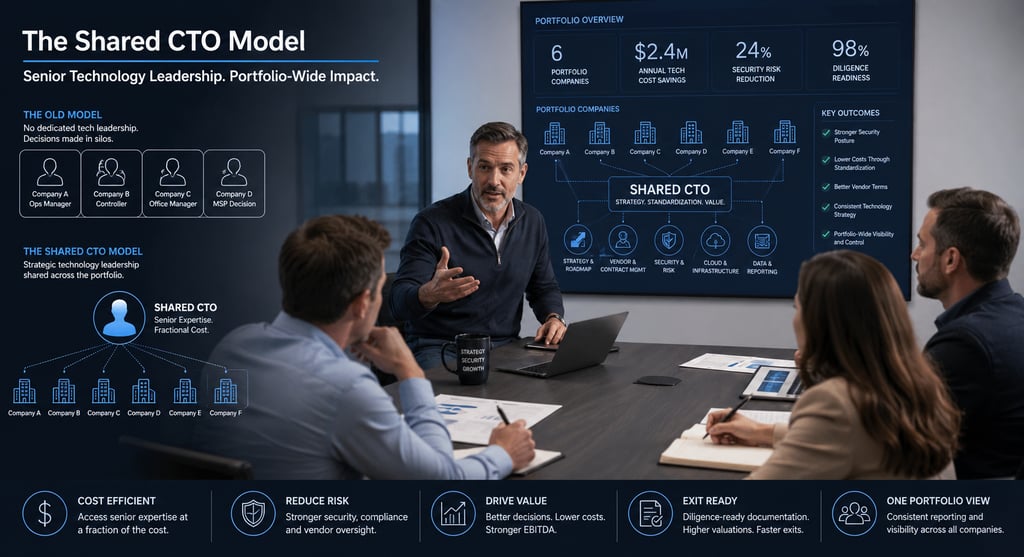
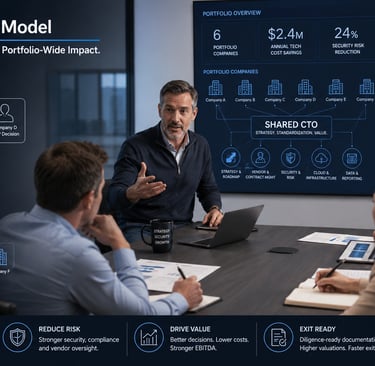
Most mid-market portfolio companies sit in an uncomfortable gap: too complex to run technology decisions on instinct, but rarely large enough to justify a full-time CIO or CTO on the payroll. The result is that critical technology decisions, cloud strategy, security investment, vendor selection, contract renewals, end up made by a controller, an operations manager, or an outside MSP whose incentives don't always align with the company's, none of whom were hired for strategic technology leadership in the first place.
The Gap PE Firms Underestimate
Operating partners are usually well aware of leadership gaps in finance or sales at a portfolio company, since those functions are easy to evaluate against familiar benchmarks. Technology leadership gaps are harder to spot from the outside, because the symptoms look like isolated problems, a security incident here, a surprising cloud bill there, a colocation renewal that got signed without anyone reviewing the market, rather than a single, identifiable root cause: nobody at the company is actually responsible for technology strategy as a full-time job.
This gap tends to get worse, not better, as a portfolio company grows under PE ownership. A company that was simple enough to run on ad hoc technology decisions at 40 employees is often carrying meaningfully more complexity and risk by 150 or 250 employees, without ever having added the technology leadership function that complexity actually requires.
Why Hiring a Full-Time CTO at Each Company Rarely Makes Sense
A senior technology executive capable of handling strategy, vendor negotiation, security oversight, and infrastructure planning commands a meaningful salary, one that's difficult to justify at a single 150-person portfolio company, even though the company genuinely needs that expertise applied to its decisions. Hiring for the role often means either overpaying for a senior hire the company can't fully utilize, or underhiring into a role that ends up handling day-to-day IT support rather than the strategic decisions that actually move EBITDA and reduce risk.
The Shared Model, Applied Across a Portfolio
A shared or fractional CTO model solves this by spreading senior technology leadership across multiple portfolio companies simultaneously, giving each one access to strategic expertise it couldn't justify hiring alone, at a fraction of the cost any single company would pay for a dedicated hire. The same standardization principle that drives volume pricing on telecom and cloud contracts applies here: the fund gets senior-level technology decision-making applied consistently across every portfolio company, without multiplying the cost across each one.
This isn't a replacement for each portfolio company's day-to-day IT support or MSP relationship, which continues handling help desk tickets, routine maintenance, and operational support. It's a layer above that: the strategic function deciding what technology investments actually matter, which vendor relationships need renegotiating, where security risk is concentrated, and how each company's technology roadmap should evolve, applied consistently across the portfolio rather than left to whoever happens to be closest to the problem at each individual company.
What Operating Partners Gain Directly
Beyond the cost efficiency, a shared model gives the fund's operating partners a single, consistent point of contact for technology questions across every portfolio company, rather than needing to evaluate each company's technology decisions independently with no common framework for comparison. It creates natural consistency in how security, vendor selection, and infrastructure decisions get made across the portfolio, which is precisely the foundation that makes portfolio-wide standardization and umbrella contract pricing possible in the first place.
It also gives the fund a technology voice already positioned to spot cross-portfolio synergies, shared vendors worth consolidating, overlapping tools worth eliminating, infrastructure that could be shared, since that voice is already looking across the entire portfolio rather than being confined to a single company's four walls.
Where This Fits in the Broader Picture
Standardized contracts, portfolio-wide audits, and diligence-ready documentation all depend on someone actually driving those decisions consistently across every portfolio company. A shared technology leadership model is the piece that makes the rest of this series practical rather than aspirational, turning portfolio-wide technology strategy from something that happens occasionally, when an operating partner has bandwidth, into something that happens continuously, as an ordinary part of how the portfolio runs.
How This Actually Runs Day to Day
In practice, a shared model means regular, scheduled touchpoints with each portfolio company's leadership, reviewing technology spend, upcoming contract renewals, security posture, and infrastructure roadmap, alongside on-demand availability for the decisions that can't wait for a scheduled review, a sudden vendor issue, an unexpected security question, an acquisition opportunity that needs a fast technology assessment. The company's existing MSP or internal IT staff continue handling operational support exactly as before; the shared model adds strategic oversight above that layer rather than duplicating or replacing it.
For the operating partner, this typically means a single monthly or quarterly summary across the entire portfolio rather than separate, inconsistent updates from each company's own IT contact, giving the fund one coherent picture of technology performance and risk instead of four or six disconnected ones that are difficult to compare against each other in any meaningful way.
The Long-Term Case for Building This Now
Funds that wait until a portfolio company is already in crisis, a serious security incident, a chaotic system migration, a due diligence process gone sideways, to bring in senior technology expertise are paying for that expertise reactively, at a moment when leverage and calm decision-making are both in short supply. Building the shared model proactively, before any single company needs it urgently, means the expertise is already in place and already familiar with the portfolio when a genuine crisis or opportunity does arise, which is a meaningfully better position for both the operating partner and the portfolio company to be in.
Across the five ideas covered this week, standardization, portfolio-wide umbrella pricing, the exit multiple math, diligence readiness, and shared technology leadership, the common thread is the same: technology has been managed company by company for too long in most mid-market portfolios, and the fund-level view is where the largest, least-contested value creation opportunity is still sitting largely untapped.
Sigma Technology Consulting, Inc.
25 Years of Experience, Vetting & Procuring Technology Vendors
Contact Us
Support
© 2026. All rights reserved.