
The Vendor Risk Blind Spot: Why Your Weakest Link Is a Company You've Never Heard Of
7/8/20264 min read
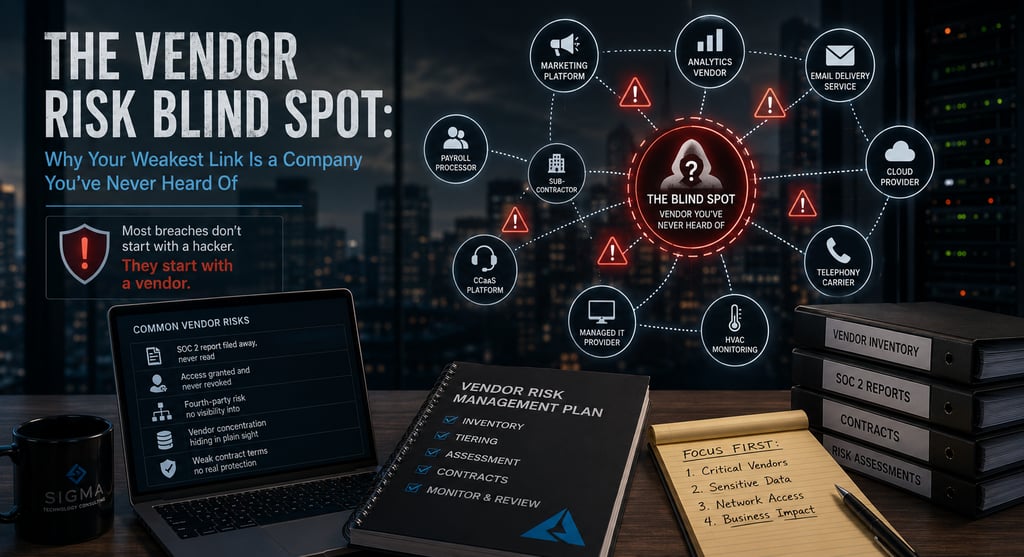
Ask most mid-market executives to name their biggest cybersecurity risk, and they'll describe a phishing email, a ransomware gang, or an unpatched server. Few will mention the payroll processor's subcontractor, the marketing platform's analytics vendor, or the HVAC monitoring company with a network connection into the building. Those are the relationships that keep showing up at the root of major breaches, and they're almost never on anyone's radar until something goes wrong.
Vendor risk gets treated as a checkbox during onboarding and rarely revisited again, even as the relationship deepens, the vendor's own environment changes, and the access originally granted quietly expands.
The SOC 2 Report Nobody Actually Reads
Most mid-market companies now ask new vendors for a SOC 2 report before signing. Fewer actually read it. A SOC 2 report is long, technical, and often includes a list of exceptions buried on page 40 that never gets reviewed once the report is filed away. It's common for a vendor to disclose a control gap, such as inconsistent access reviews or delayed patch cycles, and for that disclosure to sit unread while the vendor gains access to production data, customer records, or a network connection.
The report is also a snapshot. A SOC 2 covers a fixed audit period, often ending months before it lands in an inbox, and very few companies track whether a vendor's next report ever actually arrives on schedule.
It's worth remembering, too, that a SOC 2 report only covers the controls the vendor chose to include in scope. A vendor can hold a clean SOC 2 Type II report while running the exact system that handles your data entirely outside the audited boundary, a distinction that's easy to miss without actually reading the scope section closely.
Fourth-Party Risk: The Vendor Behind Your Vendor
Third-party risk gets some attention. Fourth-party risk almost never does. Your payroll platform relies on a cloud provider. Your CCaaS vendor relies on a telephony carrier. Your marketing automation tool relies on a third-party email delivery service. Each of those hops adds a layer of risk your organization has no visibility into and no contractual relationship with, yet a failure at any layer can take down a system your business depends on or expose data you're contractually obligated to protect.
Concentration Risk Hiding in Plain Sight
A related and underappreciated problem is vendor concentration: multiple critical systems quietly running through the same underlying provider without anyone mapping the overlap. A company might believe it has diversified its cloud footprint across separate SaaS tools, only to discover during an incident that four of them share the same regional cloud provider or the same authentication backend. When that shared dependency goes down or gets breached, the blast radius is far larger than any single vendor relationship suggested.
This kind of hidden concentration is one of the more common findings during a technology due diligence review ahead of an acquisition, and it's rarely intentional. It accumulates gradually, as different departments select different tools over several years without any central visibility into what those tools actually run on underneath, and it's rarely uncovered until an incident, or a diligence process, forces the question.
The Access Nobody Remembers Granting
Vendor risk isn't only about data handling. It's also about standing access that outlives its purpose. A managed print vendor with a network jack in the server closet. An HVAC monitoring company with remote access installed for a one-time troubleshooting call three years ago that was never revoked. A former marketing vendor whose API credentials still have read access to a customer database, months after the contract ended. None of these show up on a typical vendor risk questionnaire, because most companies never ask the more basic question: what access has been granted over the years, and has any of it ever been reviewed or revoked.
What a Real Vendor Risk Program Looks Like at Mid-Market Scale
Enterprise vendor risk management programs involve dedicated staff and expensive continuous monitoring platforms. Mid-market companies rarely need that level of overhead, but they do need a structured, repeatable process. That starts with a full vendor inventory, something most companies have never actually compiled, followed by tiering vendors by criticality: which ones touch regulated data, which ones have network access, and which ones would stop the business if they failed.
High-tier vendors warrant an annual review cycle: reading the SOC 2 or ISO 27001 report in full, not just confirming it exists, checking that breach notification timelines are specified in the contract, and confirming a right-to-audit clause exists for the vendors that matter most. Lower-tier vendors can be reviewed on a lighter cadence, but should still appear on the inventory so no relationship goes completely untracked.
For PE-backed companies, this inventory does double duty. It becomes part of the technology due diligence package for any future sale or add-on acquisition, turning a scattered set of vendor relationships into a documented, defensible program that a buyer's diligence team can actually evaluate quickly instead of treating as an open question.
Contract Language That Actually Protects You
A surprising number of mid-market vendor contracts, even for vendors handling sensitive data, say almost nothing about what happens if that vendor is breached. Breach notification timelines, when specified at all, are often vague enough to be meaningless, with language like "in a timely manner" standing in for an actual number of days. Renewal is a natural moment to fix this: adding a specific notification window, a defined right to request evidence of remediation, and, for the highest-tier vendors, a right-to-audit clause that can actually be exercised rather than sitting unused in a file.
Cyber insurance underwriters are increasingly asking about vendor risk management directly during the application process, which means a documented program isn't just a security improvement, it can also affect insurability and premium pricing at the next renewal.
The Real Fix Is Visibility, Not Paranoia
None of this requires assuming every vendor is a threat. It requires knowing which vendors matter, what they actually have access to, and whether their controls hold up under a real second look instead of a filed-and-forgotten report. The companies that get breached through a vendor are rarely the ones that had a bad relationship. They're the ones that never mapped the relationship at all.
Building that map doesn't happen overnight, and it doesn't need to. Starting with the ten or fifteen vendors that touch the most sensitive systems and data, and expanding the inventory from there, turns an overwhelming project into a manageable one, and closes the largest part of the exposure well before the full inventory is complete.
Sigma Technology Consulting, Inc.
25 Years of Experience, Vetting & Procuring Technology Vendors
Contact Us
Support
© 2026. All rights reserved.