
What Your Data Center PUE Score Is Costing You — and the Efficiency Benchmarks Providers Don't Advertise
6/3/20264 min read
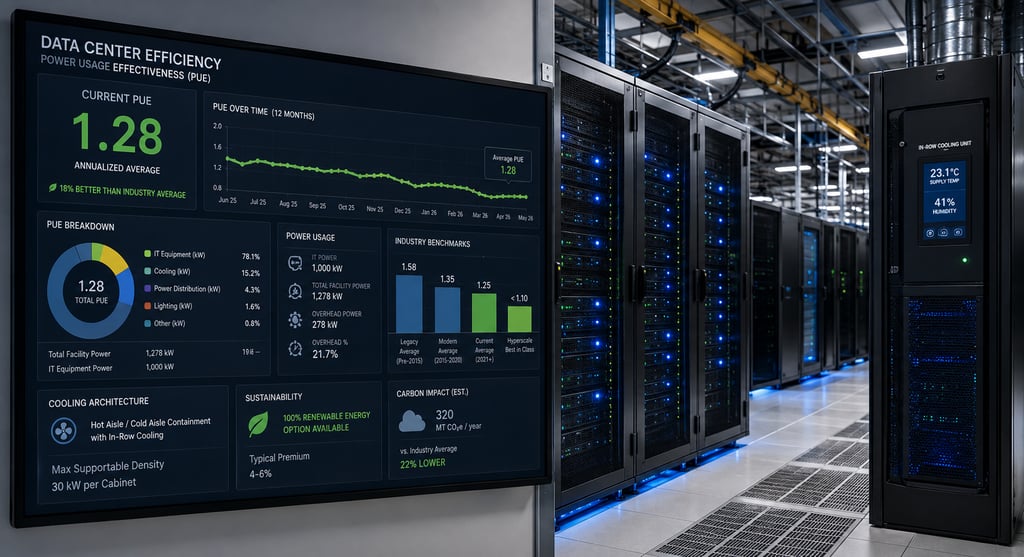
Power Usage Effectiveness — PUE — is the standard metric for data center energy efficiency. It measures the ratio of total facility power to IT equipment power: a PUE of 1.0 would mean all power delivered to the facility goes directly to IT equipment. A PUE of 2.0 means half the facility's power is consumed by cooling, lighting, and other overhead — for every watt powering your servers, another watt is consumed by the infrastructure supporting them.
PUE matters for two reasons that are directly relevant to your infrastructure costs. First, in colocation environments where power is billed as a separate line item, your effective cost per kilowatt of IT power is the stated power rate multiplied by the facility's PUE. A facility with a PUE of 1.8 costs 80 percent more in power overhead than a facility with a PUE of 1.2 delivering the same IT capacity. Second, for organizations with sustainability commitments or regulatory ESG reporting requirements, PUE is a direct input to carbon footprint calculations.
What most colo customers do not know: PUE scores vary significantly across facilities, the variance is rarely disclosed proactively, and the measurement methodology used to calculate PUE affects the result in ways that allow unflattering comparisons to be obscured.
The average PUE of legacy data center facilities in operation today is approximately 1.58. The average PUE of facilities built after 2020 using modern cooling architecture is approximately 1.25. On a 100kW IT deployment, that difference represents roughly $25,000 to $40,000 in annual power cost at current commercial electricity rates in most US markets.
Insight 1: How PUE is measured matters as much as the number
PUE can be calculated at a point in time — a single measurement — or as an annualized average across all operating conditions. Point-in-time measurements taken during favorable conditions: cool weather, light load, optimal cooling configuration — can produce PUE figures that look impressive but do not reflect year-round performance. An annualized PUE, measured continuously across all seasons and load conditions, is the only meaningful benchmark for comparison.
When evaluating a colocation facility, ask specifically for annualized PUE, not instantaneous or design PUE. Also ask whether the PUE calculation includes all facility power — lighting, physical security systems, administrative spaces — or only the data hall. Some providers calculate PUE at the data hall level only, excluding facility overhead that increases the effective number.
Insight 2: The cooling architecture determines the ceiling
PUE is fundamentally a function of cooling architecture. Legacy facilities built in the 1990s and early 2000s used raised floor air cooling with computer room air conditioning units — an approach that mixes hot and cold air inefficiently and requires significant power for air movement. These facilities typically achieve PUE in the 1.6 to 2.2 range regardless of operational optimization.
Modern cooling architectures — hot aisle and cold aisle containment, in-row cooling, rear-door heat exchangers, and liquid cooling for high-density compute — deliver PUE in the 1.15 to 1.35 range. Hyperscale facilities operated by AWS, Azure, and Google in optimal climates achieve PUE below 1.1. The cooling architecture is a structural constraint on efficiency: a facility using legacy cooling cannot achieve modern PUE benchmarks through operational optimization alone.
Insight 3: Your power density requirements affect available options
PUE benchmarks are most meaningful when evaluated alongside power density — the kilowatts per rack that your IT equipment requires. Legacy facilities designed for 3 to 5kW per rack average are not well-suited to modern high-density deployments of 10 to 30kW per rack, which is increasingly common for GPU-intensive AI workloads and high-performance computing.
A facility quoting an attractive PUE may not be able to support your actual power density requirements without custom cage configuration and supplemental cooling — costs that are not reflected in the standard rate card. Always specify your actual power density requirements and ask for facility confirmation of supportable density before comparing PUE figures.
Insight 4: Green power procurement is separate from PUE — and negotiable
PUE measures how efficiently a facility uses power. It does not address the source of that power. Sustainability-focused organizations increasingly require that their colocation power come from renewable sources — wind, solar, or hydroelectric — either through direct power purchase agreements, renewable energy certificates, or geographic location in markets with high renewable grid penetration.
Green power procurement is a contractual item, separate from the colocation agreement itself, and it is negotiable. Major colo providers offer 100 percent renewable energy matching at varying premium levels — typically 3 to 8 percent above standard power pricing. For organizations with board-level ESG commitments or regulatory sustainability reporting requirements, this is a contract term worth negotiating at renewal rather than paying as a post-hoc premium.
What to ask your current or prospective colo provider
Armed with this context, the questions that will tell you where you actually stand relative to current market benchmarks:
• What is your annualized average PUE for the specific data hall where my equipment is located — measured continuously over the past 12 months?
• What cooling architecture is used in that data hall, and what is the maximum supportable power density per cabinet?
• Is your PUE calculation inclusive of all facility power, or calculated at the data hall level only?
• What renewable energy options are available, and at what premium relative to standard power pricing?
• How has your PUE trended over the past three years, and what capital investments are planned for cooling infrastructure improvement?
The answers will position you to evaluate your current facility against modern alternatives — and to benchmark whether the power overhead embedded in your current contract reflects 2026 standards or legacy infrastructure economics. Sigma Technology Consulting evaluates data center efficiency as part of our Digital Plumbing Audit. Contact us at sigmatechconsult.com.
Sigma Technology Consulting, Inc.
25 Years of Experience, Vetting & Procuring Technology Vendors
Contact Us
Support
© 2026. All rights reserved.