
Zero Trust in 2026: Why Mid-Market Businesses Can No Longer Afford to Ignore It
5/11/20263 min read
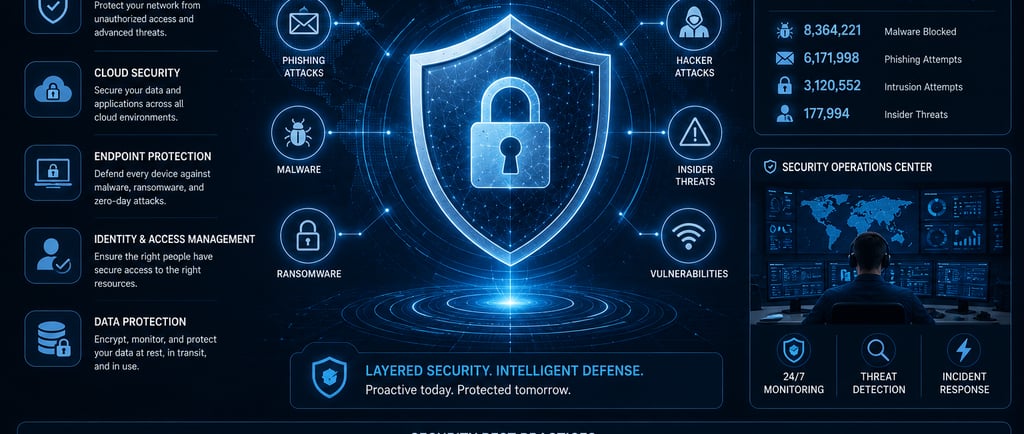
For most of the past decade, mid-market businesses operated under a comfortable assumption: enterprise-grade cybersecurity was for enterprises. Sophisticated threat actors targeted banks, hospitals, and government agencies — not a 200-person professional services firm or a regional manufacturer. That assumption is no longer valid, and the cost of maintaining it is rising sharply.
In 2025, 43 percent of cyberattacks targeted small and mid-sized businesses. The average cost of a data breach for a company with under 1,000 employees crossed $4.2 million. And the attack vector in the overwhelming majority of cases was not a sophisticated technical exploit — it was a compromised credential, a misconfigured cloud resource, or an employee who clicked a link.
Zero Trust architecture is the framework that addresses all three of these attack vectors simultaneously. And in 2026, it is no longer a theoretical framework for Fortune 500 security teams. It is a practical, implementable model for any organization with 100 or more employees and a meaningful cloud footprint.
The perimeter-based security model assumes that everything inside your network is trustworthy. In a world where your employees work from home, your data lives in the cloud, and your vendors have API access to your systems, there is no perimeter. Zero Trust is the architecture built for the world that actually exists.
What Zero Trust actually means
Zero Trust is built on a single principle: never trust, always verify. Rather than assuming that users and devices inside the network perimeter are safe, Zero Trust requires continuous verification of every user, every device, and every connection — regardless of where that connection originates. In practice, a Zero Trust architecture for a mid-market business involves five core components:
• Identity and access management with multi-factor authentication enforced for every user on every application — no exceptions for executives, IT administrators, or legacy systems
• Device health verification — ensuring that every device connecting to company resources meets a defined security baseline before access is granted
• Least-privilege access — users and systems are granted only the access they need for their specific function, reviewed and recertified on a regular cycle
• Micro-segmentation — the network is divided into isolated segments so that a compromised credential cannot move laterally across the entire environment
• Continuous monitoring and analytics — user behavior, network traffic, and system activity are monitored in real time for anomalies that indicate a breach in progress
Why mid-market is the primary target in 2026
Threat actors have made a rational economic calculation. Large enterprises have mature security programs, dedicated SOC teams, and significant defensive infrastructure. Small businesses have limited data worth taking at scale. Mid-market businesses — 100 to 2,000 employees — represent the optimal target: meaningful data assets, supply chain relationships with larger enterprises that create lateral attack paths, and security programs that are typically 18 to 36 months behind the current threat landscape.
The supply chain dimension is particularly important. A mid-market manufacturer that supplies components to a Fortune 500 company may have EDI or API access to that company's procurement systems. A regional accounting firm may have privileged access to financial systems across dozens of client organizations. Compromising the mid-market firm is often easier — and more strategically valuable — than attacking the enterprise directly.
The cost of implementation versus the cost of a breach
The most common objection to Zero Trust implementation at the mid-market level is cost. A comprehensive Zero Trust implementation for a 200-person organization — including IAM platform, MFA enforcement, endpoint detection and response, and network micro-segmentation — runs $80,000 to $180,000 in year-one implementation costs, with ongoing management running $3,000 to $6,000 per month.
The average cost of a breach at this company size: $4.2 million. The average time to detect and contain a breach: 277 days. The average operational disruption: 21 days of partial or full business interruption. The math is not complicated.
Where to start
For organizations not currently running Zero Trust principles, the implementation sequence that delivers the fastest risk reduction per dollar spent is clear: first, enforce MFA across all applications — this alone eliminates the attack vector in roughly 70 percent of credential-based breaches. Second, deploy endpoint detection and response on all company devices. Third, audit and right-size user access permissions — most organizations find that 30 to 50 percent of active permissions are broader than the user's actual role requires.
Sigma Technology Consulting partners with leading cybersecurity vendors across our 200+ provider network to help mid-market organizations build and implement Zero Trust frameworks that fit their size, budget, and risk profile. Contact us at sigmatechconsult.com to start with a security posture assessment.
Sigma Technology Consulting, Inc.
25 Years of Experience, Vetting & Procuring Technology Vendors
Contact Us
Support
© 2026. All rights reserved.